
23 January 2026 The Future is the Product of the Past

Ancient Roman Breakwater Discovered Underwater in Misenum: Sculptures and Architecture Reused to Tame the Sea

An underwater excavation off the coast of Bacoli, in southern Italy, has uncovered a remarkable Roman-era breakwater built from reused architectural and sculptural fragments.

The submerged structure, located at the ancient port of Misenum (Portus Iulius), reveals how Roman engineers deliberately arranged columns, architraves, and statues on the seafloor to serve as a protective barrier against the fierce Sirocco winds. This discovery offers rare insight into how the Roman Empire reused monumental materials to safeguard its naval infrastructure, blending maritime engineering with cultural heritage.

An extraordinary underwater archaeological mission in Bacoli, southern Italy, has led to the recovery of valuable Roman-era architectural fragments from the ancient Portus Iulius, once the main naval base of the Roman Empire in the Tyrrhenian Sea. The excavation, carried out by a multidisciplinary team of archaeologists and underwater heritage experts, brought to light sculptures, architraves, columns, and inscribed bases dating back to the Imperial period.

The operation took place in the submerged section of the ancient Roman harbor, located between Punta Terone and Punta Pennata. The area extends over 90 meters in length, with an average width of 22–23 meters and lies at a depth ranging from five to nine meters. Systematic excavations in this location began in 1996, following decades of sporadic accidental discoveries since the 1980s.

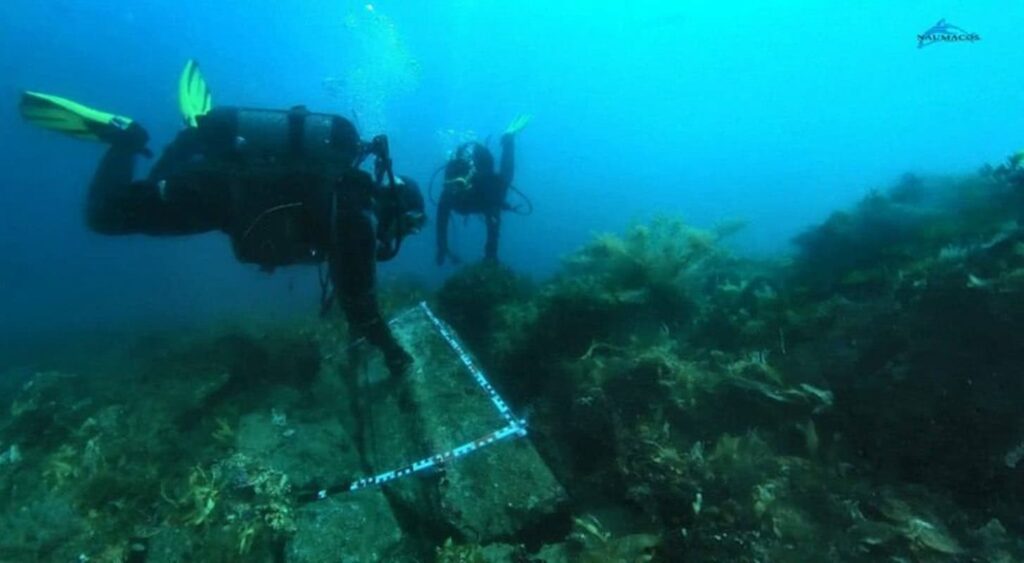
What makes this recent recovery particularly significant is the discovery that the artifacts were not the result of structural collapse or natural geological shifts such as bradyseism, which is common in the Phlegraean Fields. Instead, archaeological analysis indicates a deliberate placement of these materials on the seabed, most likely to form a barrier against the Sirocco winds—a function comparable to modern breakwaters.


📣 Our WhatsApp channel is now LIVE! Stay up-to-date with the latest news and updates, just click here to follow us on WhatsApp and never miss a thing!!


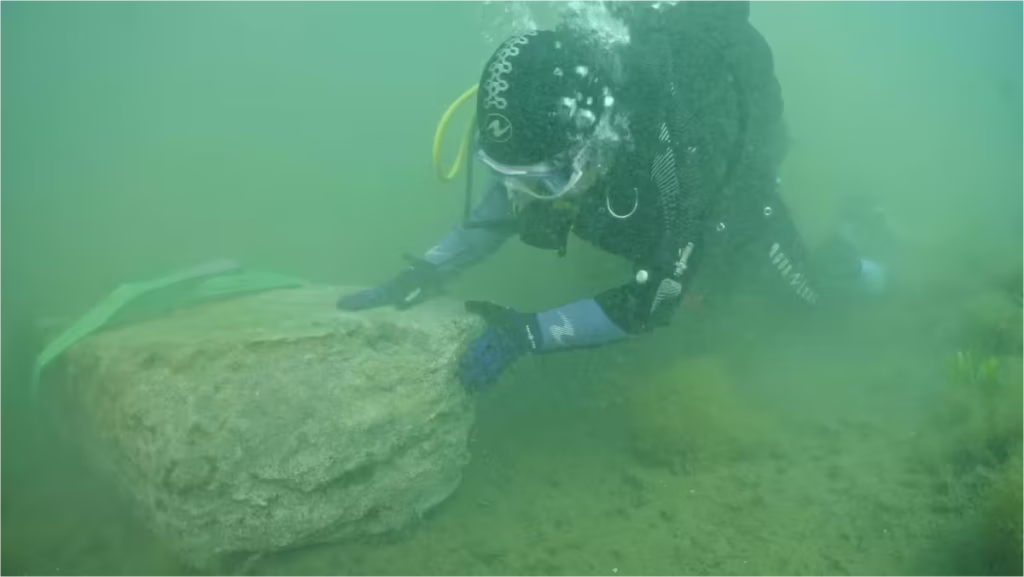
Archaeologists examine Roman-era materials deliberately placed underwater as part of an ancient breakwater system. Credit: Soprintendenza ABAP for the Metropolitan Area of Naples

Among the recovered pieces are two marble architraves featuring refined relief moldings and a fragment of a column made of cipollino marble. These were extracted using inflatable lifting balloons and transported by the Carabinieri Underwater Unit’s patrol boat. The artifacts will undergo desalination and restoration at the Bourbon Park of Fusaro, after which they will be exhibited at the Palazzo dell’Ostrichina, a historic building near Lake Fusaro now repurposed as a cultural venue.

The underwater excavation employed cutting-edge technologies including 3D scanning, high-resolution photogrammetry, and hyperspectral imaging, enabling precise mapping of the submerged structures before recovery. Notably, this operation also marked the first time in Italy that such a complex underwater intervention was broadcast live to the public, aligning with the principles of transparency and education promoted by the 2001 UNESCO Convention on the Protection of Underwater Cultural Heritage.

Simona Formola, head of the Underwater Archaeology Office of the Superintendency, emphasized that the discovery is a powerful example of Roman ingenuity in environmental adaptation. Traces of marine erosion on the recovered elements, particularly from lithodome mollusks, confirm their prolonged exposure before being repurposed in antiquity for maritime defense.
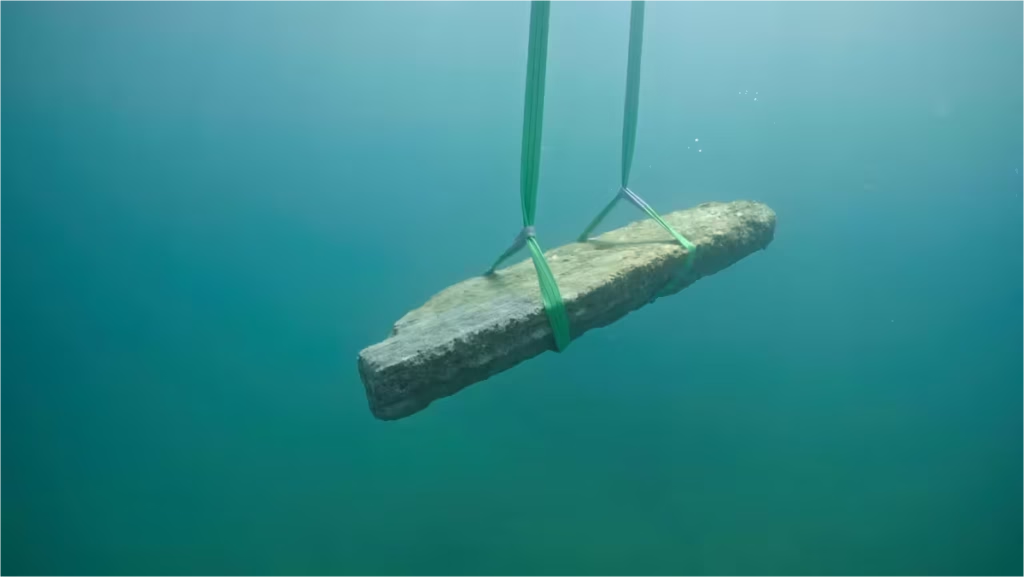
A marble architectural piece is extracted from the ancient Roman breakwater structure beneath the waters of Misenum. Credit: Soprintendenza ABAP for the Metropolitan Area of Naples

Superintendent Mariano Nuzzo described the recovery as a crucial contribution to understanding the urban and military landscape of ancient Misenum, home to the Classis Misenensis fleet, which was led by Pliny the Elder during the eruption of Vesuvius in 79 AD. Mayor Josi Gerardo Della Ragione also praised the project as a collaboration between national institutions and the local community to reclaim and showcase Bacoli’s submerged cultural treasures.

This project not only enriches our understanding of the strategic importance of Misenum in Roman times but also sets a precedent for public-facing, technologically advanced approaches to underwater heritage preservation.

Ministero Della Cultura

Cover Image Credit: Soprintendenza ABAP dell’Area Metropolitana di Napoli

Related Articles

Marmore, the Highest and Oldest Artificial Waterfall in Europe, Created by the Romans

4 March 2024

4 March 2024

Approximately eight kilometers away from the town of Terni in Umbria, Italy, there is a waterfall that is one of...

Culinary Habits of Ancient Maltese

24 February 2021

24 February 2021

Pottery shards found at the ancient settlement were analyzed for fragments of organic residue and protein. The culinary habits of...

New Discoveries Made in World’s Oldest Ancient Shipyard

11 June 2024

11 June 2024

Associate Professor Hakan Öniz, who discovered the world’s largest and oldest shipyard dating back to the Bronze Age in 2015...

The Ancient City of Miletos’s “Sacred Cave” Opened to Visitors

2 October 2021

2 October 2021

In the ancient city of Miletos, which had an important place in the advancement of philosophy, art, and science in...

Archaeologists unearth 6,000-year-old two monumental mounds containing wooden grave chambers in Germany

16 March 2024

16 March 2024

Archaeologists from the State Office for Heritage Management and Archaeology Saxony-Anhalt (LDA) have uncovered a significant Neolithic burial landscape on...

Climate has influenced the growth of our bodies and our brain

8 July 2021

8 July 2021

Over 300 fossils from the genus Homo have been measured for body and brain size by an interdisciplinary team of...

Bronze Age women’s jewelry set discovered in Güttingen carrot field, Swiss

17 October 2023

17 October 2023

A set of Bronze Age women’s jewelry was discovered by archaeologists in Güttingen, Thurgau canton, northeastern Switzerland, in a freshly...

Rare 15th-Century Coin Hoard of the Grand Duchy of Lithuania Unearthed in Smolensk: The ‘Dollar of the Middle Ages’ Found

2 October 2025

2 October 2025

Smolensk archaeologists uncover 48 medieval silver coins, including Prague groschen — widely known as the ‘Dollar of the Middle Ages’...

The 5,000-Year-Old Beaded Burials that Reveal Women’s Power in Copper Age Iberia: Over 270,000 Beads

6 February 2025

6 February 2025

Archaeologists investigating the Montelirio tholos burial site in southwestern Spain, dating back approximately 5,000 years, have uncovered that the women...

Unique ‘Excalibur’ Sword Found Upright in Ground Unearthed in Spain Holds Islamic Origins

26 April 2024

26 April 2024

Researchers have finally unraveled the mysteries of the historical sword discovered in Spain 30 years ago, which they named ‘Excalibur’...

Ancient Balkan genomes trace the rise and fall of the Roman Empire’s frontier, reveal Slavic migrations to southeastern Europe

7 January 2024

7 January 2024

The genomic history of the Balkan Peninsula during the first millennium of the common era—a period marked by significant changes...

White grape pips found in the Negev dated may be the oldest of its kind worldwide

29 April 2023

29 April 2023

Researchers from the University of York, Tel Aviv University, and the University of Copenhagen provide new insight into the mystery...

The biblical narrative of Sodom may have been inspired by a cosmic meteorite that devastated an ancient city

21 September 2021

21 September 2021

The Bible account of Sodom’s destruction lies at the heart of classic “fire and brimstone” judgment day prophesies. But what...

Copious Copper Supplies Made Cyprus a Trading Center in the Bronze Age

23 March 2023

23 March 2023

Cyprus was a surprisingly busy trading hub during the early period of international trade in the Mediterranean region. Its awe-inspiring...

Researchers discover America’s oldest mine

23 May 2022

23 May 2022

Archaeological digs headed by Wyoming’s state archaeologist and including University of Wyoming experts have revealed that people began producing red...