
When a young woman died in 17th-century Poland, those who buried her appear to have feared that death might not be enough to keep her away from the living.
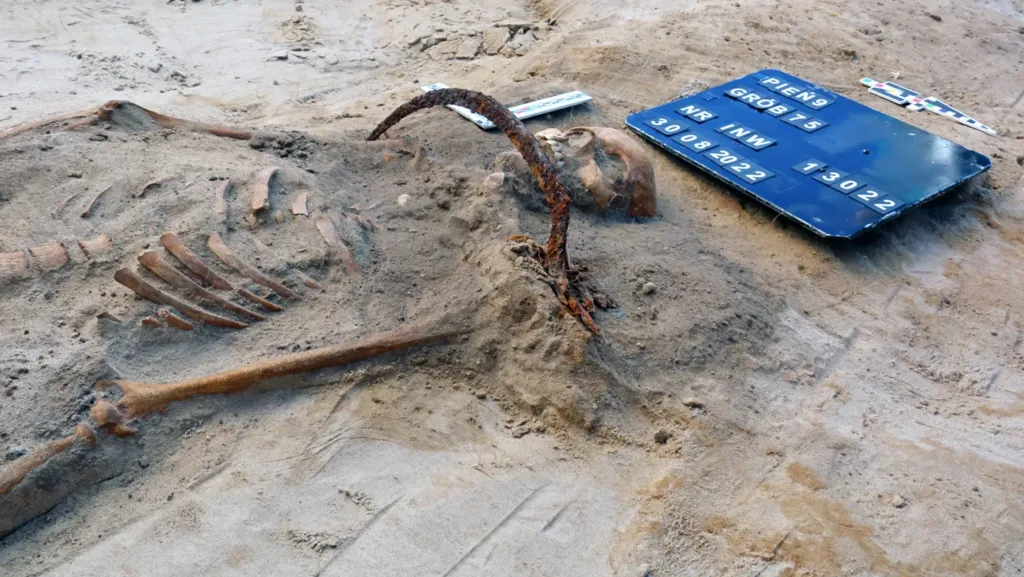
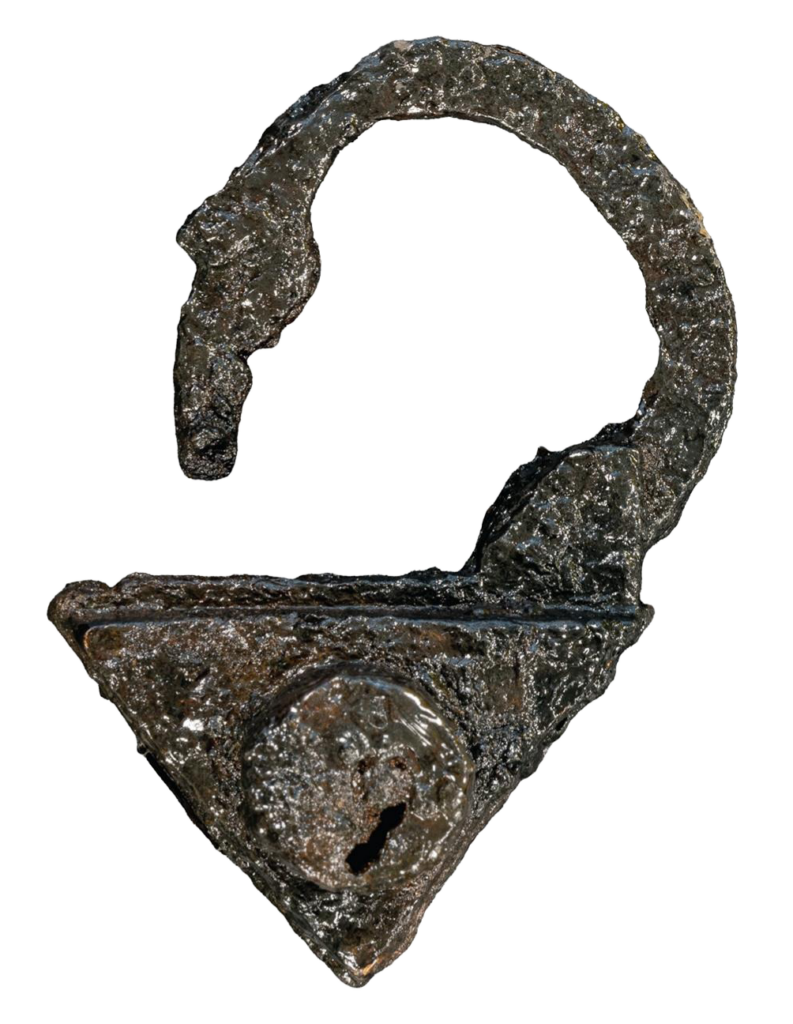
A triangular padlock was fastened to the big toe of her left foot. At some point, evidence now suggests, the grave may have been opened again before her body had fully decomposed, and a large sickle was placed across her neck with its blade turned toward her throat. Then scientists found something even harder to explain: an unusually strong concentration of copper deep inside her mouth and around the entrance to her throat.
The burial, known as Grave 75, was discovered in 2022 at Pień in north-central Poland. A new multidisciplinary study has brought together archaeology, ancient DNA, isotope analysis, osteology, textile research and elemental mapping to reconstruct both the life of the young woman and the extraordinary precautions taken around her body.
What emerges is not simply another so-called “vampire burial.” It is the story of a community that may have taken one precaution at the funeral, returned to the grave when that no longer seemed sufficient, and perhaps used a third measure whose physical form has completely disappeared.
The first measure was already unusual
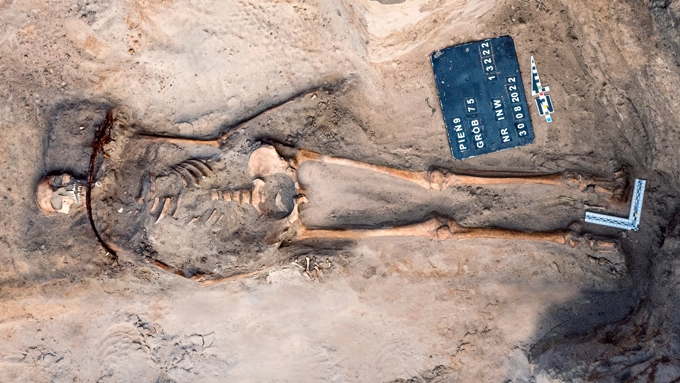
The woman lay on her back with her legs extended. Archaeologists found a triangular iron padlock attached to the big toe of her left foot, while a large elliptical sickle rested across the neck with its cutting edge facing the throat.
Either object on its own would have made the burial unusual. Together they make Grave 75 exceptional: the researchers say that the combination of a sickle and padlock in the same grave has not previously been reported in published archaeological literature.
The position of the leg bones suggests that the padlock had been there from the original burial. Researchers interpret it as a symbolic protective device, part of a wider post-medieval tradition in which locks could represent the closing of contact between the living and the dead or an attempt to prevent a dangerous deceased person from returning.
That detail matters because it means fear may have been present from the beginning. Someone who attended this young woman’s burial appears to have believed that an ordinary grave was not enough.
Then the grave may have been opened again
The sickle appears to tell a later part of the story.
During excavation, archaeologists found an unusually broad and irregular upper grave pit, disturbed edges, and mixed deposits on the northwestern side. Those features suggest that someone interfered with the burial after the original funeral.
The condition of the skeleton provides a possible time frame. The bones remained articulated even at relatively weak joints, which means that if the grave was reopened, the body was probably still held together by soft tissue.
Researchers therefore suggest that people may have returned relatively soon after burial and added the sickle as an “additional precaution.” The blade was positioned toward the neck, creating an unmistakably threatening arrangement even though its precise intended function can no longer be reconstructed with certainty.
The sequence is more unsettling than the objects themselves. The padlock appears to have been present when she was buried, but something may later have convinced people that the first measure had failed or was no longer sufficient.
Historical parallels offer possible reasons, but no definite answer. Epidemics, famine, unexplained deaths and other disasters could lead communities to blame the dead, and the study notes that such interpretations remain hypotheses rather than proof of what happened at Pień.
Something else may have been placed inside her mouth
The most mysterious evidence was not visible as an object at all.
Researchers noticed extensive green discoloration across the woman’s palate, continuing toward the throat, the base of the skull, the nasal cavity and the first two cervical vertebrae. Elemental mapping showed that copper concentrations in the back of the palate were at least ten times higher than in other parts of the skull.
That distribution led the team to a disturbing possibility. A copper-bearing object or substance may have been deliberately pushed deep into the mouth, or possibly introduced through the nasal passage.
Whatever caused the staining has not survived. The researchers considered whether a coin could explain the traces, since coins were sometimes placed in the mouths of the dead, but the evidence does not fit: comparable coins usually leave much smaller stains, while the chemical proportions found here do not match known historical alloys.
Some palate samples also contained gold and manganese, adding another layer to the puzzle. The analyses could establish that something unusual happened around the mouth, but they could not identify what the missing object or substance had been.
That uncertainty makes the find particularly important. The padlock and sickle can still be seen; the possible third intervention survives only as chemistry left behind in bone.
She was wealthy, young and apparently local
Nothing about the woman fits neatly with the image of an impoverished outcast.
Small fragments of a decorative band survived around her head and jaw. Analysis showed silk together with precious metal threads, including pure silver and gold, materials associated with expensive 17th-century dress.
The researchers argue that the decoration probably belonged to a cap and indicates high social status, perhaps even noble or wealthy urban origins. That makes the treatment of her body more difficult to explain, because fear of the dead clearly did not apply only to society’s poorest members.
She was also very young. Osteological analysis places her age at death between about 17 and 19, while her skeleton shows no traumatic injury or pathological condition that could explain how she died.
Ancient DNA adds another complication. Her mitochondrial lineage, J1c2c1, has strong phylogenetic links with Scandinavia and is rare among modern Slavic-speaking populations, yet isotope evidence suggests that she probably spent her childhood in the Pień region.
Researchers therefore consider the possibility that her maternal ancestry came from farther north while she herself grew up locally, perhaps as a second- or later-generation descendant of migrants. They emphasize, however, that neither DNA nor isotope results can show whether her neighbors regarded her as foreign.
What happened after her death remains the real mystery
More than three centuries later, science can reconstruct the sequence more clearly than the motive.
The woman appears to have entered the grave with a padlock already attached to her foot. The burial may then have been reopened while her body was still decomposing, and someone appears to have added a sickle across her throat. Chemical evidence raises the possibility that another object or substance was also placed deep inside her mouth.
None of that explains what the people around her believed she had done, or what they feared might happen if they left her alone. The study can identify protective practices and document their physical traces, but the event that caused people to return to the grave has vanished with them.
That is what makes Grave 75 more unsettling than the familiar label of a “vampire burial.” The evidence does not show a monster in the grave; it shows the fear of the living, strong enough that one precaution may not have been enough.
Poliński, D., Zagrodzka, M., Grzybowski, T., Borrini, M., Lynch, P. A., Cybulska, M., Grabarczyk, J., Kowalska, M., Laskowski, T., Karczewski, J., Molewski, P., Engelgardt, P., & Czyżewski, Ł. (2026). A unique, non-normative burial of a young adult female from a 17th-century cemetery in Pień, north-central Poland: A multidisciplinary approach. Journal of Archaeological Science: Reports, 74, 105967. https://doi.org/10.1016/j.jasrep.2026.105967
