
Thousands of ancient insects preserved inside a Gran Canaria burial cave are challenging ideas about how Indigenous communities treated the dead before burial.
What happened to the dead before Indigenous communities placed them inside the burial caves of the Canary Islands? One recent hypothesis proposed that bodies may have been exposed to sunlight and allowed to dry before they entered the caves.
Thousands of ancient insects preserved inside one Gran Canaria burial chamber now point to a different sequence of events. Their remains indicate that people brought the dead into the Cruz de la Esquina cave shortly after death and that decomposition took place there, with no evidence for prolonged outdoor desiccation beforehand.
The study, published in Antiquity by Pedro Henríquez-Valido, Jean-Bernard Huchet, Jacob Morales and Amelia Rodríguez-Rodríguez, uses archaeoentomology—the study of insect remains from archaeological contexts—to reconstruct activities that conventional artefacts alone cannot reveal. The researchers identified insects linked to different stages of decomposition, but another group of species eventually exposed an entirely different chapter in the cave’s history.
Insects reconstruct what happened after death
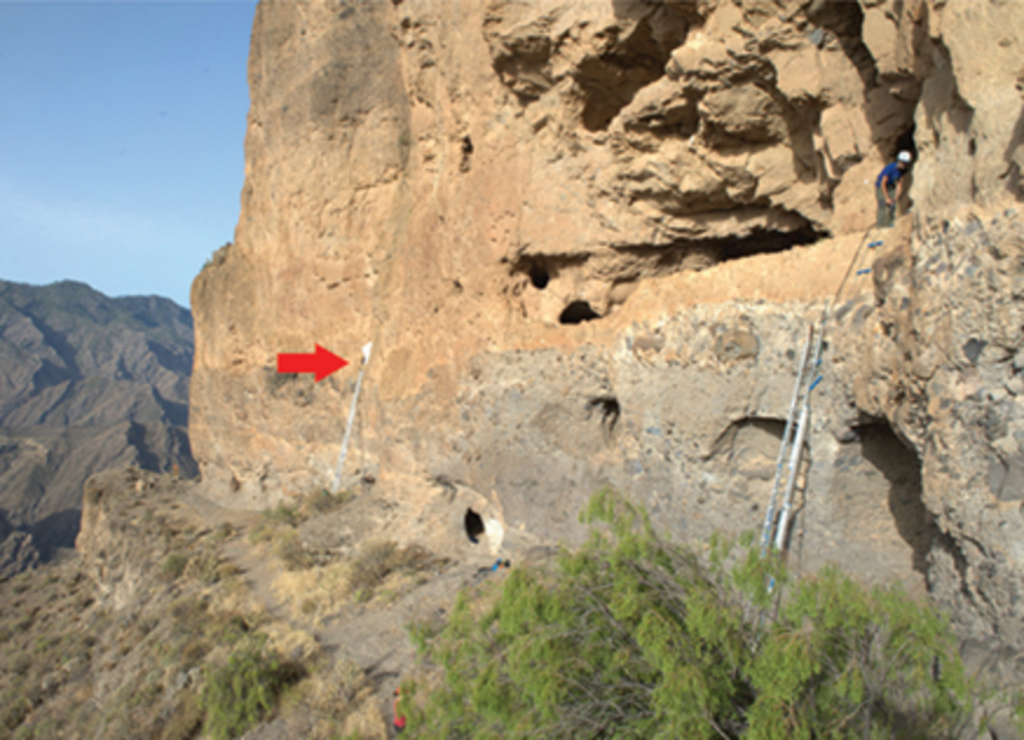
Cruz de la Esquina sits about 990 metres above sea level on the Acusa plateau in Gran Canaria’s Tejeda Basin. The surrounding archaeological complex contains roughly 20 artificial caves that Indigenous communities used for domestic activities, storage and funerary purposes, with occupation documented from at least the fifth century AD.
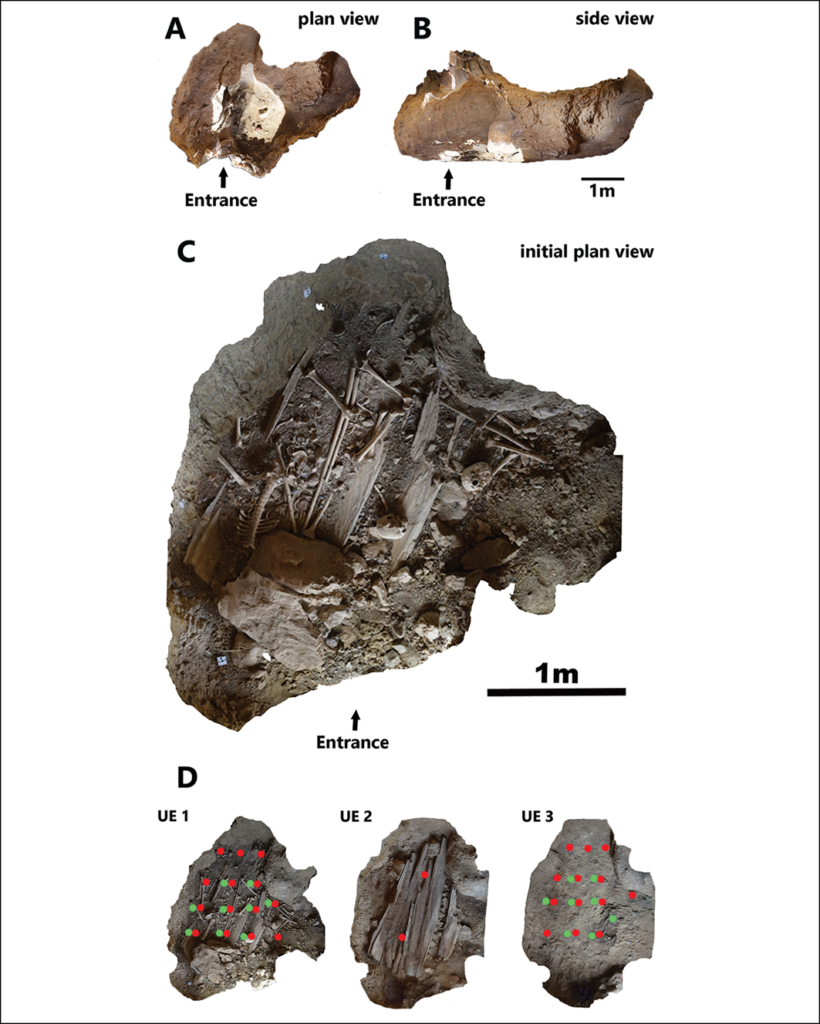
Researchers first documented the burial cave in 2001. Human bones covered parts of the floor, while wooden planks formed a platform that had supported the bodies; unusually dry conditions also preserved rope, woven rush material, leather and other organic remains.
The scattered state of the skeletons made it difficult to reconstruct exactly how people had originally placed the dead. Insects provided another route into the problem because different species reach a corpse at predictable stages of decomposition and under different environmental conditions.
The researchers collected sediment from the funerary deposit and the layers beneath the wooden platform. They recovered 8,173 arthropod remains, identified 8,082 of them and calculated a minimum of 5,792 individual organisms.
Among the most important finds were blowflies and flesh flies, insects that typically colonise bodies during the earliest stages of decomposition. More than 1,000 pupal remains from these early-stage groups helped the researchers determine that the bodies entered the cave soon after death.
Beetles associated with later stages of decay completed the sequence. Together, the insects show that decomposition continued inside the cave rather than beginning somewhere outdoors and ending after the bodies were transferred into the chamber.
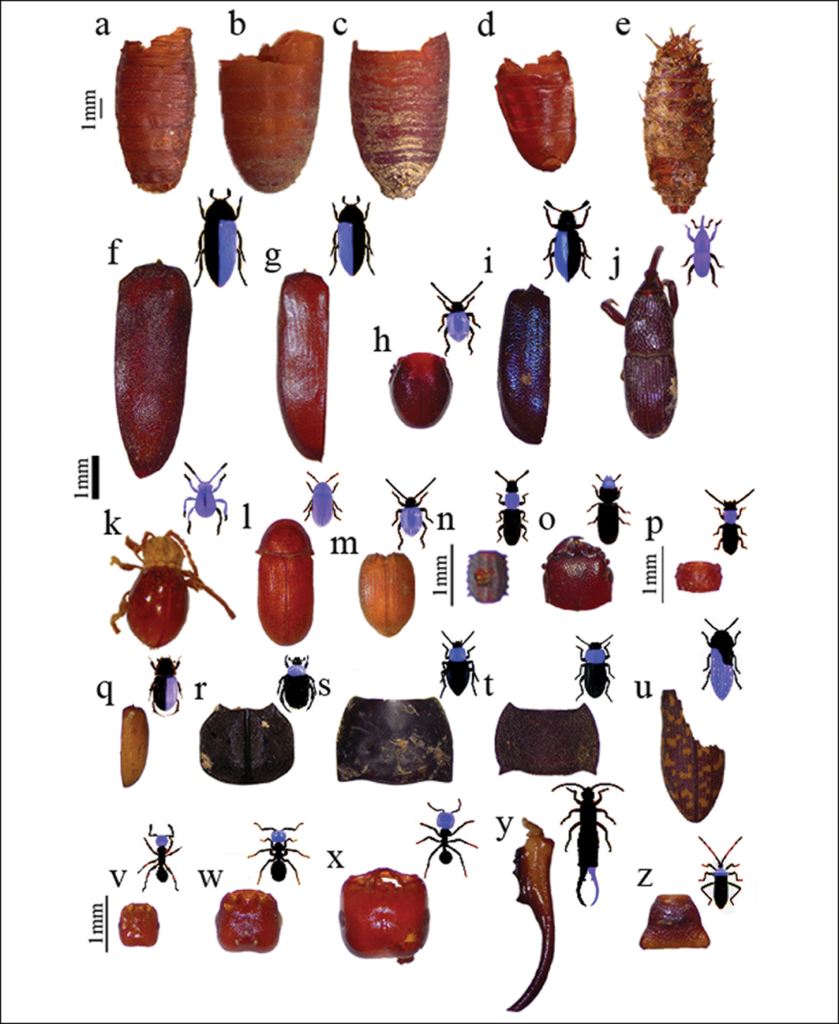
Insect remains recovered from the Cruz de la Esquina burial cave, including flies, beetles, grain pests, and other species linked to decomposition and food storage. Figure by authors. Credit: Henríquez-Valido, P., et.al., 2026, Antiquity
No evidence for prolonged drying outside the cave
That sequence directly addresses an ongoing debate in Canarian funerary archaeology. Wrapped bodies placed inside caves are well documented, but researchers have disagreed over how much time passed between death and deposition.
One recent interpretation, drawing partly on historical accounts and insect remains from museum collections, proposed that people may have left corpses exposed to sunlight before burial. The Cruz de la Esquina assemblage differs because the researchers recovered the insects directly from their archaeological context.
The abundance of species associated with the earliest stages of decay strongly supports immediate or near-immediate placement inside the cave. The team found no entomological evidence for prolonged external desiccation, while later-arriving insect groups indicate that the bodies remained inside as decomposition progressed.
Other archaeological evidence fits that interpretation. Plant-fibre textiles and leather survived inside the chamber, and comparisons with better-preserved funerary sites on Gran Canaria suggest that people probably wrapped the deceased in bundles before placing them on the wooden platform.
But the insects revealed another surprise beneath the burial evidence.
Before the dead arrived, the cave stored food
Around 21 percent of the insects belonged to species associated with stored products, and researchers found storage pests in 76 percent of the sediment samples. Such a widespread and diverse assemblage is difficult to explain simply as insects that arrived with funerary offerings.
The most abundant storage pest was Sitophilus granarius, the granary weevil. The species cannot fly and depends on people to transport infested grain, making it a particularly useful archaeological indicator of cereal storage.
Researchers therefore conclude that Cruz de la Esquina served as a granary before Indigenous communities converted it into a burial chamber. Other insects that feed on damaged or processed cereals strengthen the case for an earlier storage phase.
Radiocarbon dates help connect the two uses. A barley seed dates to AD 660–770, while human bones and insects associated with the funerary phase fall broadly between the seventh and ninth centuries. A granary weevil recovered from the wooden platform returned a calibrated date of AD 772–974.
The dates suggest that people changed the cave’s function relatively quickly rather than returning after a long period of abandonment. The researchers propose that traces of stored cereals remained on the floor when people constructed the burial platform, allowing storage pests to persist even as the cave became a place for the dead.
A small record of a much larger change
The transformation also fits broader changes taking place on Gran Canaria during the eighth and ninth centuries. Communities increasingly moved from small, isolated storage caves toward larger interconnected granaries, and archaeologists have identified another storage complex only about 20 metres from Cruz de la Esquina.
In that context, the cave may preserve a brief moment when an older storage space acquired an entirely new role. One group of insects records the grain once kept there, while another records what happened to the bodies placed above it.
The study therefore resolves more than one archaeological question. It challenges the idea that the dead at this site underwent prolonged outdoor drying before burial, while also revealing that the burial chamber itself had already lived a previous life as a granary.
Henríquez-Valido, P., Huchet, J.-B., Morales, J., & Rodríguez-Rodríguez, A. (2026). Buried in the pantry: using archaeoentomology to assess cave reuse at the pre-Hispanic site of Cruz de la Esquina. Antiquity, 1–18. doi:10.15184/aqy.2026.10407
