
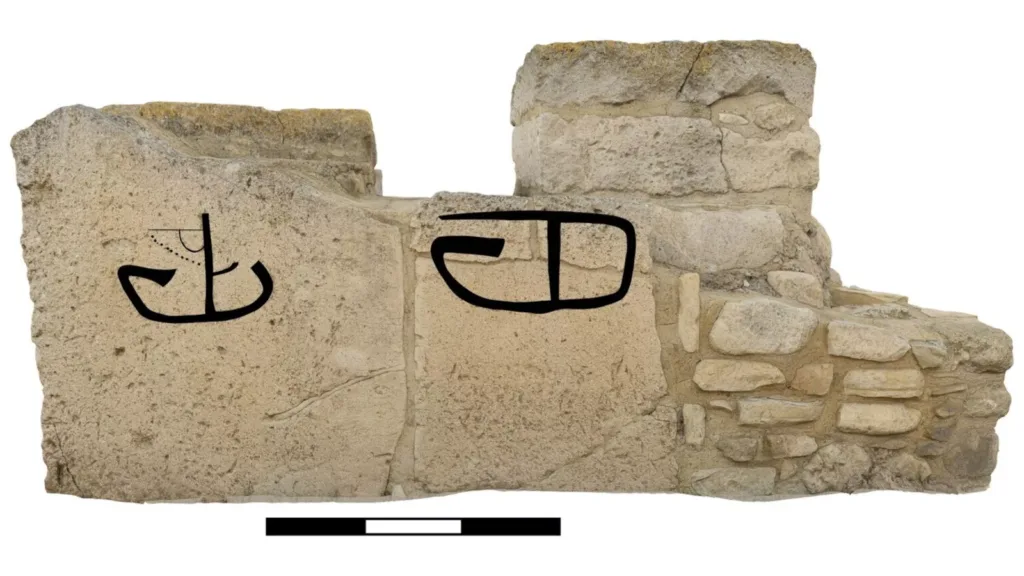
High-resolution scanning at ancient Kition has revealed previously overlooked ship graffiti and a maritime record linking Cypriot, Levantine and Aegean traditions across the Bronze–Iron Age transition.
More than 3,000 years ago, people at Kition carved ships into the stone façade of one of the settlement’s most monumental buildings. New digital analysis now shows that the wall preserved far more than a collection of ancient drawings: most of the vessels can be organized into six morphological groups reflecting different shipbuilding traditions that once shared the eastern Mediterranean.
Some resemble ships known from the Levant, others have parallels in the Aegean, while several preserve features associated with local Cypriot shipbuilding. Together, they offer a rare visual record of the vessels, technologies, and maritime connections that linked Cyprus with surrounding regions at the end of the Bronze Age and into the Early Iron Age.
The findings are presented by Graham C. Braun, Caroline Barnes and Tzveta V. Manolova in a study published in the International Journal of Nautical Archaeology in August 2026. Their reassessment changes not only how many ships can be seen at Kition, but also when those images were made and what they may tell us about maritime connections at the end of the Bronze Age.
Ships Hidden in a Weathered Wall
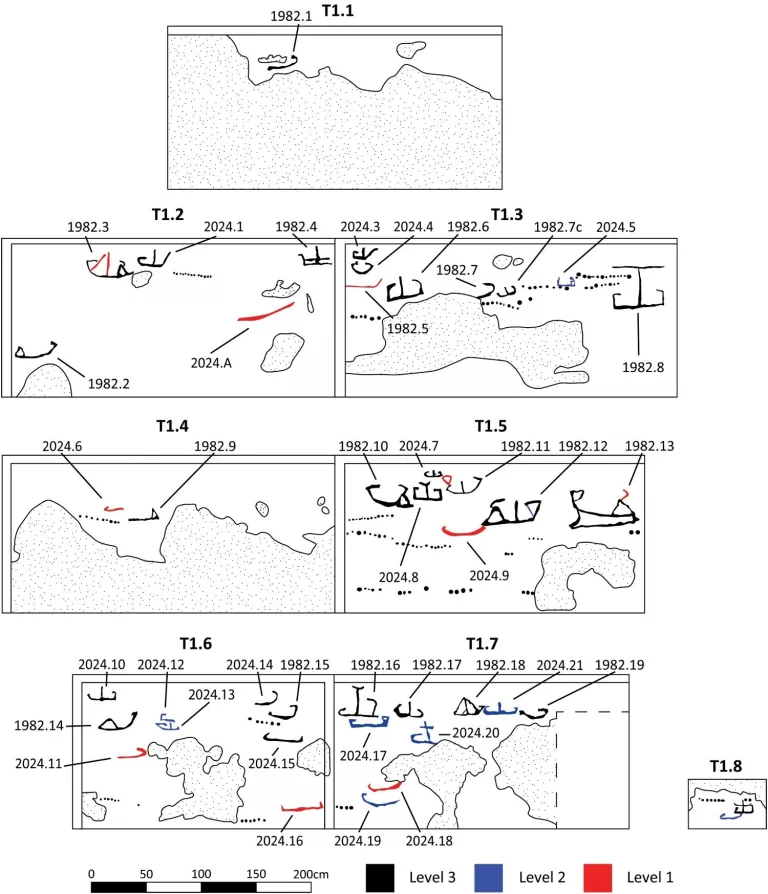
When the Kition graffiti were published in 1985, researchers identified 19 ship images on the southern façade of the building known as Temple 1, along with two examples from Temple 4. The images subsequently became familiar examples of Late Bronze Age ship iconography, but they were never subjected to an intensive digital restudy.
That changed when researchers returned with terrestrial laser scanning and photogrammetry. The technique allowed them to distinguish shallow human-made cuts from cracks, erosion, and other damage that can be difficult or impossible to recognize with the naked eye.
The team identified 23 additional potential ship graffiti on the Temple 1 blocks. Nine were classified with the highest level of confidence, while six received an intermediate rating and eight remain more uncertain. The scans also corrected details in several ships that had been drawn differently in the earlier publication.
But the increase in numbers was only part of the story.
A Maritime Archive Built Over Generations
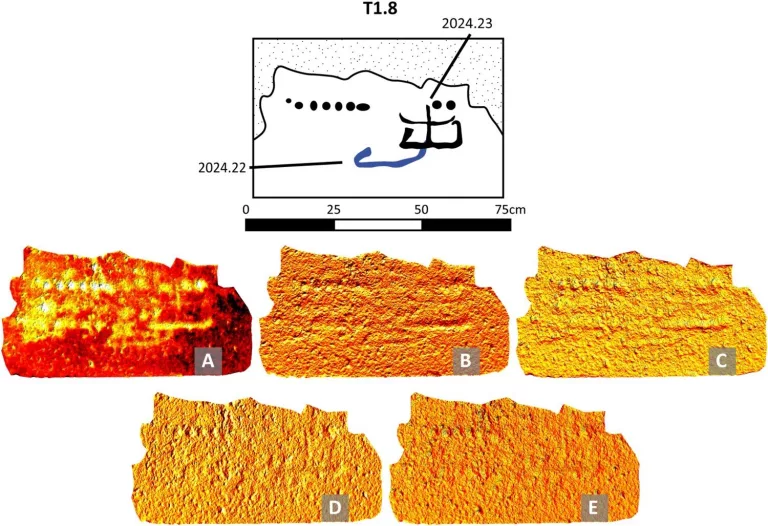
The graffiti had generally been treated as products of the Late Bronze Age. One newly examined stone, known as T1.8, made that interpretation increasingly difficult.
Unlike the original limestone blocks of Temple 1, T1.8 belonged to a later repair of the façade. Yet it too carried ship graffiti. Because the block was installed well after the temple’s original construction, the vessels carved on Kition’s walls could no longer be understood simply as one group made at one moment.
The researchers conclude that ships were probably added repeatedly from the Late Bronze Age into the Early Iron Age. T1.8 was placed roughly 150 years after the original orthostats, suggesting that later people were deliberately adding maritime images to a wall that already carried ships.
That changes the character of the monument. Rather than a single ancient “fleet” carved as one composition, the façade appears to have accumulated images over generations, while later carvers continued to work within an established maritime tradition. The study ultimately considers continuous carving from the Late Bronze Age into the Early Iron Age the most likely explanation.
Levantine, Aegean and Cypriot Ships on the Same Wall
This long chronology matters because the ships are not all alike. Researchers divided most of the graffiti into six morphological groups, ranging from merchant vessels to galleys and hybrid forms.
Taken together, they preserve something rare: a visual sample of different shipbuilding traditions circulating through the eastern Mediterranean around the transition from the Bronze Age to the Iron Age. The study finds particularly strong connections between Cyprus and the Levant, alongside more limited but significant evidence for Aegean traditions.
Some vessels have parallels with Helladic and Minoan ship imagery. Others share features with ships known from the Levantine coast, where maritime technology and imagery developed in close contact with Cyprus.
Yet Kition was not simply receiving ideas from elsewhere. Some details point toward local Cypriot developments, including triangular arrangements associated with mast support and a striking stern feature represented elsewhere as an inward-facing duck head. The latter is particularly associated with Early Iron Age Cypriot vessels and may help identify one hybrid ship type as a development originating on the island.
The result is not a picture of one maritime culture replacing another. Instead, Kition emerges as a place where different nautical traditions met, persisted, and were adapted locally. That fits its position on Cyprus, strategically placed between the Levant and the Aegean and deeply connected to eastern Mediterranean exchange.
The Aegean evidence is important precisely because it does not dominate. Ships with Aegean parallels were certainly present, but Cypriot and Levantine vessel traditions form the stronger thread through the collection. The graffiti therefore offer a more complicated picture than one in which changes at Kition can simply be explained by the arrival of Aegean populations.
Who Kept Carving the Ships?
One question remains impossible to answer securely: who made them?
The ships were carved on valuable stone belonging to one of the site’s most monumental buildings. Their repeated appearance in the same architectural space suggests that this was more than casual scratching, even though researchers retain the term “graffiti.”
One possibility is that sailors made the images themselves. Earlier interpretations proposed that they may have been votive offerings, perhaps carved before a voyage in search of protection or after returning safely. Another possibility is more immediate: people standing near Kition’s harbour may simply have carved the silhouettes of vessels they could see offshore.
Those explanations cannot yet be separated. What the new study does show is that people kept returning to ships as an image for generations.
In that sense, the weathered stones at Kition preserve more than drawings of ancient vessels. They record a community repeatedly looking toward the sea at a time when ships connected Cyprus with ports, people, and technologies across the eastern Mediterranean.
Braun, G. C., Barnes, C., & Manolova, T. V. (2026). The ship graffiti from Late Bronze Age–Early Iron Age Kition, Cyprus: New additions and reconsiderations 40 years later. International Journal of Nautical Archaeology. Advance online publication. https://doi.org/10.1080/10572414.2026.2702905
