
9 June 2026 The Future is the Product of the Past

Only Those on the Righteous Path May Enter Here”: New Mosaics Unearthed in Antalya’s Olympos

A newly discovered mosaic inscription at the entrance of a church and elaborately decorated floor mosaics have come to light during recent excavations in the ancient city of Olympos, located in Antalya’s Kumluca district.

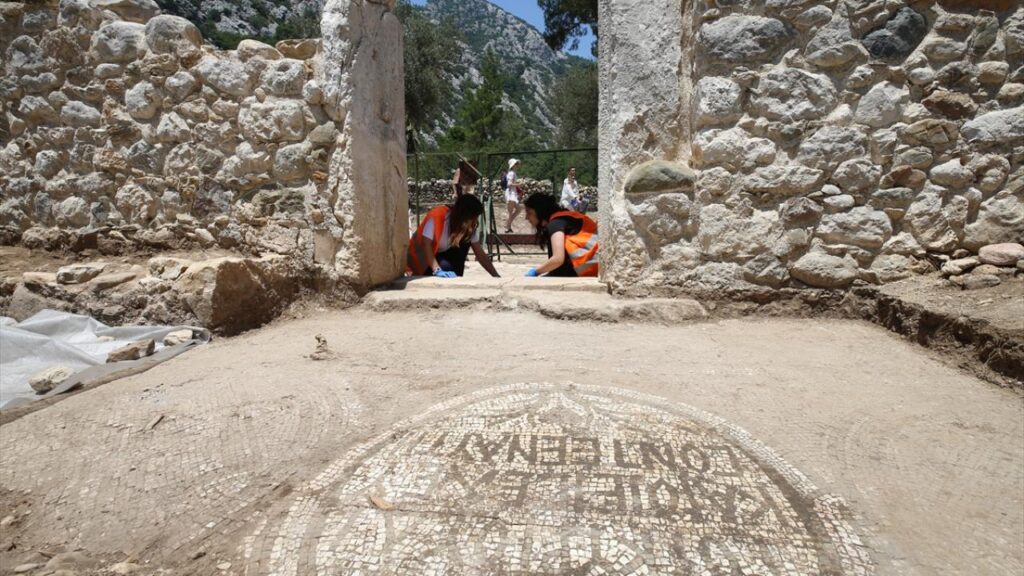
Archaeologists working in the Olympos Ancient City have unearthed a mosaic inscription placed at the entrance of a church within the site, along with previously unknown mosaic floor sections inside the same building. The inscription, reading “Only those on the righteous path may enter here,” is believed to hold religious and social significance, particularly regarding the early Christian presence in the region.

The discovery is part of a series of findings that continue to shed light on the rich historical layers of Olympos, a city that once thrived during the Hellenistic, Roman, and Byzantine periods.

Olympos: A Richly Layered Ancient Settlement in Lycia

Situated on Türkiye’s Mediterranean coast, Olympos was one of the major cities of ancient Lycia. With origins dating back to the Hellenistic period, the city later became an important Roman settlement and retained its significance well into the Byzantine era.

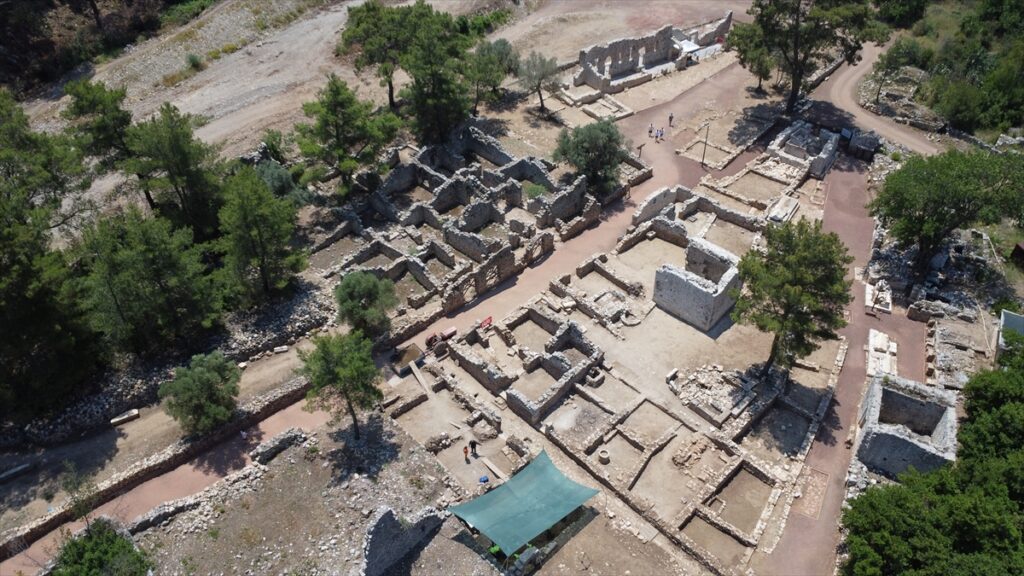
Excavations at the site have been ongoing since 2006, and for the past four years, archaeological teams have continued work year-round without interruption. Numerous important structures have been uncovered, including Churches No. 1 and 3, the entrance complex, the Episcopal Palace, a Roman bridge, monumental tombs, and richly decorated mosaic buildings.


📣 Our WhatsApp channel is now LIVE! Stay up-to-date with the latest news and updates, just click here to follow us on WhatsApp and never miss a thing!!


“Only those on the righteous path may enter here” — Mosaic inscription discovered at the entrance of a Byzantine-era church in Olympos Ancient City, Antalya. The phrase likely served as a symbolic threshold message to early Christian visitors. Credit: Anadolu Agency (AA)

Olympos Continues to Reveal its Mosaic Treasures

In a statement to the Anadolu Agency, excavation director Assoc. Prof. Dr. Gökçen Kurtuluş Öztaşkın of Pamukkale University stated that the discoveries made in 2024 add to a growing list of mosaic finds in the city.

“Olympos is full of surprises. In 2017, 2022, and 2023, we uncovered richly decorated mosaic floors in various structures. In 2024, we revealed the floor mosaics of Church No. 1, including an inscription right at the entrance,” Öztaşkın said.

The newly uncovered mosaics feature geometric patterns, floral motifs, and inscriptions. The inscription at the church entrance is especially notable for its message and placement.

“A mosaic inscription placed directly at the church’s entrance reads, ‘Only those on the righteous path may enter here.’ We also found mosaics bearing the names of the church’s benefactors. These findings confirm that Olympos was a city rich in mosaic flooring compared to the rest of the Lycian region,” Öztaşkın added.
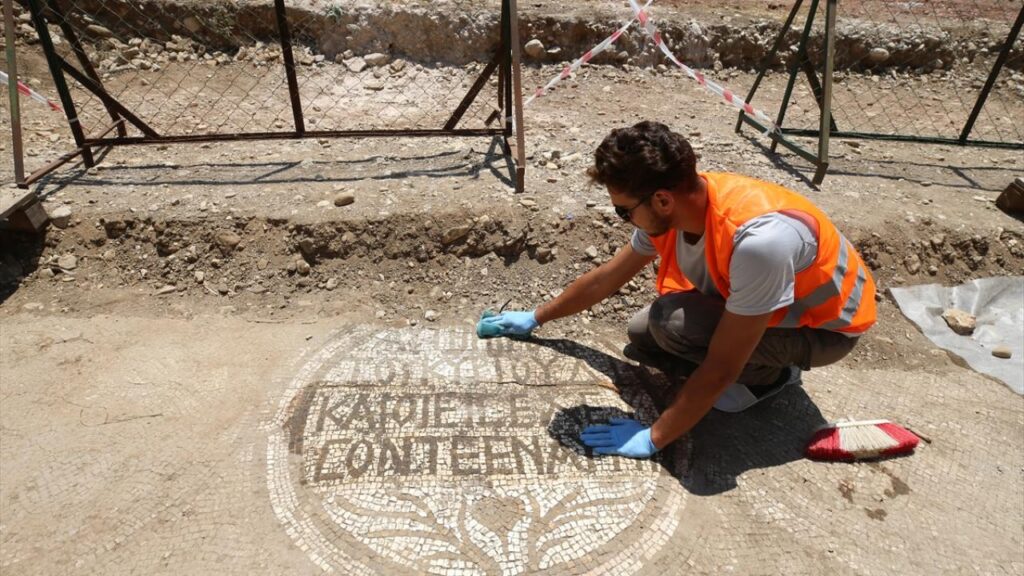
Mosaic inscription at the church entrance in Olympos: “Only those on the righteous path may enter here. Credit: Anadolu Agency (AA)

Residential Structures and Possible Temple to Be Excavated

In addition to religious structures, the excavation team is working in areas that were originally necropolises during the Roman period but later converted into residential zones during the Byzantine era due to population growth.

One building, dated to the 5th century AD, was destroyed in a fire during the 6th century but was rebuilt on the same plan and reused afterward.

“It’s a multi-room residential structure with stone-paved floors. We are currently continuing excavations there,” Öztaşkın explained.

She also noted that the team has identified an area likely to contain a previously unknown temple structure.

“At the end of last year, we spotted façades with drafted ashlar stonework. The architectural plan and construction techniques suggest it may be a temple. We plan to begin excavations in that area in the coming days.”
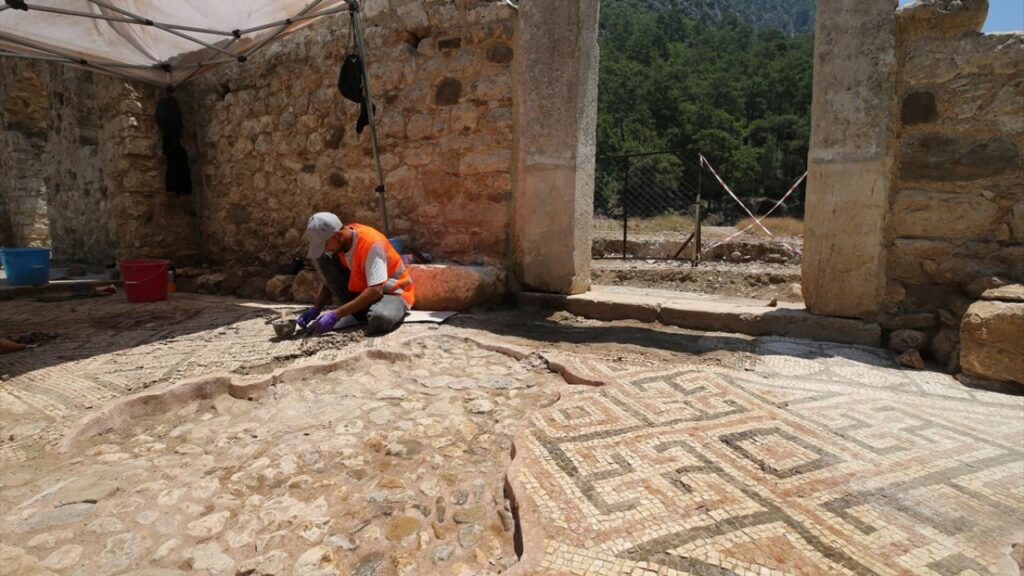
Newly discovered mosaics at Olympos Ancient City reveal intricate geometric and floral patterns inside a Byzantine-era church. Credit: Anadolu Agency (AA)

Looking Ahead: More Discoveries on the Horizon

Excavations in 2025 will focus on several key areas: the western necropolis, a central temple, the Episcopal Palace, and Church No. 3. The team also plans to complete work in the northern sector of the city within two years, followed by intensified efforts in the south.

Öztaşkın also told Anadolu Agency that a large storage jar (pithos) was found during this season’s excavations in the residential area, and that artifacts recovered from the site are being displayed at the Antalya Archaeological Museum.

Cover Image Credit: Anadolu Agency (AA)

Related Articles

A 4,500-year-old rope remains were discovered at Turkey’s Seyitömer mound

26 December 2021

26 December 2021

In the rescue excavation carried out in the mound, which is located within the license border of Çelikler Seyitömer Electricity...

The history of Kültepe Mound in central Turkey goes back another 300 years

12 December 2021

12 December 2021

In Kültepe, where the first written documents of Anatolia were unearthed, the date based on 5 thousand years was updated...

Egypt opens King Djoser’s 4,500-year-old tomb after a 15-year restoration

15 September 2021

15 September 2021

Egypt on Tuesday showcased an ancient tomb structure belonging to the cemetery complex of King Djoser, a pharaoh who lived more than 4,500...

Stonehenge could be a solar calendar, according to a new study

2 March 2022

2 March 2022

A new study posits that the Stonehenge circles served as a calendar that tracks the solar year of 365.25 days,...

Tang-e Chogan bas-relief carvings, Majestic treasures of Sassanid art, are under threat of destruction 

9 March 2022

9 March 2022

Treasures of Sassanid art, some of Tang-e Chogan’s bas-reliefs are under threat of complete destruction due to lack of maintenance...

2800-year-old two Swords found in Germany from the start of the Iron Age

8 June 2022

8 June 2022

During archaeological excavations in preparation for the construction of the fire station in the Frieding district of Andechs in southern...

Native American artifacts from 1100 AD found in North America’s First City

20 June 2024

20 June 2024

Cahokia is the largest and most significant urban settlement of the Mississippian culture, known for creating massive earthen platform mounds...

Alexander the Great’s Sacred Purple Tunic Found in a 2,400-year-old Macedonian Tomb?

29 October 2024

29 October 2024

Archaeologists have found a sacred chiton (tunic) in a 2400-year-old royal tomb in the Macedonian city of Vergina in northern...

One More Missing Links of Evolution Found

29 April 2021

29 April 2021

There is a phenomenon of missing links in the theory of evolution. Theorists of evolution continue to find these missing...

Roman era total of 46 early settler burials discovered in Germany

17 September 2023

17 September 2023

Students from Goethe University Frankfurt, in collaboration with the Hesse archeology department at the Darmstadt branch of the State Monument...

World’s oldest wooden structure ‘476,000 years old’ discovered in Zambia

20 September 2023

20 September 2023

An ancient wooden structure found at Kalambo Falls, Zambia—dated to about 476,000 years ago—may represent the earliest use of wood...

2,000-Year-Old Shipwreck in Croatia Reveals How Romans Kept Their Vessels Waterproof

25 April 2026

25 April 2026

A Roman-era shipwreck resting off the Croatian coast is offering an unusually intimate look at how ancient shipbuilders protected their...

1400-year-old artifacts discovered in the ancient city of Uzuncaburç (Diocaesarea)

26 January 2022

26 January 2022

During the excavations carried out in a tower in the ancient city of Uzuncaburç (Diocaesarea) in Mersin province in the...

Ancient Well Dating Back to 7th Century AD Discovered on Failaka Island

18 March 2025

18 March 2025

An ancient well, dating back to the pre-Islamic and early Islamic periods, has been discovered on Failaka Island, providing valuable...

The Golden Helmet of Leiro: A Bronze Age Masterpiece Hidden for Millennia on Spain’s Atlantic Coast

20 March 2026

20 March 2026

On a rugged stretch of Galicia’s Atlantic coastline, where waves carve stories into stone, an extraordinary object once lay hidden...