
15 June 2026 The Future is the Product of the Past

One of Gaul’s Largest Roman Villas Discovered Near Auxerre, France, Spanning Over 4,000 m²

Archaeologists uncover a massive 4,000 m² Roman villa near Auxerre, revealing elite lifestyles in ancient Gaul.

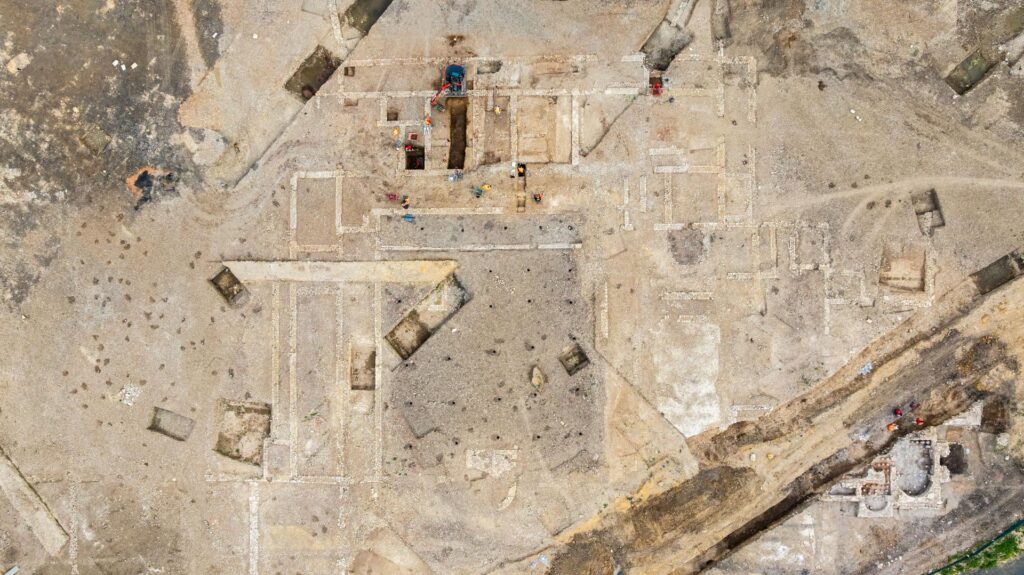
A remarkable archaeological discovery just 3 kilometers south of Auxerre is shedding new light on the scale and luxury of Roman-era rural estates in ancient Gaul. In advance of infrastructure development on the city’s southern bypass, archaeologists have uncovered a vast Roman villa covering more than 4,000 square meters at a site known as Sainte-Nitasse, on the right bank of the Yonne River.

The villa, once thought to be a modest Roman outpost, has now been confirmed as one of the largest and most elaborate Gallo-Roman residences ever excavated in France. Initial clues to its existence date back to the 19th century, but systematic excavation only began in 1966 when gravel extraction operations exposed part of a rectangular building with ten rooms and decorative elements, including funerary steles and hypocaust systems.

However, that early discovery turns out to have been merely a secondary wing. Current excavations, led by a team under the direction of the French Ministry of Culture and the DREAL Bourgogne-Franche-Comté, reveal that the site includes an expansive central garden, porticoed galleries, private bath complexes, ornamental fountains, and evidence of sophisticated architecture—indicating that this villa was far more than a countryside retreat.

A Glimpse into Roman Luxury

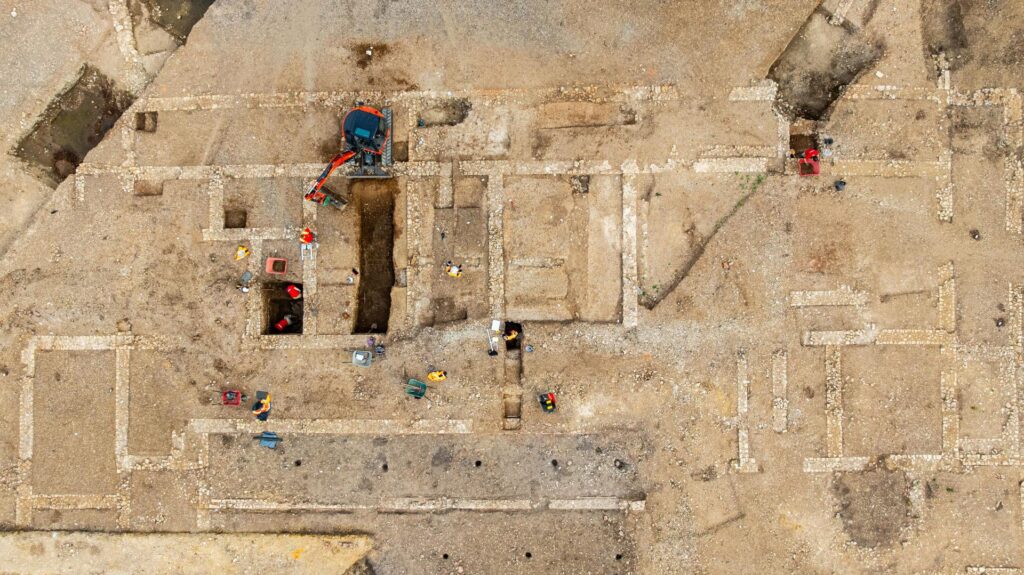
At the heart of the villa lies a square garden enclosed by galleries, stretching over 450 square meters per side. To the north, a large basin likely served both ornamental and hydraulic purposes, while a smaller fountain at the southern end may have marked a point of ritual or aesthetic significance.


📣 Our WhatsApp channel is now LIVE! Stay up-to-date with the latest news and updates, just click here to follow us on WhatsApp and never miss a thing!!


View of the north wing of the villa under excavation, seen from the northwest. Credit: Ch. Fouquin, Inrap

Adjoining these spaces are reception rooms, technical facilities, and a well-preserved bathhouse, complete with underfloor heating. These features confirm the site’s role not just as a farm estate (pars rustica) but as a luxurious home (pars urbana) belonging to a wealthy and likely aristocratic Roman family.

According to the excavation team, the architecture and spatial planning of the site parallel the urban development of Autessiodurum (modern-day Auxerre), which evolved from a minor settlement in the 1st century AD into a regional capital by the 4th century.

Public Access and Ongoing Research

In celebration of the European Archaeology Days (JEA), the excavation site will be open to the public on Sunday, June 15. Visitors can join guided tours led by the archaeologists themselves, with shuttles running every 15 minutes from the Arquebuse parking area. Entry is free and open to all.

While the full scope of the villa is still being revealed, researchers have already identified multiple phases of construction, suggesting the estate evolved significantly over time. Future analysis of ceramics, mosaics, and organic materials is expected to offer insights into the daily life of the villa’s ancient residents.
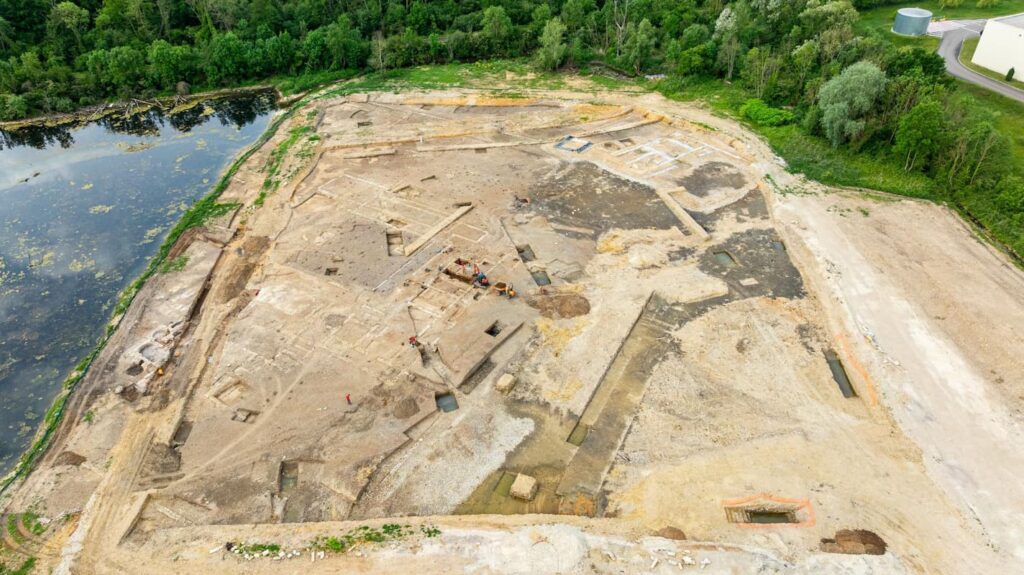
General view of the site from the north. Credit: Ch. Fouquin, Inrap

This exceptional discovery not only highlights the richness of Roman life in provincial Gaul but also raises new questions about economic power, land ownership, and cultural exchange in the late Roman Empire. As the dig continues, the Auxerre villa is poised to become a landmark case study in Roman archaeology.

INRAP

Cover Image Credit: Panoramic view of the Roman villa uncovered at Sainte-Nitasse. Credit: Ch. Fouquin, Inrap

Related Articles

Rare Roman Cavalry Swords Lead to Major Archaeological Discovery of Iron Age to Roman Settlement in Gloucestershire

4 July 2025

4 July 2025

A remarkable archaeological excavation in Gloucestershire has unveiled a vast settlement site dating back over 2,000 years, bridging the Iron...

Archaeologists found a mysterious stone tablet in Georgia that contains an unknown language

5 December 2024

5 December 2024

Archaeologists have unearthed a basalt tablet with inscriptions in an unknown language near Lake Bashplemi, in the Dmanisi region of...

Rare 400-year-old Bronze Trumpets Discovered on a shipwreck in Croatia

12 July 2024

12 July 2024

Croatian underwater archaeologists have made an extraordinary discovery off the southern coast of Istria near Cape Kamenjak. They have unearthed...

Rare a Serbian Stefan Uros II Milutin Silver Grosso discovered in Bulgaria’s Medieval Rusocastro Fortress

8 September 2023

8 September 2023

Archaeologists have discovered a silver grosso minted by the Serbian king Stefan Uros II Milutin in the medieval Rusocastro fortress,...

The first Bull Geoglyph discovered in central Asia

29 September 2021

29 September 2021

Archaeologists from the Russian Academy of Sciences’ Institute of History of Material Culture (IIMK RAS) and LLC Krasnoyarsk Geoarchaeology discovered...

Archaeologists unearth the Torah Ark of the Great Synagogue of Vilna, destroyed in Lithuania

30 August 2021

30 August 2021

In Vilnius, the capital of Lithuania, in excavation exposed the Torah ark and bimah (raised prayer platform) of the Great...

Archaeologists Discovered One of the Earliest Christian Buildings in Bahrain

14 July 2024

14 July 2024

Archaeologists have uncovered one of the earliest known Christian buildings in the Arabian Gulf, located in Samahij, Bahrain, and providing...

Mysterious Dead Sea Copper Scroll May Hide the Financial Secrets of a Failed Jewish Revolt

1 June 2026

1 June 2026

The Copper Scroll has always looked less like a manuscript than a deliberate act of silence. Found in 1952 inside...

The 1000-year Curse of the Croatian King Zvonimir

26 September 2023

26 September 2023

Croatia is a fascinating country that continually rises up people’s must-visit lists thanks to its sparkling Adriatic coastline, 1,244 islands,...

Roman Gold Mines Hidden in Spain’s Pyrenees Finally Revealed After 1,700 Years

26 May 2026

26 May 2026

For nearly two thousand years, the rivers of the Pyrenees kept part of their Roman past hidden in plain sight....

Roman Soldiers at Vindolanda Secretly Made Their Own Ink — Using Techniques Forgotten in the Mediterranean

5 March 2026

5 March 2026

At the northern edge of the Roman Empire, where winds swept across Britain’s frontier and soldiers guarded the boundary of...

Researchers may have found the wreck of British explorer James Cook’s Endeavour

3 February 2022

3 February 2022

The wreck of Captain James Cook’s famed vessel the Endeavour has been found off the coast of the U.S. state...

Archaeologists 3D map Red Lily Lagoon, the hidden Northern Territory landscape where first Australians lived more than 60,000 years ago

10 May 2023

10 May 2023

Archaeologists map Red Lily Lagoon, a hidden landscape in the Northern Territory where the first Australians lived more than 60,000...

Rare Egyptian-Iconography Relief Discovered at Sagalassos: Afyon Marble Panels Depict God Tutu

5 October 2025

5 October 2025

Archaeologists excavating the ancient site of Sagalassos in the Ağlasun district of Burdur have made a striking discovery: a relief...

Medieval Cannonballs Found Beneath Future Administrative Centre in Belgium’s Nieuwpoort

28 April 2026

28 April 2026

A future civic building in Nieuwpoort has unexpectedly opened a window onto the Belgian city’s defensive past. Archaeologists working on...