

On the western wall of Istanbul’s Chora Church, now known as Kariye Mosque, one of the most striking images of late Byzantine art has survived for roughly seven centuries. The mosaic depicts the Dormition of the Virgin Mary, or Koimesis in Greek, literally her “falling asleep”, a Christian tradition that presents Mary’s death not simply as an ending, but as a passage into eternal life.
Created during the celebrated restoration of the Chora under Byzantine statesman and scholar Theodore Metochites around 1316–1321, the mosaic occupies a prominent position above the western entrance to the naos, the church’s main worship space. It is one of only three mosaics that survive in the central church, making it particularly important for understanding the building’s original decorative program.
Mary lies on a richly covered funeral bier, her eyes closed as though she were sleeping. Apostles and other mourners gather around her. Directly behind the bier stands Christ, surrounded by a radiant mandorla filled with angels. In his arms he holds a small figure wrapped in white cloth.
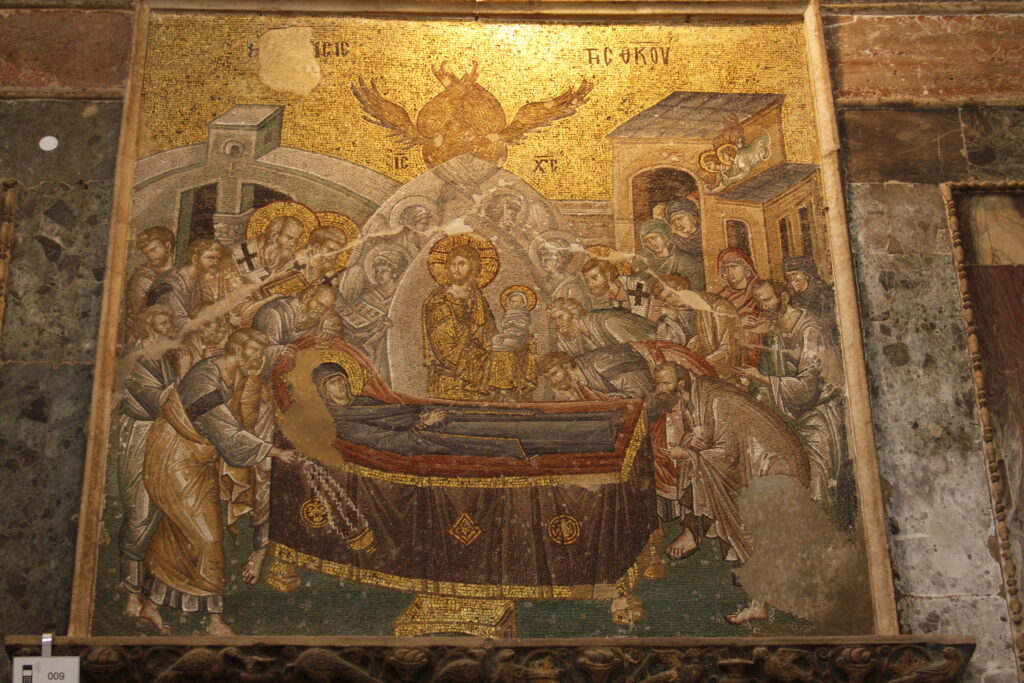
The scene reverses one of Christianity’s most familiar visual relationships. In countless images, Mary holds the infant Jesus. Here, Christ holds an infant-like figure representing Mary’s departed soul. The composition expresses the Byzantine belief that Christ has come to receive his mother and carry her into heaven.
The Dormition itself does not appear in the canonical Gospels. The tradition developed gradually in early Christianity, and August 15 had become established as its feast day by the sixth century. Although earlier depictions of the Dormition survive, the Chora mosaic stands among the most accomplished and visually powerful examples of the theme in Byzantine art. Its monumental scale, refined composition and remarkable preservation make it one of the defining images of the Palaiologan artistic tradition.
The Chora has an equally complex history. Although the monastery’s origins reach much further back, the surviving structure reflects several Byzantine rebuilding campaigns. Metochites transformed it in the early 14th century, commissioning an extraordinary program of mosaics and frescoes devoted largely to Christ, the Virgin and the Christian idea of salvation.
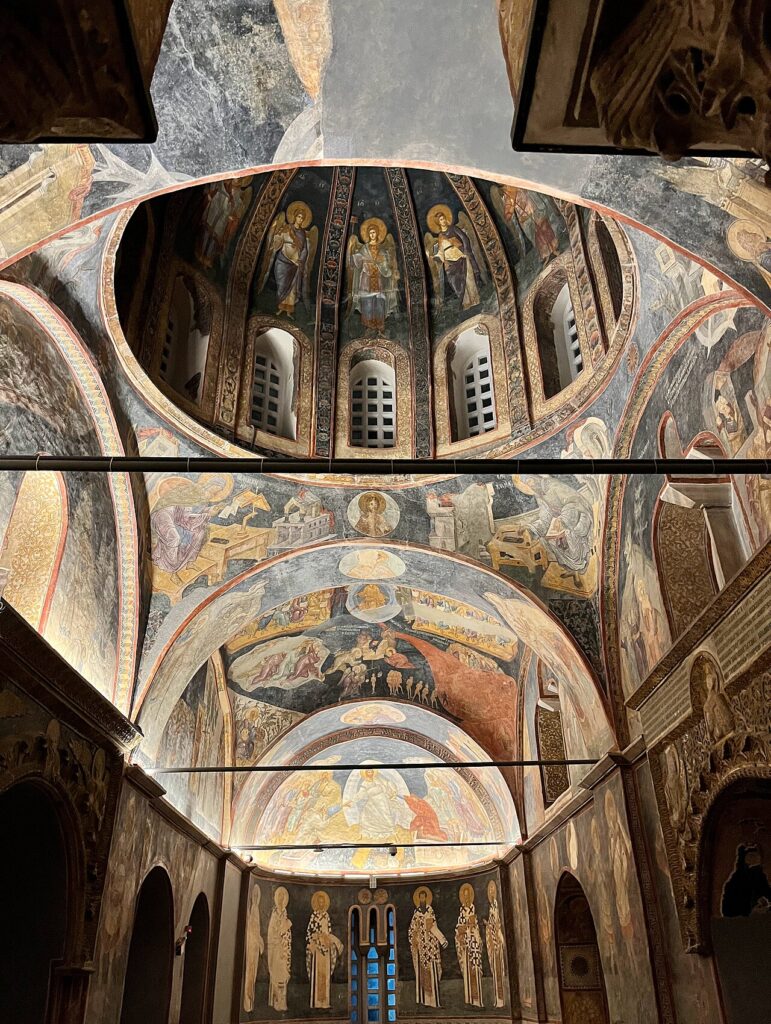
After the Ottoman conquest of Constantinople, the church remained in Christian use for several decades before Grand Vizier Hadım Ali Pasha converted it into a mosque in 1511. Rather than being systematically destroyed, much of its Christian imagery was gradually concealed with plaster, limewash, paint, or wooden coverings. Some mosaics remained visible even during the Ottoman period.
Beginning in the late 1940s, the Byzantine Institute of America undertook a major conservation campaign, removing later layers and revealing the medieval decoration beneath. The building subsequently operated for decades as the Kariye Museum before returning to mosque status and reopening for worship in May 2024.
Today, the Dormition remains where Byzantine artists placed it nearly 700 years ago: Mary asleep below, Christ standing above her, and a tiny swaddled soul at the center of one of Istanbul’s most extraordinary surviving medieval images.
