20 February 2026 The Future is the Product of the Past

Oman discovers fort dating back to the 5th century in North Al Batinah

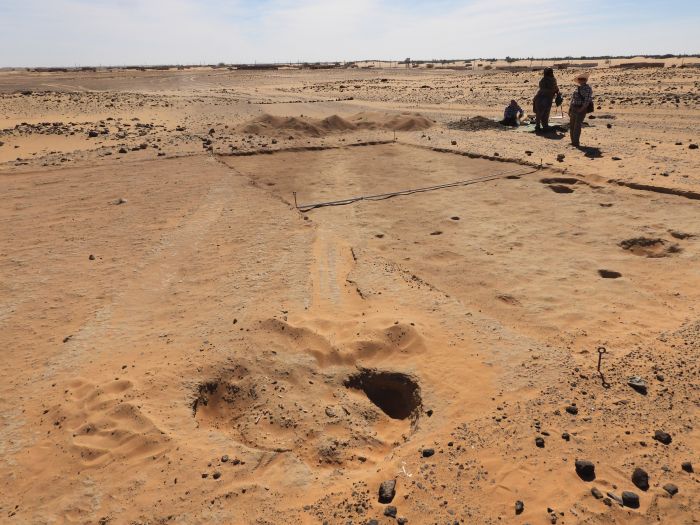
A fort dating back to the 5th century has been discovered at Oman’s Al Fulaij archaeological site in North Al Batinah Governorate.

The site includes furnaces dating back to the fifth century AD, and burials from the third and first millennium BC. The facilities of the fort were surrounded by circular towers.

The Ministry of Heritage and Tourism said in a statement: “Archaeological excavations are continuing which are being carried out by the Ministry of Heritage and Tourism, in cooperation with a joint archaeological mission from Sultan Qaboos University and the British University of Durham, at the Al Fulaij archaeological site in the Wilayat of Saham, where the facilities of a square fort surrounded by circular towers were discovered, “

Oman discovers fort dating back to the 5th century
Oman’s Al Fulaij archaeological site in North Al Batinah Governorate.

During a meeting with the Director of the Department of Archaeological Surveys and Excavations with Dr. Seth from the University of Durham in Britain, the results of the archaeological excavation will continue until the end of this month. The archaeological site includes furnaces dating back to the fifth century AD, and burials from the third and first millennium BC.

Earlier in January this year, a large settlement dating back more than 4,000 years was discovered in Oman’s Wilayat of Rustaq, South of Al Batinah Governorate.


📣 Our WhatsApp channel is now LIVE! Stay up-to-date with the latest news and updates, just click here to follow us on WhatsApp and never miss a thing!!


The sophisticated settlement included a large number of huge buildings and burial sites and was discovered in the Al Tekha area, located on the edge of the Al Hajar Mountains, by the joint archaeological mission between the Archaeological Department of the College of Arts and Social Sciences at Sultan Qaboos University, and the Italian University of Pisa, under the supervision of the Ministry of Heritage and Tourism.

Related Articles

18,000 years ago, late Pleistocene humans may have hatched and raised the “World’s Most Dangerous Bird.”

2 October 2021

2 October 2021

Researchers say the eggshell is an understudied archaeological material that has the potential to clarify past interactions between humans and...

The earliest manuscript of Gospel about Jesus’s childhood discovered in Germany

14 June 2024

14 June 2024

A newly deciphered manuscript dating back 1,600 years has been determined to be the oldest record of Jesus Christ’s childhood,...

A 2,000-Year-Old Mystery Unlocked: Scholar Cracks the “Cryptic B” Writing of the Dead Sea Scrolls

13 December 2025

13 December 2025

For over seventy years, one of the last undeciphered writing systems of the Dead Sea Scrolls—known as Cryptic B—has puzzled...

In Ryazan, the first birch bark letters were discovered

13 September 2021

13 September 2021

The first birch bark letters were found at the Vvedensky excavation site in the Kremlin in Pereyaslavl Ryazan (modern Ryazan)....

Rare waka unearthed from New Zealand River, after being hidden for 153 years

16 June 2023

16 June 2023

A waka -the traditional canoe of the Maori people- believed to be over 150 years old has been salvaged from...

2,000-Year-Old Artifacts Found at Swat’s Butkara Site in Pakistan, Including Coins and Kharosthi Inscriptions

14 February 2025

14 February 2025

Excavations at the Butkara Stupa, located near Mingora in Swat, Pakistan, have uncovered significant findings, including two-thousand-year-old coins, pottery, and...

Europe’s Oldest Blue Pigment Found in Stone Age Paint Box

30 September 2025

30 September 2025

Archaeologists in Germany have uncovered the earliest evidence of blue pigment ever used in Europe, rewriting our understanding of Stone...

New study reveals Dog ancestry can be traced back to two separate wolf populations

30 June 2022

30 June 2022

An international group of geneticists and archaeologists with participation of the University of Potsdam have found that the ancestry of...

Archeologists Unearth Spectator snacks from the Roman Period in Colosseum

28 November 2022

28 November 2022

An excavation of the Colosseum’s sewer systems has uncovered a selection of spectator snacks from the Roman Period. It appears...

Archaeologists reveal 4,000-year-old rock-cut tomb, artifacts in Saqqara

8 January 2024

8 January 2024

A team of Egyptian and Japanese archaeologists has unveiled a rock-cut tomb believed to be more than 4,000 years old...

Ancient Rituals and ‘Devil’s Money’: Elite Pagans’ Medieval Cult Site Unearthed at Hezingen

15 February 2025

15 February 2025

Researchers in the eastern Netherlands have uncovered a medieval cult site featuring structural remains and a hoard of gold and...

Detector finds rare Merovingian gold ring refers to a previously unknown principality

22 February 2024

22 February 2024

A metal detectorist has unearthed a very rare, 1,500-year-old Merovingian gold ring made of 22-carat gold at Emmerlev in Southwest...

The Entire Genome Of 35,000-Year-Old Skull From Romania Sequenced “Peştera Muierii 1”

24 May 2021

24 May 2021

Researchers have successfully sequenced the whole genome from the skull of Peştera Muierii 1, women who lived in today’s Romania...

Roman girl adorned with 1800-year-old jewelry found in a lead coffin on Mount Scopus

9 April 2023

9 April 2023

“After the destruction of the Jerusalem Temple and the exodus of the Jewish population, late Roman Jerusalem—renamed Aelia Capitolina—had a...

4,000-Year-Old Flint Arrow Lodged in Human Rib Reveals Direct Evidence of Prehistoric Violence

18 July 2025

18 July 2025

In a discovery shedding light on prehistoric human conflict, archaeologists have found a flint arrowhead embedded in a human rib...