
23 June 2026 The Future is the Product of the Past

3500-year-old menhir discovered in Mahbubabad, India

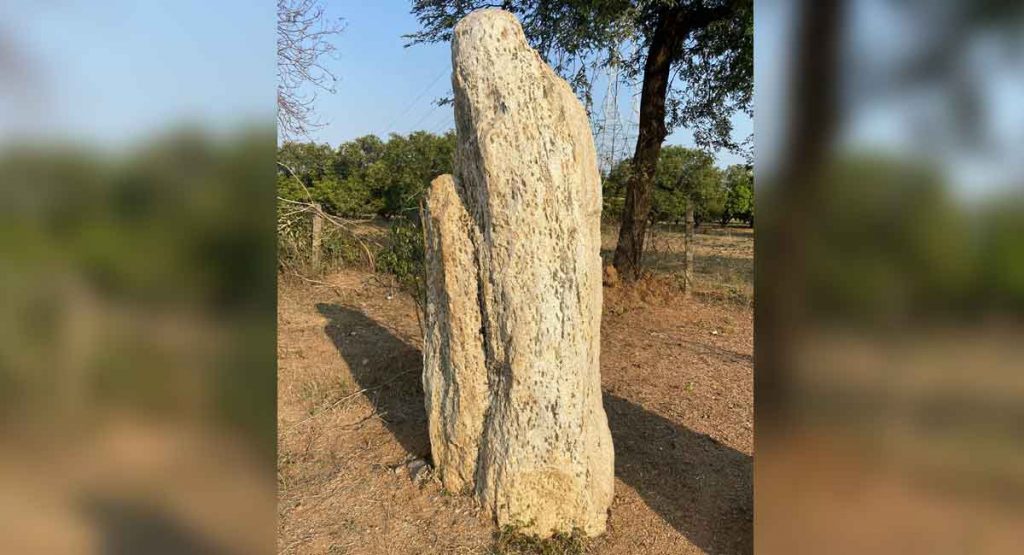
Six feet in height stone, also called a menhir, was found on the roadside of Ellarigudem, a hamlet of Beechrajupally village of Maripeda Mandal in the Mahabubbad region of India.

Archaeologist Dr. E. Sivanagi Reddy, who is the CEO of Pleach India Foundation, said it was noticed during his survey of archaeological and heritage remains in Maripeda Mandal on Sunday under ‘Preserve Heritage for Posterity’ program.

Dr. E. Sivanagi Reddy said it was a chance found during a survey of archaeological and heritage remains in Maripeda Mandal that was conducted.

“The menhir is 6 feet in height and 3 feet in diameter, buried 3 feet deep. It was erected in the memory of a dead person”.

Former director of the geological survey of India (GSI) Dr. K Mahender Reddy said that the menhir is made of Leuco granite stone (weathered and comprises almost negligible mafic minerals) stone category and holds historical importance.


📣 Our WhatsApp channel is now LIVE! Stay up-to-date with the latest news and updates, just click here to follow us on WhatsApp and never miss a thing!!


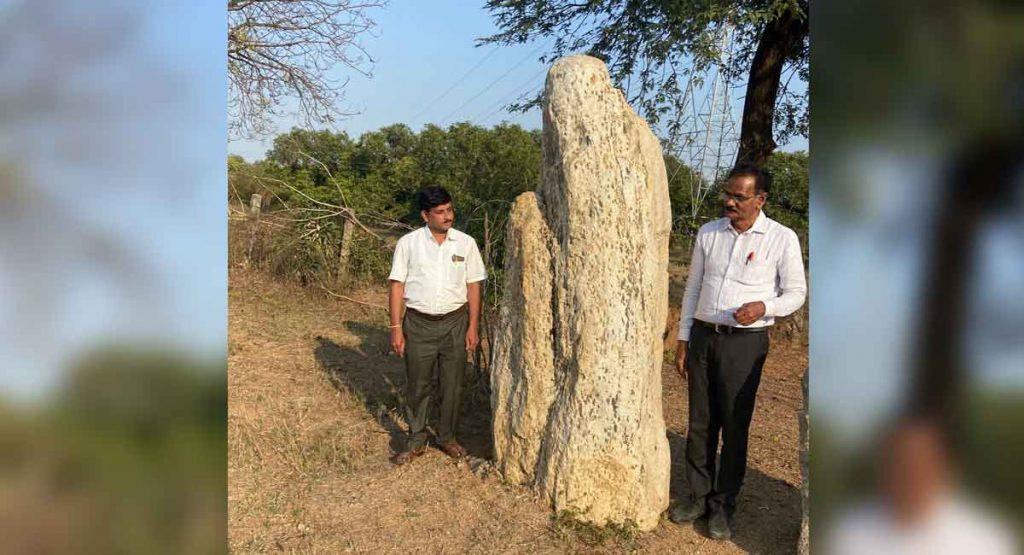
Archaeologist Dr Sivanagi Reddy (right) and D.R. Shyamsundar Rao, designs in-charge, Buddhavanam project, who was accompanying the former, stand beside the menhir found in Mahbubabad district. — DC Image
Archaeologists Dr. Sivanagi Reddy (right) and D.R. Shyamsundar Rao, designs in-charge, Buddhavanam project, who was accompanying the former, stand beside the menhir found in Mahbubabad district. Photo:  ARRANGEMENT

He said that Sriramoju Haragopal, convenor, Kotha Telangana Charitra Brindam, has confirmed that the menhir belongs to the Megalithic period and its peculiarity lies in its white colour.

Dr. Sivanagi Reddy sensitized the local community on the archaeological significance of the menhir and urged them to preserve it by arranging for a barricade around it along with a plaque embossed with its details.

What is Menhir?

A menhir, standing stone, orthostat, or lith is a large man-made upright stone. It is believed that the practisers of the megalithic faith traveled via the sea, as the mass majority of menhirs are located on coasts, islands, and peninsulas. They are widely distributed across Europe, Africa, and Asia, but are most numerous in Western Europe. For more…

Related Articles

Archaeologists find the earliest evidence Maya sacred calendar in the Guatemalan pyramid

14 April 2022

14 April 2022

Archaeologists identified two plaster fragments depicting a date that the Maya civilization called ‘7 deer’ and was part of the...

Researchers Define the Borders of El Argar, the First State-Society in the Iberian Peninsula

18 March 2025

18 March 2025

Recent research conducted by scholars from the Autonomous University of Barcelona (UAB) and the Max Planck Institute for Social Anthropology...

Outstanding Bronze Age artifacts discovered in the Auvergne-Rhône-Alpes region of France

23 August 2021

23 August 2021

Hundreds of bronze objects have been discovered buried in pottery in the Auvergne-Rhône-Alpes region of France. The research team, led...

The rich-poor distinction draws attention in the nutrition of the inhabitants of the Ancient City of Pergamon

27 November 2021

27 November 2021

The hegemony of wealth to the poor, arising from the ruler, elite structure, property ownership, unjust acquisition, and distribution of...

The Metropolitan Museum of Art Celebrates 151th Anniversary of Its Establishment

13 April 2021

13 April 2021

The Metropolitan Museum of Art, one of the few museums in the world, celebrates the 151st anniversary of its establishment....

Rare African Script Offers Clues to the Evolution of Writing Systems

4 February 2022

4 February 2022

The world’s very first invention of writing took place over 5000 years ago in the Middle East, before it was...

‘Lost’ 4,000-year-old wedge tomb rediscovered in Ireland

22 January 2024

22 January 2024

A “lost” 4,000-year-old wedge tomb has been rediscovered in County Kerry, in the peninsular southwest region of Ireland. The megalithic...

Archaeologists find a 5,000-year-old piece of wood in Orkney, which they describe as “astonishing”

10 August 2021

10 August 2021

Archaeologists continue to make surprising discoveries in Orkney. Although organic materials are quite difficult to find, archaeologists have found a...

Archaeologists may have discovered the site where Otto the Great, founder of the Holy Roman Empire, died

5 October 2023

5 October 2023

Archaeologists believe they have found the site where Emperor Otto I (936-973), known as the Great, founder of the Holy...

Bronze Age Ceremonial Sword Found in Håre in Vestfyn will be on Display Soon

13 March 2021

13 March 2021

Archaeologists excavating the village of Håre on the island of Funen in Denmark have discovered an ornate Bronze Age sword...

Mystery of the 1,700-year-old Mosaic Solved: The Medallion in the Mosaic uncovered to be the Symbol of a Roman Military Unit

10 August 2024

10 August 2024

The mystery of the 1,700-year-old mosaic, which was found during excavations in Amasya province in northern Turkey 11 years ago...

Teacher unearthed stone with ancient ogham writing from Ireland in Coventry garden

9 May 2024

9 May 2024

A geography teacher, Graham Senior, stumbled across a rock with mysterious incisions while tidying his overgrown garden in Coventry, England. ...

Scientists Use Artificial İntelligence to Study Ancient Australian Rock Art

1 April 2021

1 April 2021

Rock art is the oldest surviving human art form. Throughout Australia, petroglyphs are part of the life and customs of...

In the city of Gods and Goddesses Magnesia, Zeus Temple’s entrance gate found

26 September 2021

26 September 2021

During an excavation in the ancient city of Magnesia, located in the Ortaklar district of Germencik in Turkey’s Aegean province...

Iron Age comb found made from human skull in UK

2 March 2023

2 March 2023

Researchers from the London Archaeological Museum (MOLA) determined that an Iron Age comb they found during an archaeological dig that...