
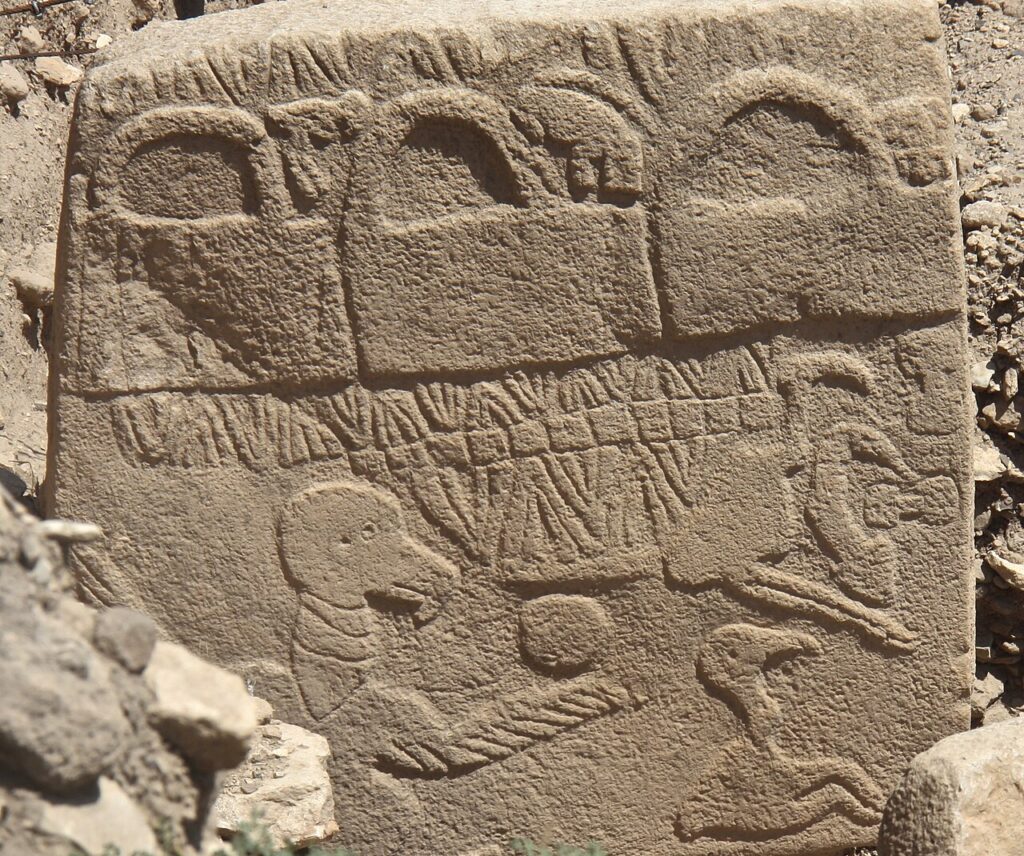
A new study compares the carved symbolism of Göbekli Tepe’s Vulture Stone with ritual imagery from the Trypillia culture, suggesting that early farming societies in Anatolia and Eastern Europe may have shared cosmological ideas about time, death, sacred space and the movement of the heavens.
At Göbekli Tepe, the famous Vulture Stone has never been easy to read. Its carved birds, snakes, scorpion, abstract signs and headless human figure have inspired competing interpretations for decades. Was it a scene of death ritual, an astronomical code, a mythic narrative, or something more complex? A new study argues that the answer may not lie in choosing one explanation over another, but in seeing the pillar as part of a wider symbolic system linking architecture, timekeeping and cosmology across early farming societies.
A new reading of one of Göbekli Tepe’s most debated pillars
The study, published in the International Journal of Culture and History by Oleksandr Zavalii, focuses on the cosmological aspects of Göbekli Tepe’s T-shaped stelae and compares them with religious symbolism from the Trypillia culture of Ukraine. Its central claim is cautious but ambitious: the carvings at Göbekli Tepe may preserve not isolated symbols, but a structured sacred language involving solar cycles, lunar rhythms, animal imagery, geometry and sacred space.
Göbekli Tepe, dated to the Pre-Pottery Neolithic period, roughly 9600 to 8200 BCE, already occupies a special place in archaeology as one of the earliest known monumental ritual landscapes. Zavalii’s paper revisits several pillars, especially Stele 43, known as the Vulture Stone, along with Steles 33, 18, 20 and 1. Rather than treating the carvings as decoration, the study reads them as components of a broader visual grammar.
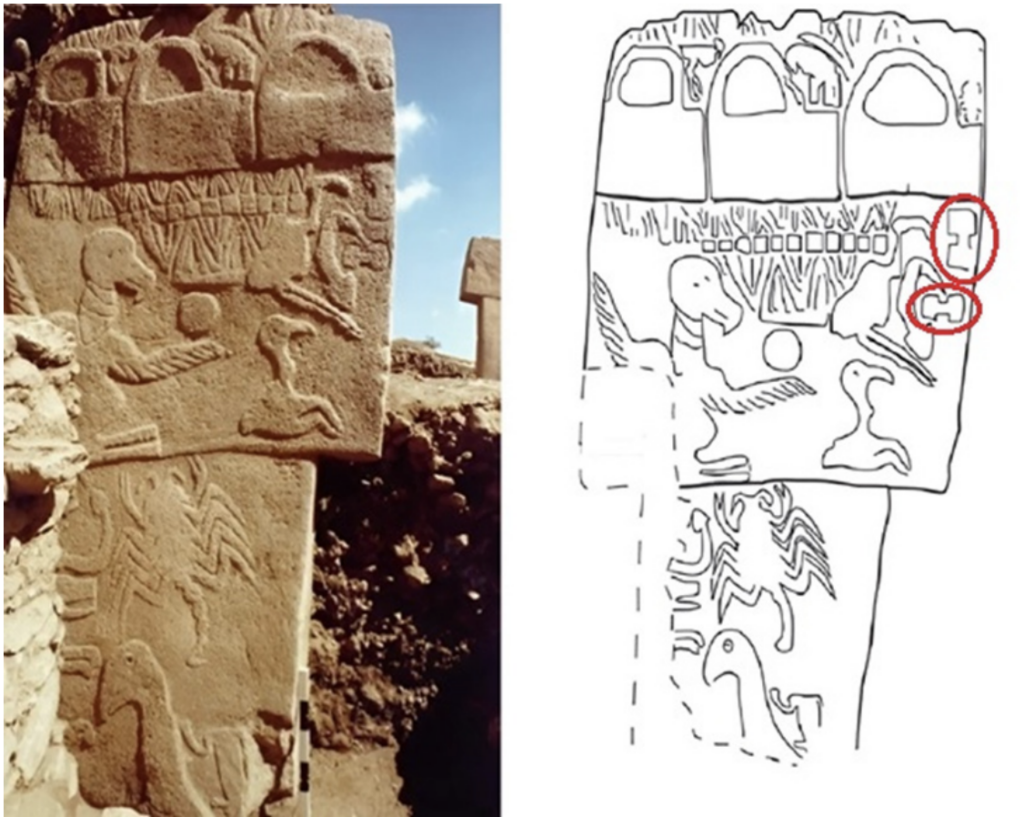
On Stele 43, the upper register includes bird figures, three arch-like forms, a central circle, rectangular elements and H-shaped signs. The lower register contains animals more closely associated with the earth or underworld, including a scorpion, snake, boar, waterfowl and a headless human figure. Zavalii suggests that this division may reflect a two-level cosmos, with celestial imagery above and chthonic or mortal imagery below.
Calendar, ritual, or death symbolism?
This is not the first time the Vulture Stone has been linked to the sky. In 2017, Martin Sweatman and Dimitrios Tsikritsis proposed that Pillar 43 encoded an astronomical “date stamp” around 10,950 BCE, connected to the debated Younger Dryas impact hypothesis. Their argument interpreted some animal figures as constellations and suggested that Göbekli Tepe may have recorded cometary encounters.
A later 2024 study by Sweatman extended this astronomical model, proposing that V-shaped marks on Pillar 43 could represent a lunisolar calendar with 12 lunar months and 11 extra days, potentially making it one of the oldest known examples of such time reckoning.
But these astronomical readings remain controversial. Researchers associated with the German Archaeological Institute have warned that Göbekli Tepe’s buildings were rebuilt, modified and possibly roofed, which complicates claims that they functioned as open sky observatories. They also argued that focusing too heavily on a single pillar risks removing the imagery from its wider archaeological and iconographic setting.
This is where Zavalii’s study takes a different route. It does not depend entirely on matching the carvings to modern constellations or a single catastrophic event. Instead, it looks for repeated patterns across several pillars and compares them with later symbolic systems in Eastern Europe. The result is not a rejection of astronomical interpretation, but a broader version of it.
The number eleven and the structure of sacred time
One of the study’s most interesting observations concerns the repeated appearance of numerical patterns. Zavalii notes that Stele 43 contains eleven rectangular elements, while certain Göbekli Tepe enclosures also include eleven T-shaped pillars. In his interpretation, this may refer to divisions of the year or sacred intervals between major solar events.
Stele 33 strengthens this argument, according to the paper. Its surface contains wavy lines interpreted as snakes, together with animal and abstract motifs. Zavalii draws attention to the numbers two, three, eleven and thirteen, suggesting that they may encode duality, solar structure and lunar cycles. The thirteen snake heads, in this reading, could evoke the lunar year, while eleven may relate to solar calendar organization.
This proposal overlaps partly with earlier calendar theories, especially Sweatman’s 2024 lunisolar model, but it shifts the emphasis. Instead of treating the Vulture Stone as a precise scientific record, Zavalii frames it as a sacred cosmological diagram. In that model, numbers, animals, circles, crescents and architectural alignments work together as a symbolic system.
From Göbekli Tepe to Trypillia
The most distinctive part of the new study is its comparison with the Trypillia culture, which flourished millennia later in parts of modern Ukraine, Moldova and Romania. Zavalii argues that Trypillian ritual objects, temple layouts and ceramic motifs show parallels with Göbekli Tepe’s symbolic world.
The study gives special attention to the Nebelivka Temple and Trypillian ritual ceramics. It compares Göbekli Tepe’s H-shaped signs with Trypillian “binocular-shaped” ritual objects, suggesting that both may express ideas of duality, equinoxes or the division of sacred time. It also compares circular and crescent motifs, solar-lunar symbolism and the organization of sacred space.
This does not mean that the study proves a direct line of transmission from Göbekli Tepe to Trypillia. The chronological gap is large, and archaeological continuity across such distance remains difficult to demonstrate. A safer reading is that Zavalii identifies a set of recurring symbolic solutions used by early agricultural societies to organize the relationship between sky, season, ritual and community.
Göbekli Tepe Still Resists a Single Explanation
Other theories remain important. Klaus Schmidt and later researchers emphasized Göbekli Tepe’s role in ritual gathering, ancestor symbolism and the social power of monument building. Studies of headless figures, vultures and human remains have also linked the site to death ritual, skull cult practices and concepts of transformation after death.
Giulio Magli proposed another astronomical possibility, suggesting that the enclosures may have been oriented toward the appearance of Sirius in the southern sky.
Taken together, these theories show why Göbekli Tepe resists a single explanation. Its pillars may have carried several meanings at once: social, ritual, mortuary, astronomical and mythological. For prehistoric communities, these categories may not have been separate at all.
The new study is valuable because it places Göbekli Tepe within a wider conversation about how early societies made time visible. Whether every proposed parallel with Trypillia proves correct or not, the argument draws attention to something increasingly clear: the builders of Göbekli Tepe were not simply carving animals into stone. They were creating a dense symbolic environment in which architecture, memory, death, renewal and the movement of the heavens may have belonged to the same sacred order.
Zavalii, O. (2025). Cosmological aspects of the stelae of Göbekli Tepe and their parallels with the religious symbolism of the Trypillia culture. International Journal of Culture and History, 12(1), 1–55. https://doi.org/10.5296/ijch.v12i1.22688
Cover Image Credit: Pillar 43, Enclosure D: the “Vulture Stone”. Sue Fleckney – Public Domain
