

A small cylindrical stone discovered inside the mouth area of a roughly 2,300-year-old Qin burial in China has raised an unusual archaeological question: could it represent an early attempt at a dental implant? A new bioarchaeological study has examined that possibility in detail, but the evidence tells a more complicated story.
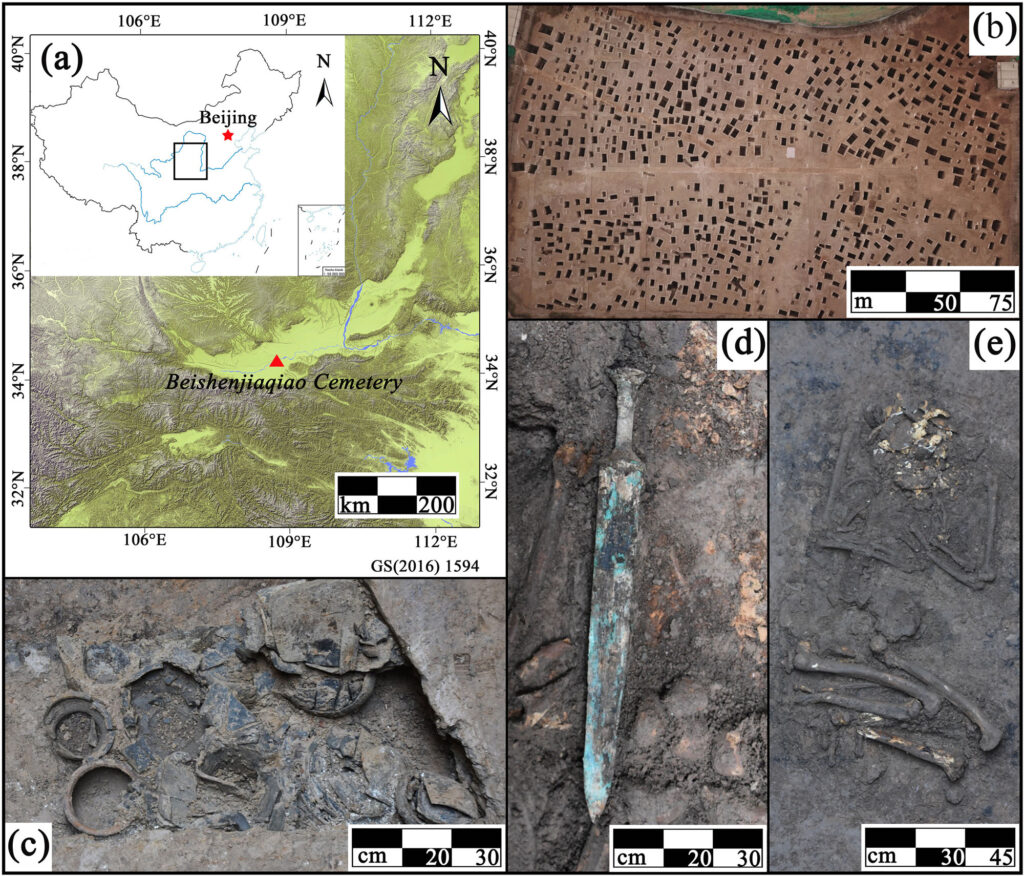
The object came from Burial M280 at the Beishenjiaqiao cemetery in Xi’an, Shaanxi Province, a cemetery associated with Qin communities during China’s Warring States period. Researchers reported the stone within a pathological cavity around the upper right second molar, a position that initially made dental function worth investigating.
Published on September 10 in npj Heritage Science, the study was conducted by researchers from Jilin University, the Xi’an Institute of Cultural Relics Protection and Archaeology, and Zhengzhou University. Rather than beginning with the assumption that the object served as an implant, the team compared several possible explanations for how a stone could have ended up in such an unusual location.
A stone in an unexpected place
Chemical composition and density measurements indicated that the object consists of carbonate rock. Its cylindrical shape and position within the diseased tooth socket made the possibility of an ancient prosthetic or implant-like device particularly intriguing.
If someone had inserted the object during life and used it for a significant period, however, researchers would expect the surrounding bone and the stone itself to preserve traces of that interaction.
The team therefore examined the object and jaw through macroscopic observation, radiography and microscopy while also considering the archaeological context. They looked for signs of deliberate shaping, a mechanism that could have held the object in place, wear produced by chewing, and changes in the surrounding bone that might indicate the body had adapted to a foreign object.
Those expected signals were absent.
The researchers found no fixation features or clear evidence that craftspeople had intentionally prepared the stone for dental use. They also identified no masticatory wear on its surface and no adaptive bone response that would normally strengthen the case for prolonged use during the person’s lifetime.
The diseased tooth socket adds another clue
The condition of the jaw provided another important part of the puzzle. The area showed severe alveolar abscess formation as well as loss of the buccal root.
Taken together, the pathological damage and the absence of wear, modification, and bone adaptation make sustained use as a functioning dental implant or prosthesis difficult to support, according to the study. The authors do not simply replace that interpretation with another definitive answer, however.
One possibility is that someone deliberately placed the stone in the mouth or tooth cavity after death. Such an act could potentially have carried a funerary or other symbolic meaning, although the available evidence does not establish that explanation.
A less dramatic scenario also remains possible. Soil movement, decomposition or other post-burial processes may have moved the stone into the cavity long after the individual had been buried.
Researchers cannot confidently separate those possibilities because archaeologists did not document the stone’s precise relationship with the surrounding sediment and bone before removing it. That missing contextual information now limits how far the interpretation can go.
More than a question about ancient dentistry
Beishenjiaqiao lies in Xi’an’s Yanta District on the Guanzhong Plain and represents a cemetery used by Qin communities during the Warring States period, generally dated to approximately 475–221 BCE. Previous research at the cemetery has examined dozens of human remains to reconstruct the biological history and lives of the people buried there.
The new study therefore does more than address one unusual stone. It highlights a broader problem in bioarchaeology: objects found beside or inside human remains can easily appear connected to medical treatment, ritual behavior, or personal practices when later movement inside a grave may offer an equally plausible explanation.
For the researchers, the M280 case demonstrates why extraordinary interpretations require several independent forms of evidence. The stone’s location made an ancient dental implant a reasonable possibility to investigate. Detailed analysis, however, shows why location alone cannot reveal what an archaeological object once meant or how people used it.
The mystery has not entirely disappeared. The study narrows the possibilities, but one question remains unresolved: why did a cylindrical stone end up inside a diseased tooth cavity in a Qin burial more than two millennia ago?
Study: Wang, S., Zhang, X., Wang, C., et al. “Differential bioarchaeological assessment of an intraoral stone object from a Warring States-period Qin burial, China.” npj Heritage Science (2026). DOI: 10.1038/s40494-026-02987-6.
