
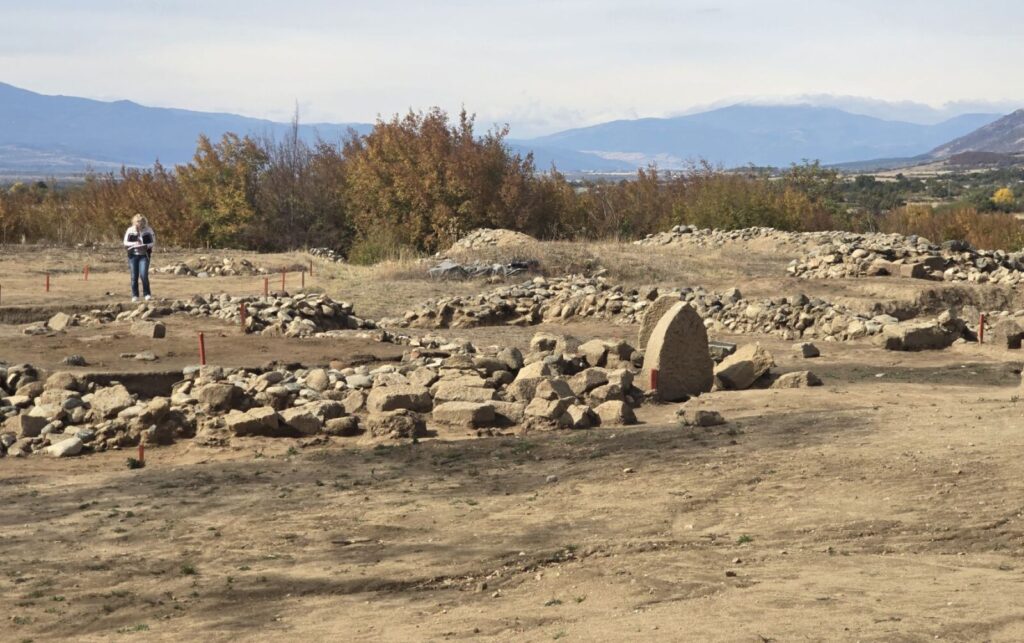
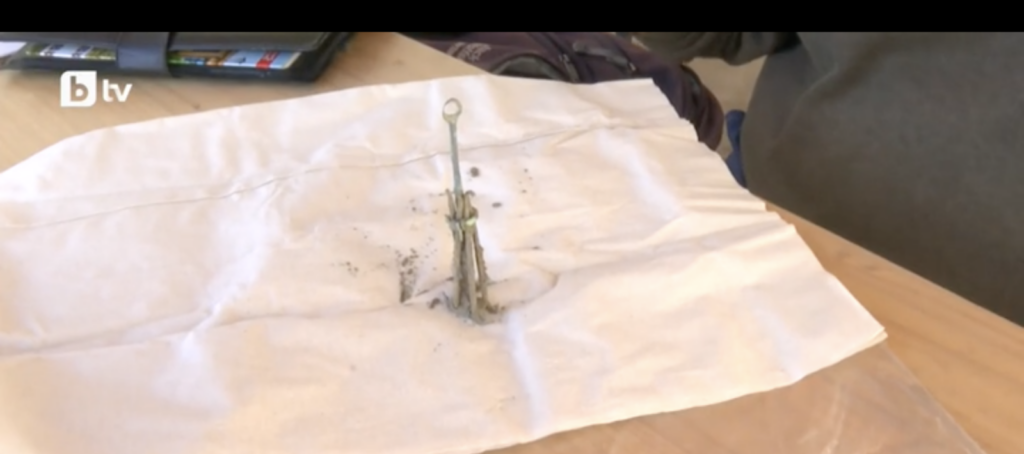
Archaeologists excavating an ancient Thracian city in southern Bulgaria have discovered an unusual bronze mechanism inside a temple. The object, featuring a ring and four carefully fashioned hooks, was found near the village of Vasil Levski, where researchers are investigating a fortified settlement that may have served as the first capital of the Odrysian Kingdom.
The settlement dates primarily to the sixth and fifth centuries BC and includes monumental stone architecture, defensive walls, and religious buildings. Excavations are led by Associate Professor Kostadin Kisyov, director of the Regional Archaeological Museum in Plovdiv, who has investigated the site intermittently for approximately three decades.
A Bronze Mechanism with an Unknown Purpose
Speaking to Bulgarian broadcaster bTV, Kisyov described the discovery as a bronze mechanism unlike anything his team had previously encountered. Found in the entrance chamber, or pronaos, of a temple, it consists of a ring supporting four hooks with carefully formed, backward-pointing barbs resembling those of fishing hooks.
Kisyov emphasized the precision of its construction and suggested that the mechanism might originally have supported hanging lamps. Such an arrangement could have accommodated lamps made from clay, bronze, or glass. However, archaeologists have not discovered the chains that would have been needed to suspend them.
Another possibility is that the mechanism was associated with fishing. Kisyov noted that the prominent barbs resemble those found on fishing hooks, although their unusually large size makes the interpretation more complicated.
The settlement lies near the Stryama River, a tributary of the Maritsa, but the mechanism may have been unsuitable for fishing in relatively small waterways. Kisyov suggested that equipment of this size might instead have been used in larger rivers, such as the Maritsa or Danube, or at sea. Neither interpretation has been confirmed, and the object’s original function remains unknown.
The Golden City of the Thracians
Kisyov has also drawn attention to the scale and sophistication of the ancient settlement, which occupies a mountain terrace along the southern foothills of the Balkan Mountains. According to Karlovo Municipality, the archaeological complex covers more than three hectares and includes a fortified citadel and early Thracian temple architecture.
The site is sometimes called the “Golden City of the Thracians,” a modern designation associated with its unusually decorated roof tiles. Kisyov explained that the tiles feature several protective layers, including red and black coatings and a golden-colored surface produced using a mineral pigment. Some have survived remarkably well despite approximately 2,500 years of exposure.
The architecture also reveals connections with the ancient Greek world. Massive stone blocks and construction techniques resemble practices known from Greek settlements, while imported amphorae from Chios, Samos, and Thasos indicate that the community had access to Aegean wine and olive oil.
Kisyov believes the settlement’s monumental buildings may indicate that it functioned as an early royal center, potentially associated with Teres I, a ruler linked to the formation of the Odrysian Kingdom. However, the city’s ancient name remains unknown, and its identification as the kingdom’s first capital has not been conclusively established.
Temples and Religious Life in Ancient Thrace
Excavations have also revealed evidence of a substantial religious complex. Researchers have identified two architecturally similar buildings, with the second temple still under investigation. Their close structural relationship suggests that they may have formed part of a larger sacred precinct.
Kisyov has suggested that the buildings could have been dedicated to different deities, although archaeologists have not yet established which gods were worshipped there. Karlovo Municipality also reports evidence of an earlier Thracian sanctuary dating to the ninth century BC, indicating a longer history of religious activity at the location.
The bronze mechanism adds an intriguing element to this setting, but its discovery inside a temple does not necessarily mean that it had a ritual function. Further examination will be needed to determine whether it belonged to the building’s furnishings or served an entirely different purpose.
