
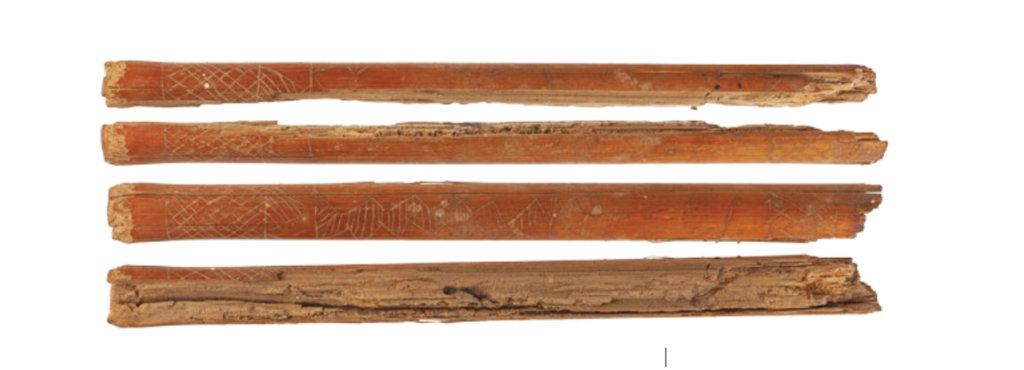
First of its kind in the Southern Levant, the Middle Bronze Age object still keeps its purpose secret.
A slender reed fragment found deep inside a cave in the Judaean Desert has emerged as one of the most unusual objects known from the Middle Bronze Age Southern Levant. It is small, fragile, and incomplete, yet its incised surface carries a set of deliberate designs that have survived for nearly 3,700 years in the dry darkness of Wadi Murabbaʿat Cave 2.
A new study published in Tel Aviv identifies the object as the first known reed item from this period ever reported in the Southern Levant. Radiocarbon dating places it between 1743 and 1542 BCE, in the second half of the Middle Bronze Age. Its exact purpose remains unresolved, but the evidence points to an object that was handled, decorated, and possibly connected to a ritual or funerary setting.
The reed was discovered during the 2003–2007 survey of the Wadi Murabbaʿat cave complex, on the surface of the innermost chamber of Cave 2. The cave lies in the northern Judaean Desert, about 5 kilometers upstream from the Dead Sea shore, in a landscape where organic material can survive under exceptionally dry conditions.
The new study, published in Tel Aviv: Journal of the Institute of Archaeology of Tel Aviv University, was written by Matthew Susnow, Roi Porat, and Uri Davidovich of the Hebrew University of Jerusalem.
A rare object from a cave better known for later finds
Wadi Murabbaʿat is famous mainly for later-period discoveries, including ancient documents and artefacts that drew scholarly attention in the 1950s after looted material began appearing on the antiquities market in Bethlehem and Jerusalem. The caves were investigated in 1952 by Roland de Vaux and Gerald Lankester Harding, and later revisited through surveys.
The decorated reed belongs to a much older and far rarer horizon. Middle Bronze Age evidence from the Judaean Desert is limited, and the arid regions east and south of the Mediterranean zone were largely outside the main settled landscapes of the period. The study notes that, apart from Wadi Murabbaʿat and the Naḥal Ẓeʾelim cave complex, very few cave sites in the Judaean Desert have yielded material from this time.
That makes the reed more than an isolated curiosity. It comes from a remote cave system at the edge of the settled world, more than 20 kilometers from major centers such as Jerusalem or Jericho. Its presence suggests a brief but purposeful human activity in a place not normally associated with Middle Bronze Age settlement.
A decorated reed, not a simple plant stem
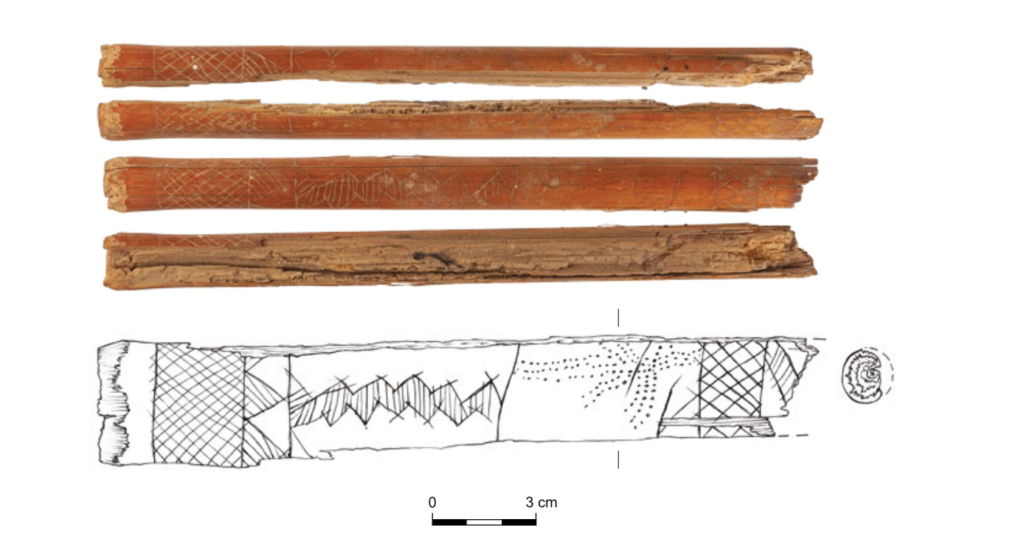
The object is preserved to a length of about 20 centimeters and has a diameter of roughly 1.3 centimeters. It was made from a reed species that probably grew locally in freshwater oases along the western shore of the Dead Sea, such as Phragmites australis or Arundo donax.
Its surface is covered with incised decoration. The visible motifs include net patterns, zigzag lines, diagonal lines, dots, and possibly a schematic tree. The incisions seem to have extended around the circumference of the reed, even though part of the object is now missing.
The work is not perfectly regular. Some lines are uneven, others cross beyond their intended endpoints, and the spacing is not always controlled. That detail is revealing. The object was probably not made in a professional workshop. It seems more likely to have been shaped and decorated locally by someone using familiar visual motifs on a simple organic material.
Microscopic analysis also detected wear on the preserved end of the reed, apparently from repeated rubbing or handling. Traces of black material may represent adhesive, raising the possibility that another object was once attached to it. If so, the attachment was probably not functional in a practical sense. The reed would have been too fragile to serve as the handle of a tool or weapon.
Familiar Bronze Age patterns on an unexpected material
The reed is unique because of its material and preservation, not because its designs are alien to the period. Net patterns and zigzags were widely used in Middle Bronze Age visual culture across the Southern Levant.
Similar motifs appear on bone inlays, pins, pottery, metal objects, scarabs, and wooden vessels from sites such as Jericho, Megiddo, Tel Aphek, Tel Ifshar, Tell el-ʿAjjul, and Byblos. In other words, whoever decorated the reed was drawing on a visual language that was already familiar across the region.
The possible tree motif adds another layer. Tree imagery, especially palm-like forms and branches, was common in Bronze Age iconography and often carried religious or symbolic associations. The study does not assign a fixed meaning to the reed’s decoration, but the motifs place it within a broader artistic world shared by Middle Bronze Age communities.
The object therefore opens a narrow but vivid window onto materials that archaeology usually loses. Reeds were likely used for many purposes in antiquity, from mats and baskets to screens, roofs, writing materials, musical instruments, and other everyday or symbolic objects. In the Southern Levant, however, such objects almost never survive from the Middle Bronze Age.
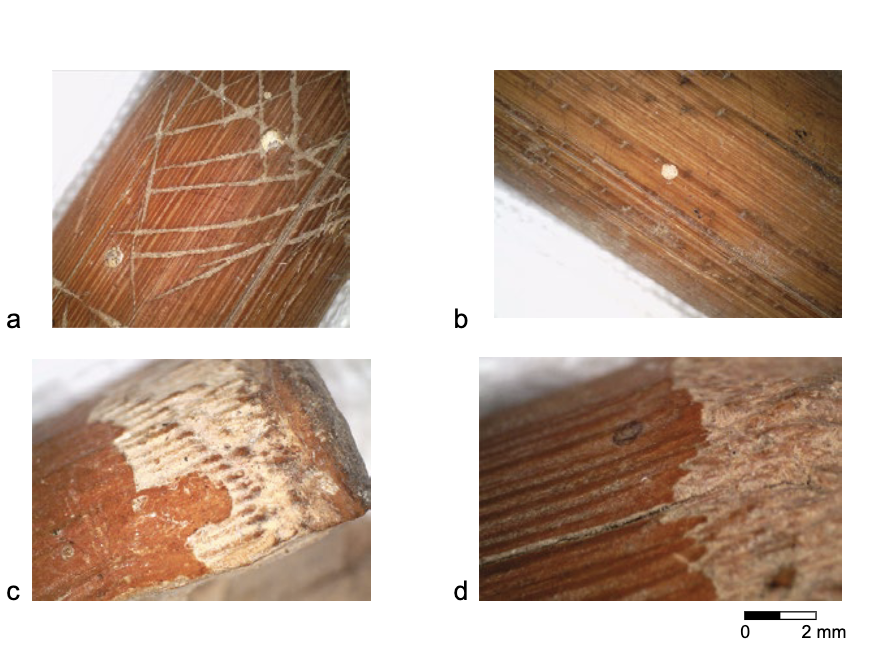
Closeups of the reed object: a) incised lines; b) incised dots; c) abraded end of the reed with signs of repeated rubbing; d) black remains of possible adhesive (photos by Miriam Lavi). Credit: Susnow, M., Porat, R., & Davidovich, U., 2026
A possible link to burial activity
The function of the decorated reed remains the central mystery. It was not strong enough to support a heavy object, not hollow enough to hold an inserted shaft, and not perforated in a way that would point to a clear mechanical use.
The wider assemblage from Wadi Murabbaʿat Cave 2 offers a possible direction. Earlier excavations and later study identified Middle Bronze Age pottery, an alabaster juglet, fragments of wooden combs, a scarab, and bronze toggle pins from the cave. These object types are frequently known from burial contexts in the Southern Levant, especially at Jericho.
For that reason, the authors suggest that the cave may have been used for mortuary purposes during the Middle Bronze Age, and that the reed may have belonged to burial equipment or another ritual object deposited in the cave. The interpretation remains open. No single burial can be directly linked to the reed, and the exact activity behind the object is still unknown.
That uncertainty is part of the object’s force. It is not a spectacular treasure, but it preserves a rare meeting point between a local desert resource, a human hand, and a decorative tradition shared across the Bronze Age Levant.
A small object from the edge of the Bronze Age world
The Middle Bronze Age in the Southern Levant is often told through fortified towns, urban growth, trade, and elite burial customs. The decorated reed from Wadi Murabbaʿat belongs to a quieter setting: a remote desert cave, far from the main centers of settlement.
Its survival changes the picture in a small but important way. It shows that reeds were used and decorated in the Southern Levant during the Middle Bronze Age, even though the archaeological record had not preserved such objects before. It also suggests that organic materials may have carried visual and symbolic meanings similar to those seen on bone, pottery, metal, stone, and wood.
The object’s maker cannot be named. Its original purpose cannot yet be reconstructed. But the reed still carries the marks of choice, touch, and memory: a local stem cut from the Dead Sea landscape, decorated with familiar Bronze Age signs, and left in a cave where the desert kept it almost impossibly intact.
Susnow, M., Porat, R., & Davidovich, U. (2026). A Decorated Middle Bronze Age Reed from Wadi Murabbaʿat. Tel Aviv, 1–19. https://doi.org/10.1080/03344355.2026.2620264
Cover Image Credit: Susnow, M., Porat, R., & Davidovich, U., 2026
