
14 June 2026 The Future is the Product of the Past

Monumental Tomb of an Aristocratic Woman Unearthed in Ancient Olympos

Archaeologists working in the ancient city of Olympos in Antalya have uncovered a monumental tomb believed to have belonged to an aristocratic woman, revealing new evidence of wealth, status, and funerary culture in one of Lycia’s most important coastal cities.

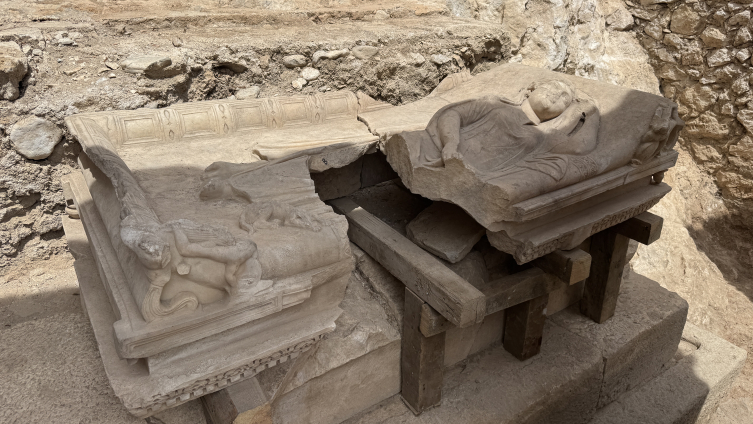
The discovery was made in the port district of Olympos, located in Kumluca on Türkiye’s Mediterranean coast. Inside a vaulted tomb rising about 10 meters high, archaeologists found a decorated marble sarcophagus adorned with hunting scenes, figures of Nike and Eros, and motifs associated with immortality.

The excavation is being carried out under Türkiye’s Ministry of Culture and Tourism’s “Heritage for the Future Project,” which supports long-term archaeological work at major ancient sites.

A third monumental tomb in Olympos

Speaking to Anadolu Agency (AA), excavation director Assoc. Prof. Dr. Gökçen Kurtuluş Öztaşkın of Pamukkale University said the team had been working in the area of monumental tombs near the ancient harbor when they identified a previously unknown structure.

Until now, two monumental tombs were known in this part of Olympos. The new discovery has confirmed the existence of a third.


📣 Our WhatsApp channel is now LIVE! Stay up-to-date with the latest news and updates, just click here to follow us on WhatsApp and never miss a thing!!


The tomb contains a sarcophagus that survived in a damaged state. Archaeologists have begun restoring it after identifying around 50 broken fragments. The work is being carried out with the precision of a conservation puzzle, since each piece must be matched, stabilized, and placed back into its original position before the tomb can be opened to visitors.
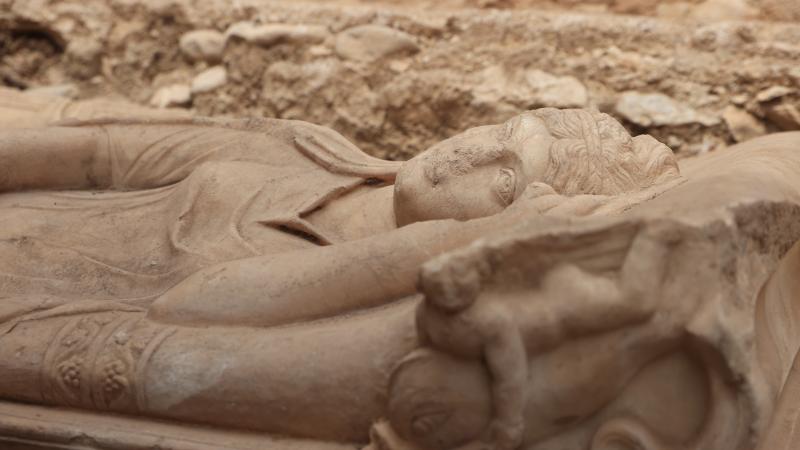
Until now, two monumental tombs were known in this part of Olympos. The new discovery has confirmed the existence of a third. Credit: AA

Hunting scenes, Nike, and Eros

The decoration on the sarcophagus is one of the strongest clues to the social identity of its owner. Hunting imagery in the Roman world was closely tied to elite status, power, control, and wealth. Such scenes were not simple ornament. They often projected the values that aristocratic families wanted associated with their memory.

The presence of Nike, the winged goddess of victory, and Eros, the god of love and desire, adds another symbolic layer. On funerary monuments, these figures could point toward triumph, continuity, and ideas of life beyond death.

According to Öztaşkın, the sarcophagus was made from high-quality marble brought from İscehisar in Afyonkarahisar, one of Anatolia’s important marble-producing regions. This detail further supports the view that the tomb belonged to one of Olympos’ wealthy and influential families.

A Lycian port city with a long history

Olympos was not an ordinary settlement. It was one of the significant cities of ancient Lycia, a region known for its distinctive rock-cut tombs, maritime networks, and powerful city traditions.

The site preserves remains from the Hellenistic, Roman, and Byzantine periods. Ancient Olympos was also among the leading cities of the Lycian League, a political federation in southwestern Anatolia. Its position near the sea helped connect it with trade, travel, and regional power struggles across the eastern Mediterranean.

Today, Olympos is valued not only for its ruins, but also for the way its ancient streets, tombs, churches, bath structures, and harbor remains survive within a dramatic river valley near the coast.
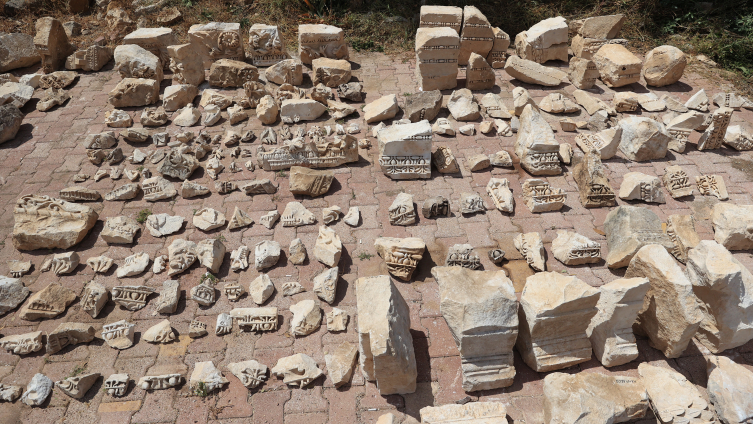
Last year, two sarcophagi discovered in Olympos were found in 722 fragments. Credit: AA

Restoring Olympos piece by piece

The newly found sarcophagus is not the first major restoration challenge at the site. Last year, two sarcophagi discovered in Olympos were found in 722 fragments. Archaeologists reassembled them piece by piece before putting them on display.

The same method will now be applied to the newly discovered sarcophagus. Once restoration is completed, the tomb is expected to become part of the visitor route.

For researchers, the tomb is important because it adds another chapter to the story of the people who lived, died, and were buried in Olympos. For visitors, it offers something more immediate: a rare look at how an elite Lycian-Roman family used art, architecture, and imported marble to preserve memory.

The discovery also strengthens the importance of the harbor district, where monumental tombs appear to reflect the social hierarchy of the ancient city. Each tomb is not only a burial place, but also a statement of identity, wealth, and belonging.

Cover Image Credit: AA

Related Articles

A 2,000-year-old whistle was found in a child’s grave in the ruins of Assos, Turkey

18 October 2022

18 October 2022

A terracotta whistle believed to be 2,000 years old from the Roman era and placed as a gift in a...

Archaeologists Discovered Remarkably Preserved Shrines inside the Assyrian Temple of Ninurta, in Nimrud

29 December 2024

29 December 2024

Recent archaeological work in Nimrud, led by the Penn Museum in collaboration with Iraqi archaeologists, has uncovered two remarkably well-preserved...

Red lipstick dating back 3,600 years was discovered in Iran -the oldest ever found-

14 February 2024

14 February 2024

Archaeologists have discovered a small chlorite vial containing a deep red cosmetic preparation believed to be an ancient type of...

Largest Known Collection of Ancient Rus’ Glass Bracelets Found in Ukraine — A Merchant’s Lost Treasure

3 January 2026

3 January 2026

Archaeologists in western Ukraine have announced one of the most remarkable archaeological discoveries in recent decades — an unprecedented cache...

Anatolia’s Lost Language Sidetic Moves Closer to Decipherment as Ancient Side Alphabet Expands to 31 Letters

4 June 2026

4 June 2026

New inscriptions bring fresh hope for Anatolia’s lost language A lost Anatolian language once spoken in the ancient city of...

Staging of religion on rock paintings that are thousands of years old in southern Egypt desert

10 May 2023

10 May 2023

Egyptologists at the University of Bonn and the University of Aswan want to systematically record hundreds of petroglyphs and inscriptions...

Researchers measure the impact of Population Pressure on Prehistoric Violence in Japan’s Yayoi Period

23 August 2021

23 August 2021

Are wars part of human nature? Do people tend to fight instinctively or do they war as a result of...

Sensational Discovery in Kazakhstan: Rare Turko-Sughd Early Medieval Coin Discovered in Almaty Region

24 June 2024

24 June 2024

A sensational discovery was made in the Kogaly Valley, two hours from Almaty, Kazakhstan. For the first time in Kazakhstan,...

Minoan civilization may have used celestial navigation techniques

3 March 2023

3 March 2023

According to a study done by an American researcher at the University of Wales, ancient civilizations may have used celestial...

Contemporaneous with ancient Egypt and Mesopotamia the Indus Valley Civilization city of ‘Mohenjo Daro’: Skilled urban planners with a reverence for the control of water

10 September 2022

10 September 2022

The Indus River Valley (or Harappan) civilization (3300-1300 BCE) lasted 2,000 years and spanned northeast Afghanistan to Pakistan and northwest...

Scientists find the oldest evidence of humans in Israel -a 1.5 million-year-old Human vertebra

3 February 2022

3 February 2022

An international group of Israeli and American researchers, an ancient human vertebra has been uncovered in Israel’s Jordan Valley that...

8,500-year-old marble statuette found in Çatalhöyük

28 December 2021

28 December 2021

In the 29th season of the excavations in Çatalhöyük, one of the first urbanization models in Anatolia, in the Çumra...

Visit Baalbek’s Famous Temples with a Free 3d Virtual Tour

10 April 2021

10 April 2021

Baalbek, which has traces of settlement since 9000 BC, was one of the cornerstones of ancient civilizations. The famous Baalbek temple...

2,000-year-old Celtic hoard of gold ‘rainbow cups’ discovered in northeastern Germany

13 January 2022

13 January 2022

Archaeologists have found an ancient Celtic coins treasure consisting of 41 gold coins in a field in Brandenburg, a state...

Evidence of Intentional Roman Use of Narcotic Seeds, Found in Bone Vessel in the Netherlands

8 February 2024

8 February 2024

Archaeologists have discovered the first conclusive evidence of the existence of a hallucinogenic and poisonous plant thought to have been...