

Archaeologists excavating the ancient city of Side in southern Türkiye have uncovered a monumental Late Antique gate built with nearly 1,800-year-old Roman reliefs depicting the Twelve Labors of Herakles and several Greco-Roman gods.
The discovery emerged during excavations along a 390-meter-long street that preserves evidence of how Side’s urban landscape was reshaped between the Roman period and Late Antiquity.
Known as Street B, the route runs between the northwestern corner of the gymnasium and Side’s East Gate. What archaeologists have exposed along it is not simply another Roman street. The buildings, blocked entrances and reused sculptures preserve successive attempts to reshape the same part of the city over several centuries.
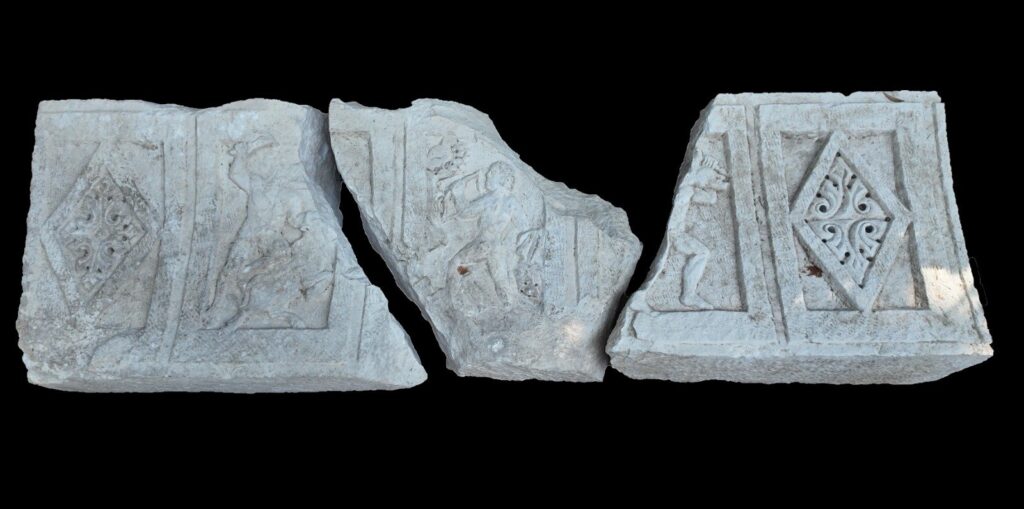
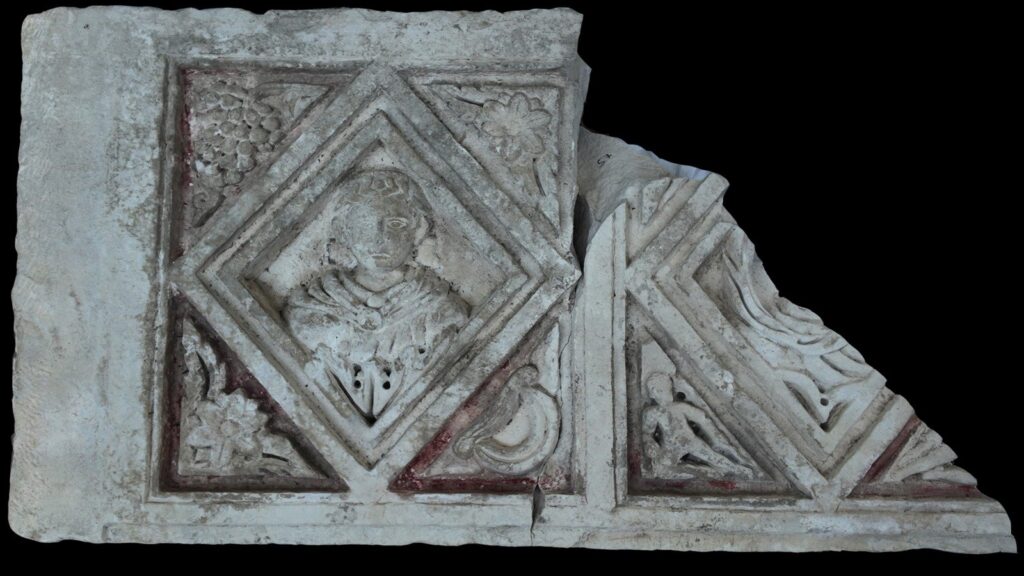
The most striking feature is the Herakles Gate, where sculptural reliefs carved in the early 3rd century AD were incorporated into a later monumental entrance. Alongside episodes from the Twelve Labors of Herakles are coffered panels depicting Athena, Zeus, Artemis, Hygeia and Tyche. The sculptures were already centuries old when builders reused them during Late Antiquity.
A Roman street survived, but its purpose changed
Excavations along the northern side of Street B revealed a stoa, or covered colonnade, dating to the 2nd century AD, with numerous rooms behind it. Surviving door jambs and threshold blocks have helped archaeologists reconstruct how buildings originally opened onto the Roman street.
Three monumental entrances have now been identified along the stoa, from west to east: the West Gate, the Herakles Gate and the North Bath Gate.
That sequence provides archaeologists with something more useful than the plan of a single building. It allows them to follow changes in Side’s urban organization along one continuous route.
Side was one of the major harbor cities of ancient Pamphylia, and its streets connected gates, public buildings, commercial spaces and monumental architecture. Archaeological research elsewhere in the city has shown that these streets did not simply disappear when the Roman period ended. They continued to be repaired and adapted during the Early Byzantine period.
Street B now provides a particularly clear example of that process.
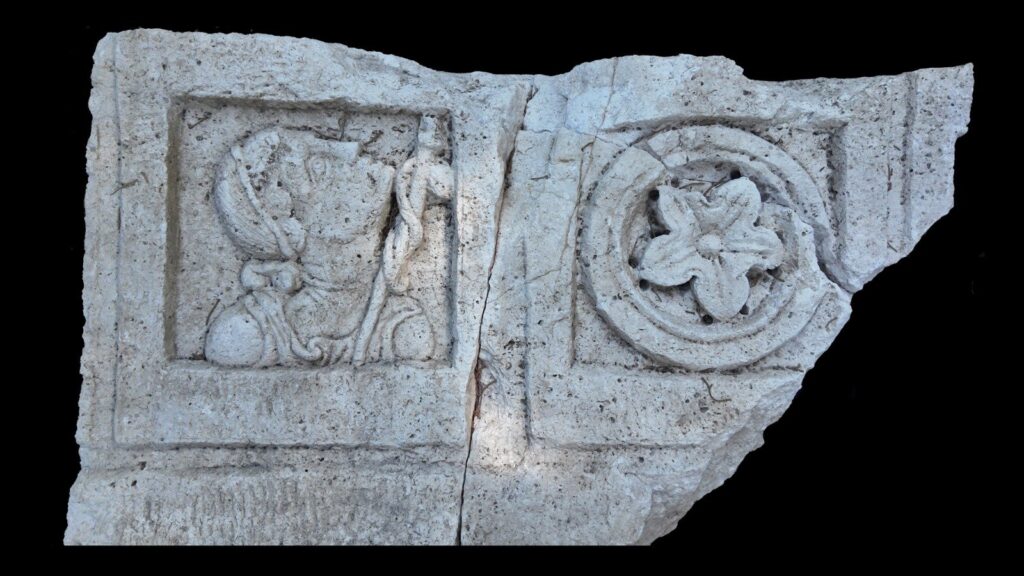
Why were pagan gods placed in a Late Antique gate?
The Herakles Gate raises an obvious question. Why would builders working in a city increasingly dominated by Christianity install sculptures of Herakles and several traditional Greco-Roman gods in a new monumental entrance?
The archaeological evidence points to spolia — architectural or sculptural elements removed from older monuments and reused in later construction.
Such reuse became widespread across the Roman and Late Antique Mediterranean. Valuable stone did not have to be quarried, transported, and carved again, while older architectural elements could lend scale and visual richness to new buildings.
At Side, the material had particular value. Research on the city’s architectural decoration has noted that Side lacked local marble quarries and depended on imported marble, making the reuse of earlier stonework economically practical.
Yet economy may not tell the whole story
The Herakles Gate did not reuse anonymous blocks alone. Its builders incorporated recognizable mythological reliefs into a prominent entrance. That makes the gate an example of how the physical appearance of a Roman city could survive even as the institutions around it changed.
The reuse should not automatically be interpreted as evidence that people still worshipped Herakles or the other gods represented on the panels. Nor does it prove that Christian builders deliberately preserved pagan imagery for its religious meaning. The archaeological evidence establishes reuse; the motives behind the choice remain harder to reconstruct.
One figure, however, had especially deep roots in Side. Athena occupied a major position in the city’s Roman-period religious life and was closely associated with Side and its maritime identity. Archaeological and epigraphic research describes her as one of the city’s principal deities.
By the time her image appeared in the later gate, the urban world in which that religious system had operated was changing rapidly.
In the 5th century, the center of power shifted
The most important transformation along Street B took place during the 5th century AD. A large area north of the street became part of Side’s Episcopal Palace complex. Entrances that had once connected the Roman stoa with buildings behind it were closed, while new monumental passages were constructed along the northern portico.
These alterations changed both movement and visibility. Someone entering Side through the East Gate would now follow a monumental route closely connected with the expanding episcopal quarter. The street still used the framework inherited from the Roman city, but its architectural emphasis had shifted toward institutions associated with the Christian administration of Late Antique Side.
The episcopal district itself was substantial. Research by the Austrian Archaeological Institute describes a complex that included a basilica, baptistery, episcopal residence, memorial buildings and additional structures within a large enclosed area. The scale of the complex reflects Side’s continued importance into the Late Antique and Early Byzantine periods.
That makes the changes on Street B easier to understand. The city was not simply abandoning its Roman past. It was reorganizing inherited streets and monuments around a different civic and religious landscape.
The East Gate adds another layer to the story
The eastern end of Street B is also important because research has changed archaeologists’ understanding of Side’s East Gate itself.
The gate and adjoining fortifications were once regarded as Hellenistic. More recent archaeological work, however, found no evidence supporting that early date and instead places their construction in the Roman Imperial period, probably during the 1st century AD and the Flavian-era expansion of Side.
Street B therefore connected parts of the city whose histories span several distinct phases: Roman expansion, the monumental building programs of the 2nd and 3rd centuries, and the Christian reorganization of the 5th century.
The newly exposed Herakles Gate sits directly within that sequence. Its sculptures belonged to an earlier Roman Side. Its later architecture belonged to a city being reorganized during Late Antiquity. And the street around it remained useful enough to be adapted rather than abandoned.
Seen together, the discoveries along the 390-meter route document something that individual statues or buildings rarely show so clearly: how an ancient city changed without starting over.
Side’s new rulers, institutions and religious communities inherited a city built by earlier generations. They closed some doors, opened others, redirected movement and placed old marble into new architecture.
The result was neither wholly Roman nor entirely new. It was the Late Antique city growing inside the physical framework of its Roman predecessor.
