

23 January 2026 The Future is the Product of the Past

Michelangelo, the artistic giant, was actually rather short

The legendary Michelangelo Buonarroti left huge works behind as an artist. But Italian researchers found that the shoes of this giant artist were not big at all.

Michelangelo di Lodovico Buonarroti Simoni (6 March 1475 – 18 February 1564) was an Italian Renaissance painter, sculptor, architect, and poet.

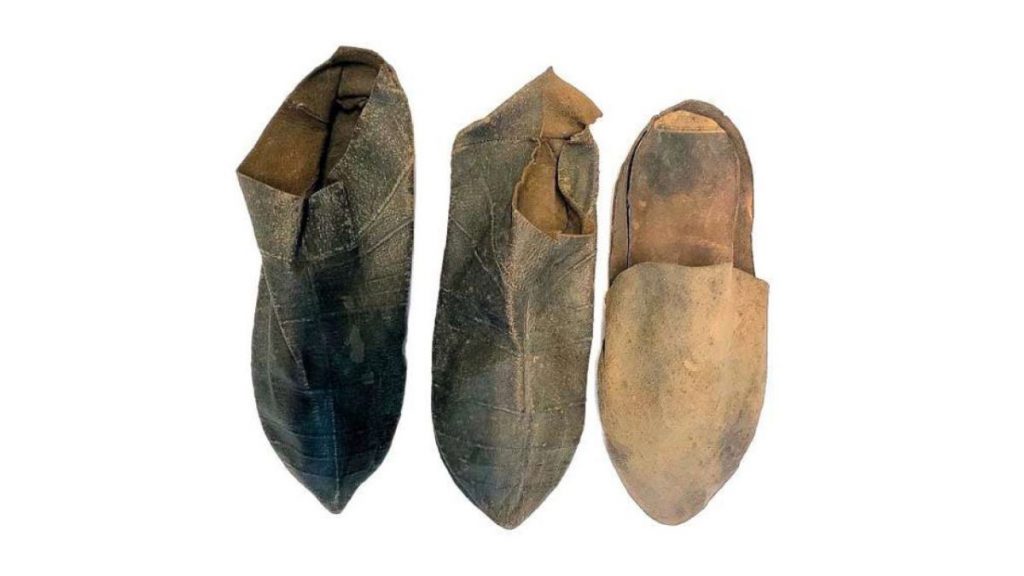
Italian researchers have studied three shoes said to have belonged to Michelangelo that were discovered in his home after his death and is now housed at the Casa Buonarroti Museum in Florence, Italy: a pair of leather shoes and a solitary leather slipper (the companion was stolen in 1873). The findings were published in the September 2021 issue of the journal Anthropologie.

The study is the first to assess the artist’s physical features based on measurements of personal things such as footwear, and they discovered that Michelangelo, although still an artistic giant, stood no more than 5 feet 2 inches (1.6 meters).

FAPAB researchers Francesco Galassi, a paleopathologist, and Elena Varotto, a forensic anthropologist, measured the shoes and determined the wearer’s foot measurements and height, and their findings matched a description of Michelangelo by 16th-century artist and writer Giorgio Vasari. According to the research, Vasari said that Michelangelo was “wide in the shoulders,” but the rest of his physique was “slightly thin in proportion” and his stature was average.


📣 Our WhatsApp channel is now LIVE! Stay up-to-date with the latest news and updates, just click here to follow us on WhatsApp and never miss a thing!!


Michelangelo's alleged shoes, in the collection of Florence's Casa Buonarroti Museum.
Michelangelo’s alleged shoes, in the collection of Florence’s Casa Buonarroti Museum. Photo: Casa Museo Buonarroti/Anthropologie

According to experts at the Forensic Anthropology, Paleopathology, and Bioarchaeology Research Center (FAPAB) in Avola, Italy, while this is a very small height for a European adult man by today’s standards, it would not have been unusual during the time Michelangelo lived (1475–1564).

The shoes have long been linked to Michelangelo, but it’s also conceivable that they belonged to another male in the artist’s home, such as a family member or one of Michelangelo’s descendants, the scientists said.

Scientists can’t be confident about Michelangelo’s condition when he died at the age of 88 since his remains have never been unearthed and examined. According to the authors, investigations like these might assist fill in some of the physical characteristics concerning Michelangelo near the end of his life.

Originally published on Live Science.

Related Articles

Seven Lost Cities Mentioned in Ancient Texts That Archaeologists Have Yet to Find

14 January 2026

14 January 2026

For centuries, ancient texts have described powerful cities, wealthy capitals, and sacred trade centers that once shaped human civilization. While...

Ancient Tamil Nadu’s Metalworking Legacy Traced Back to 3300 BCE

7 February 2025

7 February 2025

Recent archaeological research has uncovered compelling evidence that Tamil Nadu’s metalworking traditions date back to at least 3300 BCE, highlighting...

Khirbet Midras pyramid and  Archaeological Site in Israel

28 November 2022

28 November 2022

Khirbet Midras (Arabic) or Horvat Midras (Hebrew) is one of several antiquities sites located within the Adullam Grove National Park,...

China’s 4300-Year-Old Ancient Pyramids

26 March 2021

26 March 2021

Shaanxi Province in Northwest China is famous for its rich archaeological treasures. Among the many sites discovered in Shaanxi, the...

Venice of the Pacific: The mysterious Micronesian ruins of Nan Madol

12 July 2022

12 July 2022

Sometimes art and architecture challenge our perceptions of what was formerly thought to be feasible and what our forefathers were...

Bristol Redcliff Quarter’s outstanding medieval knife

17 May 2022

17 May 2022

In 2017 and 2018, Cotswold Archeology and Oxford Archeology, in a joint venture, undertook excavations ahead of redevelopment at Redcliff...

Archaeologists have uncovered the source of King Solomon’s wealth

31 August 2021

31 August 2021

An archeological team working in Israel’s Timna Valley believes they have discovered the reason behind King Solomon’s legendary wealth. The...

The Babylonian captivity or Babylonian exile

16 August 2021

16 August 2021

The Babylonian captivity or exile was an era in ancient Israel’s history. That exile began with a two-stage expulsion in...

The Ephesus Massacre: 80,000 Romans Slaughtered in a Single Night of Blood and Betrayal

29 May 2025

29 May 2025

The Ephesus Massacre saw 80,000 or more Romans killed overnight during the Asiatic Vespers — one of the deadliest uprisings...

Column of Arcadius: “The Roman Column That Fed Istanbul”

28 December 2025

28 December 2025

Rising once above the seventh hill of Constantinople like a carved chronicle in stone, the Column of Arcadius—known in Turkish...

Istanbul’s Iron Church of Unique Beauty

1 November 2021

1 November 2021

The Bulgarian Church of St. Stephens was constructed like a cross-shaped Basilica. St. Stephen Church is also known as The...

The 11-meter giant statue of the island of Naxos “Dionysus of Apollonas”

22 March 2023

22 March 2023

One of the two ancient marble quarries, thought to have begun the sculpture, the greatest art of antiquity, is located...

1,000-year-old Chicken Egg Found in Israel

9 June 2021

9 June 2021

Archaeologists discover almost fully intact but nearly empty egg and three rare Islamic-period bone dolls in excavation of settlement dating...

700 Years After Dante’s Death, His Handwritten Notes Are Discovered

11 July 2021

11 July 2021

Dante Alighieri, an Italian poet, and scholar are best known for his masterwork La Commedia (also known as The Divine...

‘Dinosaur dance floor’ dating back 80 million years found in China

20 April 2021

20 April 2021

In China, researchers have found many dinosaur footprints in an area of 1,600 square meters described in the literature as...