
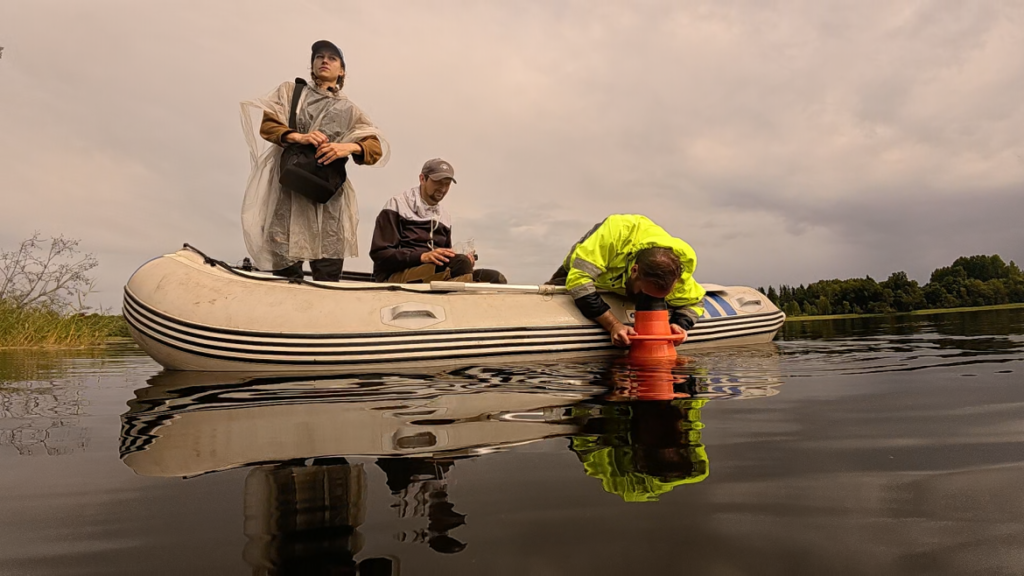
Latvia’s first underwater archaeological excavation has revealed evidence of an unusual island settlement that may represent a previously unrecognized type of lakeside habitation. Researchers also recovered a prehistoric bone fishing spear that could be up to 11,000 years old, adding a much earlier chapter to the site’s history.
Archaeologists investigating a small island in Latvia’s Lake Indzers have uncovered evidence of a settlement that does not fit the region’s known lake-dwelling traditions. Unlike the wooden platforms and pile-supported structures associated with other ancient lake settlements, the site on Cepurīte Island has revealed no such construction remains. Researchers believe it may represent a different form of island occupation, raising new questions about how communities lived around Latvia’s lakes during the first millennium AD.
The discovery emerged during Latvia’s first underwater archaeological excavation, conducted by researchers from the Latvian Academy of Culture. Alongside pottery, animal bones, and settlement deposits extending beneath the lake, the team recovered a bone fishing spear that may date back as far as 11,000 years. The weapon points to human activity in the area thousands of years before the island’s later inhabitants established their settlement.
An Island Settlement Unlike Latvia’s Known Lake Dwellings
Cepurīte Island first attracted archaeological attention in 1983, when archaeologist Māris Atgāzis identified traces of an ancient settlement. Researchers returned in 2025 and established that archaeological deposits covered the entire island, prompting a more extensive investigation in August 2026.
The latest excavations revealed numerous pottery fragments, animal remains, and evidence of human activity extending beyond the island’s present shoreline. Much of the pottery appears to belong to the second half of the first millennium AD and resembles material associated with ancient Latgalian communities in Latvia’s Vidzeme region.
However, the settlement differs from the region’s better-known lake dwellings in one important respect. Archaeologists found no evidence of the wooden piles or supporting platforms that characterized those structures, even though the archaeological remains indicate substantial human activity on and around the island.
Excavation director Juris Urtāns believes the site may represent a previously unrecognized type of island settlement, combining characteristics of conventional land-based communities with those of lake dwellings. Researchers have not yet identified a comparable settlement in Vidzeme, although further excavation will be necessary to understand its construction and occupation.
Latvia’s First Archaeological Excavation Beneath the Water
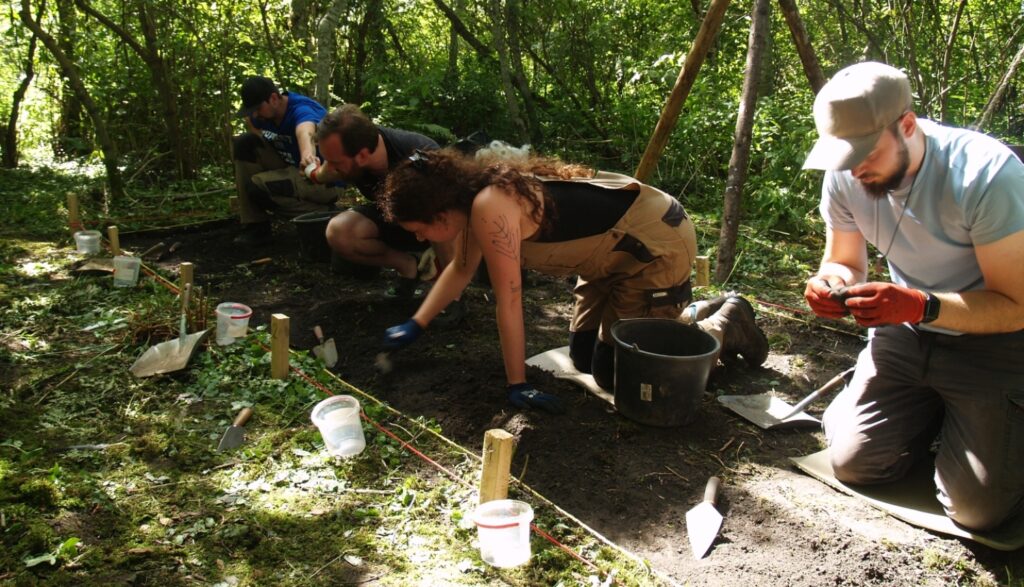
The team investigated Cepurīte Island and its surrounding lakebed during fieldwork in early August 2026. On land, archaeologists excavated an area of 10 square metres and examined the remaining surface through test pits, documenting a cultural layer approximately half a metre thick across much of the island.
Their underwater investigation revealed an even wider distribution of archaeological material. Divers identified pottery fragments, animal bones, split stones, and stones bearing traces of fire as far as approximately 12 metres from the island’s shore.
Among the finds were large fragments of ceramic vessels and several preserved vessel bases. These objects suggest that activities associated with the settlement extended into areas now covered by the lake, although researchers have not yet established how the objects originally reached the lakebed.
To investigate the deposits more closely, archaeologists conducted small excavations at a depth of 2.5 metres. Archaeologists Agnese Čakare and Kaspars Markuss Molls worked alongside divers Saulvedis Vārpiņš and Laimnesis Markūns from the Association of Underwater Cultural and Historical Heritage.
According to Urtāns, the investigation marked the first archaeological excavation conducted underwater in Latvia. Earlier underwater heritage studies had examined submerged sites, but this project allowed researchers to investigate archaeological deposits directly beneath the lakebed.
A Fishing Spear That May Be 11,000 Years Old
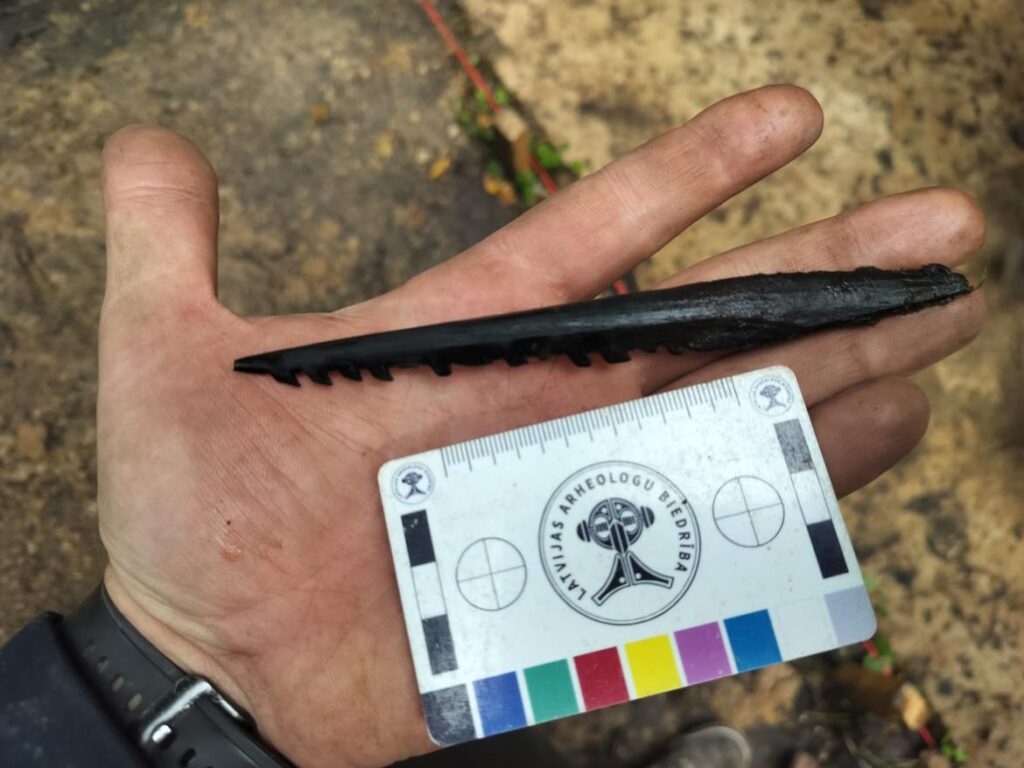
The underwater investigation also produced a discovery from a much earlier period: a fishing spear made from bone, apparently designed for catching larger fish. Its form suggests that it belongs to the Middle or Late Mesolithic, long before the early medieval settlement developed on Cepurīte Island.
Urtāns provisionally dates the weapon to between the ninth and sixth millennia BC, based on comparisons with similar prehistoric implements. This places its estimated age between 8,000 and 11,000 years, although the dating remains preliminary and relies on the object’s characteristics rather than laboratory testing.
The spear provides evidence of Stone Age fishing activities around Lake Indzers, but archaeologists caution against assuming that its owners lived on the island. Prehistoric communities may have visited the lake to exploit its fishing resources while maintaining their settlements elsewhere.
Researchers also recovered a flint flake during their 2025 survey, which may have served as a scraper. Together, these objects suggest that people used the lake environment long before the settlement associated with the later pottery deposits emerged.
Evidence of Human Activity Across Different Periods
The archaeological investigation has revealed material spanning several distinct periods, making it important to distinguish the prehistoric finds from evidence of later occupation.
During their 2025 survey, researchers recovered two intact clay vessels and animal bones from the lakebed. They also discovered a human femur that radiocarbon analysis dated to AD 578–654, providing evidence of human remains associated with the area during the second half of the first millennium.
This date corresponds broadly with the period suggested by much of the pottery, although archaeologists have not established a direct relationship between the individual and the island’s inhabitants. Further investigation may help clarify whether the surrounding waters served domestic, ceremonial, or other purposes.
The discovery also raises questions about the wider settlement landscape. Several ancient burial grounds occupy the shores of Lake Indzers, but Cepurīte Island appears too small to have accommodated all the people associated with those cemeteries.
Archaeologists therefore suspect that additional settlements may once have existed around the lake. Preliminary investigations of two nearby islands, Liepu and Stradu, have not revealed comparable archaeological deposits, suggesting that future research may need to focus on other parts of the shoreline.
A New Direction for Latvia’s Underwater Archaeology
The excavations form part of a wider research programme titled Archaeological Heritage of Inland Waters: Islands and Lake Dwellings in Latvian Lakes, led by the Latvian Academy of Culture. The project runs from 2025 to 2027 with €300,000 in funding from the Latvian Council of Science.
Researchers aim to investigate ancient island settlements and submerged archaeological landscapes, combining field excavation with historical and ethnological research. Lake Indzers provides an important case study because its archaeological deposits preserve evidence of human activity from widely separated periods.
For the team, the next challenge is to establish how the island settlement functioned and how its different archaeological layers developed. Additional study of pottery, organic remains, and architectural evidence may determine whether Cepurīte represents a distinct settlement tradition.
The results could also influence future investigations of similar sites elsewhere in Latvia. By extending excavation beneath the water, researchers have begun to examine parts of the archaeological landscape that remained inaccessible to conventional land-based surveys.
