
12 February 2026 The Future is the Product of the Past

Kevenli Castle Reveals Van’s Largest Ancient Urartian Storage Center – 76 Pithoi Marked with Cuneiform Measurements Found

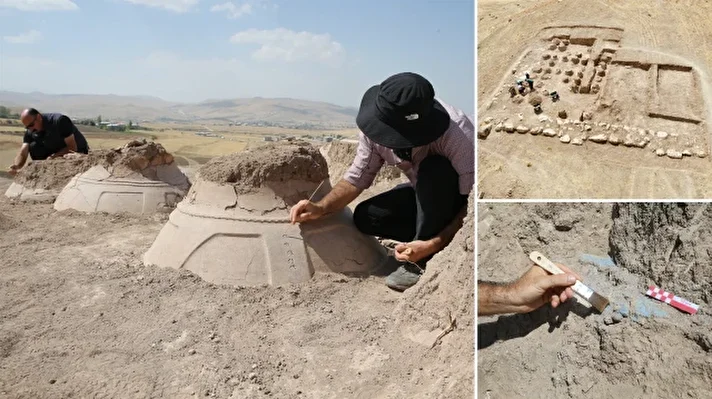
Excavations at the ruins of Kevenli Castle in Van’s İpekyolu district have brought to light the largest known storage center in Van to date. Archaeologists uncovered 76 massive pithoi, each carefully marked with cuneiform measurements, providing rare insight into how the Urartians stored and recorded agricultural products such as oil, grain, and beverages.

A Major Storage Center of the Urartian Era

The pithoi—massive storage jars—were used during the Urartian period (9th–7th centuries BC) to store oil, grain, and beverages. Experts believe the recently unearthed collection represents the largest storage facility ever identified in Van. Despite Kevenli Castle being relatively small in scale compared to other Urartian fortresses, the sheer volume of pithoi indicates that it functioned as a central depot for agricultural goods produced across the Van Plain.

Associate Professor Rıfat Kuvanç of Iğdır University, who is leading the scientific team, explained:

“Although Kevenli Castle is a small fortress, the discovery of 76 pithoi shows us that its storage capacity was far greater than expected. This suggests the castle played a vital role as a storage and distribution hub for agricultural products. For Van, this is the largest storage area ever identified so far.”
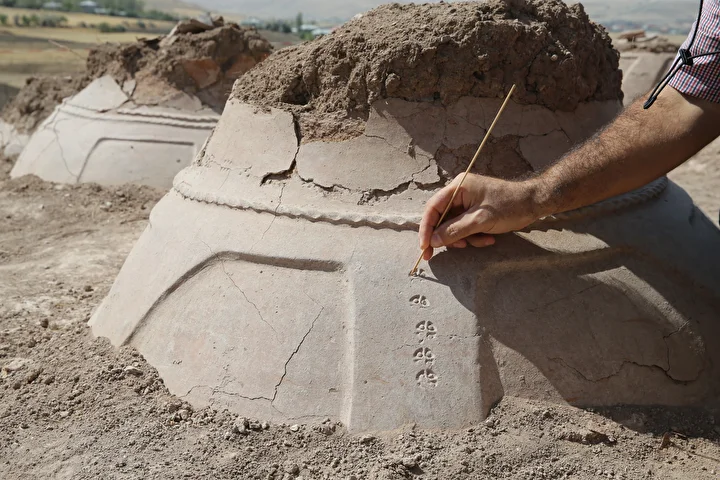
The 76 Urartian pithoi unearthed at Kevenli Castle were carefully marked with cuneiform measurements for storing oil, grain, and beverages during the Iron Age. Credit: AA

Evidence of Advanced Storage and Measurement Systems

Preliminary analysis has revealed that the pithoi were symmetrically arranged and inscribed with cuneiform signs. These inscriptions provide crucial information about the volume and types of goods stored inside, demonstrating the Urartians’ advanced methods of inventory management. Archaeobotanical studies are also underway: researchers found traces of seeds inside some of the jars and plan to conduct ancient DNA analysis to better understand the agricultural economy of the region.


📣 Our WhatsApp channel is now LIVE! Stay up-to-date with the latest news and updates, just click here to follow us on WhatsApp and never miss a thing!!


The excavations also uncovered part of a terracotta water conduit (küng) that likely supplied liquid to the storage chambers. This find highlights the engineering capabilities of the Urartians, who constructed complex water and storage systems across their fortified settlements.

Wall Paintings and Ceramics Add Cultural Depth

Beyond storage, Kevenli Castle has yielded fragments of painted plaster in red and black, indicating that some walls were adorned with murals. This suggests the fortress held administrative or ceremonial functions alongside its role as a depot.

Among the ceramic finds, archaeologists identified examples of “palace ware”, a fine red pottery style associated with Urartian elites. One shard even depicted a lion figure, underscoring the symbolic and cultural value embedded in daily objects.
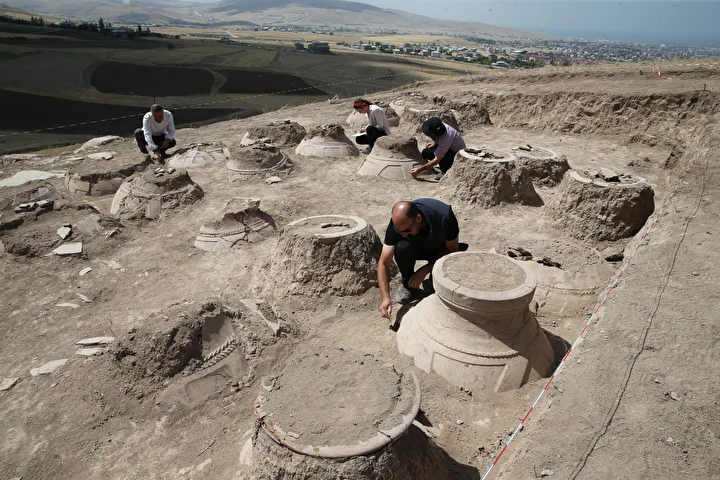
Archaeologists concentrated their work on the southern section of the castle ruins, where they uncovered 76 symmetrically arranged pithoi marked with cuneiform inscriptions, believed to have served as storage for grain and beverages during the Urartian period. Credit: AA

The Strategic Role of Kevenli Castle

Kevenli Castle is located only about 10 kilometers from Van Castle (ancient Tushpa), the Urartian capital built by King Sarduri I in the 9th century BC. Its strategic position on the slopes of Mount Erek allowed it to both guard the fertile Van Plain and serve as a logistical support point for the capital.

Covering approximately 4,500 square meters and fortified by defensive walls, the site combined military protection with resource management, a dual-purpose design typical of Urartian strongholds.

A Landmark Discovery for Urartian Studies

The discovery at Kevenli Castle adds significantly to the growing body of evidence that the Urartians were not only skilled warriors and builders but also master organizers of agricultural resources. The combination of cuneiform-labeled pithoi, water infrastructure, and decorated walls makes Kevenli one of the most informative Urartian sites discovered in recent years.

As Dr. Kuvanç noted, “Every jar, every inscription brings us closer to understanding the organization and daily life of the Urartians. Kevenli Castle has already proven itself as one of the most significant Urartian discoveries in Van.”

Excavations will continue in hopes of uncovering additional storage facilities, murals, and artifacts that will further enrich our knowledge of this Iron Age civilization.

Cover Image Credit: Mesut Varol – AA

Related Articles

2,300-Year-Old Gold Ring Reveals Jerusalem’s Hidden Hellenistic Rituals

27 May 2025

27 May 2025

A remarkable gold ring recently uncovered in Jerusalem is offering fresh insight into Hellenistic-era rituals, ancient jewelry traditions, and the...

Dingoes were regarded as “almost human” in pre-colonial Australia

21 October 2023

21 October 2023

When it comes to Australia’s wild dingoes, the phrase “a dog is a man’s best friend” takes on new meaning....

Evidence of Early Forms of Pottery Production and 8,000-Year-Old Buildings Belonging to the Elite of the Time Discovered in Iraqi Kurdistan

9 January 2025

9 January 2025

Archaeologists from the University of Udine have uncovered two ancient human settlements in the Rovia sub-district of Dohuk province in...

Archaeologists uncover 4,000-year-old earliest large-scale Archaic fish-trapping facility recorded in ancient Mesoamerica

28 November 2024

28 November 2024

Archaeologists, using drones and Google Earth imagery, have discovered a 4,000-year-old network of earthen canals in what is now Belize...

Morocco team announces 1.3 million years major Stone Age find

29 July 2021

29 July 2021

A multinational team of archaeologists announced the discovery of North Africa’s oldest Stone Age hand-ax manufacturing site, going back 1.3...

Ancient Chinese porcelain worth 1 million euros was stolen from the German museum, sparking anger

15 September 2023

15 September 2023

Nine pieces of historic Chinese porcelain worth around €1 million were stolen from the Museum for East Asian Art (Cologne)...

An Unprecedented Discovery: Archaeologists Found a Viking Age Vulva Stone -A Counterpart to Phallic Symbols?

25 September 2025

25 September 2025

Archaeologists in Norway may have uncovered the first known vulva stone from the Viking Age. The find could reshape our...

A Thousand-Year-Old Iron Age-old grave in Finland Is Ascribed to a Prominent Non-Binary Person

10 August 2021

10 August 2021

Archaeologists found a weapon grave in Finland’s Suontaka Vesitorninmäki in 1968. The remains discovered in the burial have been at...

Terracotta Army Emperor’s Quest for Immortality: Tibetan Inscription Confirmed Authentic

19 September 2025

19 September 2025

Qin Shi Huang, China’s first emperor and the visionary behind the world-famous Terracotta Army, has long been remembered for his...

Ancient Murals of Two-faced Figures Found in Peru

21 March 2023

21 March 2023

Archaeologists are reporting a number of fascinating discoveries as work on the excavations at Pañamarca progresses that are helping to...

4,000-year-old Rock Art From A Previously Unknown Ancient Culture uncovered in Venezuela

4 July 2024

4 July 2024

An archaeological team in Venezuela has uncovered 20 ancient rock art sites in Canaima National Park in the southeastern part...

Bone tools for bleeding cows discovered in a 7,000-year-old cemetery in Sudan

24 March 2023

24 March 2023

During excavations in the Letti basin in northern Sudan, archaeologists have unearthed 7,000-year-old bone tools used to bleed cows. Explorers...

For the first time, a Viking Age grave rich in artifacts has been found in Norway’s capital city, Oslo

23 December 2022

23 December 2022

A Viking Age grave rich in artifacts has been discovered for the first time in Norway’s capital city, Oslo. The...

Mystery of the 1,700-year-old Mosaic Solved: The Medallion in the Mosaic uncovered to be the Symbol of a Roman Military Unit

10 August 2024

10 August 2024

The mystery of the 1,700-year-old mosaic, which was found during excavations in Amasya province in northern Turkey 11 years ago...

Rich Bronze Age Chamber Tombs Preserved for Over 3,000 Years Discovered at Cyprus’ Ancient Trade Hub Hala Sultan Tekke

2 February 2026

2 February 2026

New archaeological discoveries at Hala Sultan Tekke, one of the most important harbor cities of the Late Bronze Age, are...