
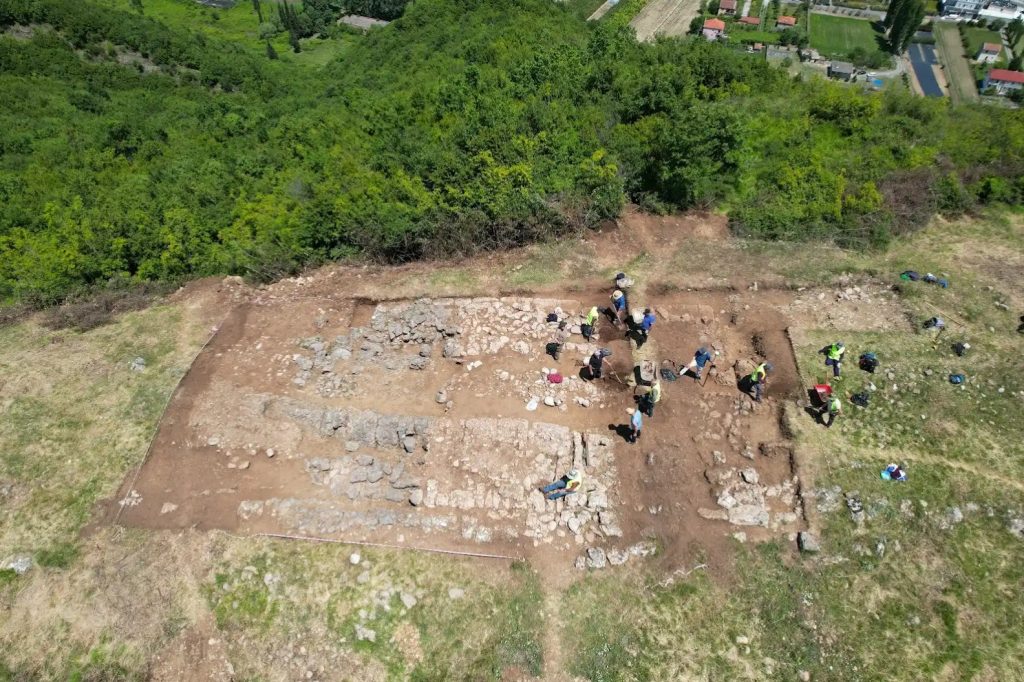
Archaeologists working in northern Albania have uncovered the stone foundations of a large Hellenistic temple on the acropolis of an ancient Illyrian city, a discovery that adds new weight to the search for the long-lost city of Bassania.
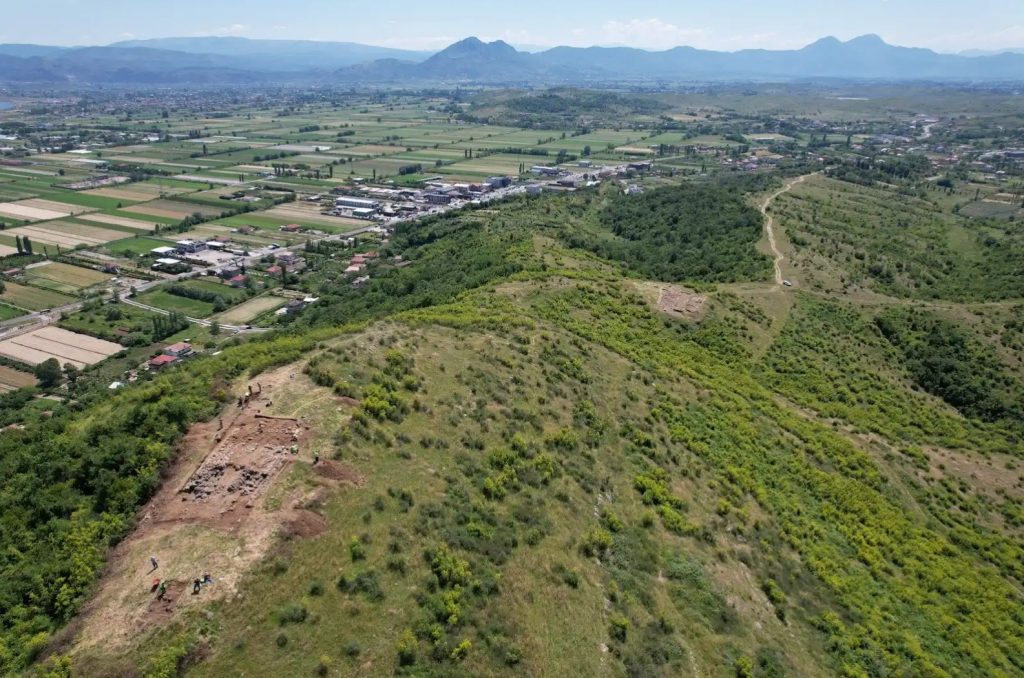
The find was made by researchers from the University of Warsaw and the University of Tirana at Bushat, a site located about 10 kilometers south of Shkodra. The settlement, forgotten for centuries and rediscovered only in 2018, is now emerging as one of the most important Illyrian urban sites in the western Balkans.
A temple crowning the Acropolis
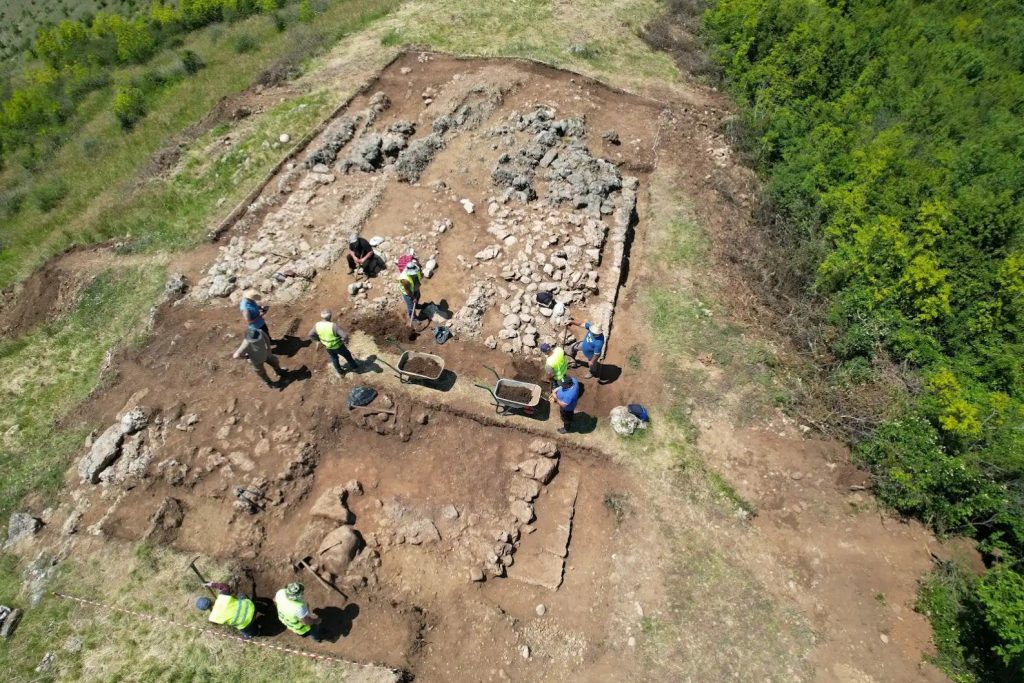
The latest excavation season focused on the city’s acropolis, set on the top of a hill overlooking the entire archaeological site. There, archaeologists exposed the complete stone foundations of a rectangular building measuring 13.6 meters by 9.6 meters.
Its proportions closely match those of classical Greek temples, while its position on the highest part of the hill suggests that it once held a central role in the city’s religious and civic landscape.
“Judging by the location of the building on the hilltop and its orientation toward the cardinal directions, we can consider these to be the remains of a temple that crowned the city’s acropolis from the 4th to the 2nd century BCE,” said Prof. Piotr Dyczek, director of the Center for Research on the Antiquity of Southeastern Europe at the University of Warsaw.
He added: “During the work, we also partially uncovered the defensive wall surrounding the hill, which at the same time formed the so-called temple temenos.”
In ancient Greek and Hellenistic religious architecture, a temenos was a sacred enclosure, a marked space separating the sanctuary from the surrounding urban area. At Bushat, the wall appears to have served both defensive and ritual purposes, protecting the hilltop while defining the sacred zone around the temple.
First Illyrian temple identified in northern Albania
The discovery is especially important for the study of Illyrian culture. According to the University of Warsaw, this is the first Illyrian temple identified in northern Albania.
That detail matters because Illyrian archaeology has long been dominated by fortifications, hilltop settlements, burial customs and scattered material culture. Clear evidence for cult architecture, especially in the northern part of Albania, has been far more difficult to document.
The Bushat temple therefore offers a rare view of how local Illyrian elites may have adopted and adapted Greek architectural forms during the Hellenistic period. The building’s Greek-style proportions do not necessarily mean the city was Greek. Rather, they point to a cultural zone in which Illyrian communities engaged with the wider Hellenistic world while maintaining their own political and regional identity.
A lost city near Shkodra
Modern Bushat lies in northwestern Albania, near Shkodra, one of the most historically significant cities in the region. In antiquity, this area stood within the broader Illyrian world, close to major routes linking the Adriatic coast, inland valleys, and fortified urban centers.
The ancient settlement at Bushat was rediscovered in 2018 by archaeologists from the University of Warsaw’s Center for Research on the Antiquity of Southeastern Europe and their colleagues from the University of Tirana. Since then, topographic research and archaeological work have suggested that the site may be ancient Bassania.
Bassania is known from ancient written sources, but its exact location has long remained uncertain. The possibility that it stood at Bushat is based on the site’s position, scale, and comparison with classical accounts. For now, researchers treat the identification as a strong possibility rather than a final conclusion.
Earlier work at Bushat revealed substantial defensive structures, including city gates and stone walls. The new temple discovery now adds a religious dimension to the site, showing that this was not only a fortified settlement but also a planned urban center with a prominent sanctuary on its acropolis.
Between Illyria, Greece, and Rome
The temple appears to have stood between the 4th and 2nd centuries BCE, a period when Illyrian communities in the western Balkans were deeply connected to the political and cultural changes of the Hellenistic Mediterranean.
Its location would have made it visible across the settlement and the surrounding landscape. In many ancient cities, temples placed on high ground did more than serve religious practice. They also projected authority, identity, and collective memory.
Bushat seems to have been abandoned while the Hellenistic period was still underway. Yet the hill did not lose its strategic value. In the 3rd century CE, during the Roman period, a small structure was built beside the temple ruins and remained in use for almost a century.
Researchers interpret this later Roman building as anobservation point. From the hill, it would have been possible to control a broad area stretching from Shkodra toward ancient Lissos and the Adriatic coast.
This later reuse shows how the meaning of the site changed over time. What had once been a religious and urban landmark of an Illyrian city became, centuries later, part of a Roman system of territorial surveillance.
A clearer picture of Illyrian urban life
The Bushat discovery strengthens the view that Illyrian cities in northern Albania were more complex than once assumed. The combination of fortifications, an acropolis, a sanctuary, and later Roman activity points to a settlement shaped by local traditions, Hellenistic influence, and long-term strategic importance.
For archaeologists, the temple is more than an isolated building. It is a fixed point in the urban plan of a city that disappeared from memory, survived only in fragments, and is now being reconstructed through excavation.
If future research confirms the identification with Bassania, Bushat could become one of the key sites for understanding the final centuries of Illyrian urban culture before Roman domination in the western Balkans.
Cover Image Credit: University of Warsaw
