

Archaeologists excavating a Chalcolithic settlement in north-eastern Romania have uncovered an unusually large pottery kiln that may mark an important step toward specialised ceramic production in prehistoric Europe. Built around the end of the fifth millennium BCE, the two-chamber structure at Ursoaia was engineered for repeated, high-capacity firing on a scale well beyond most known Cucuteni–Trypillia kilns.
Excavated in 2025, the kiln had a working surface of approximately 7.5 square metres and an estimated upper firing chamber volume of about 12 cubic metres. Researchers describe it as the largest securely documented example of its type within the Cucuteni–Trypillia tradition and argue that its size, construction and repeated use point toward an intensification of pottery production.
A Settlement with At Least Eight Kilns
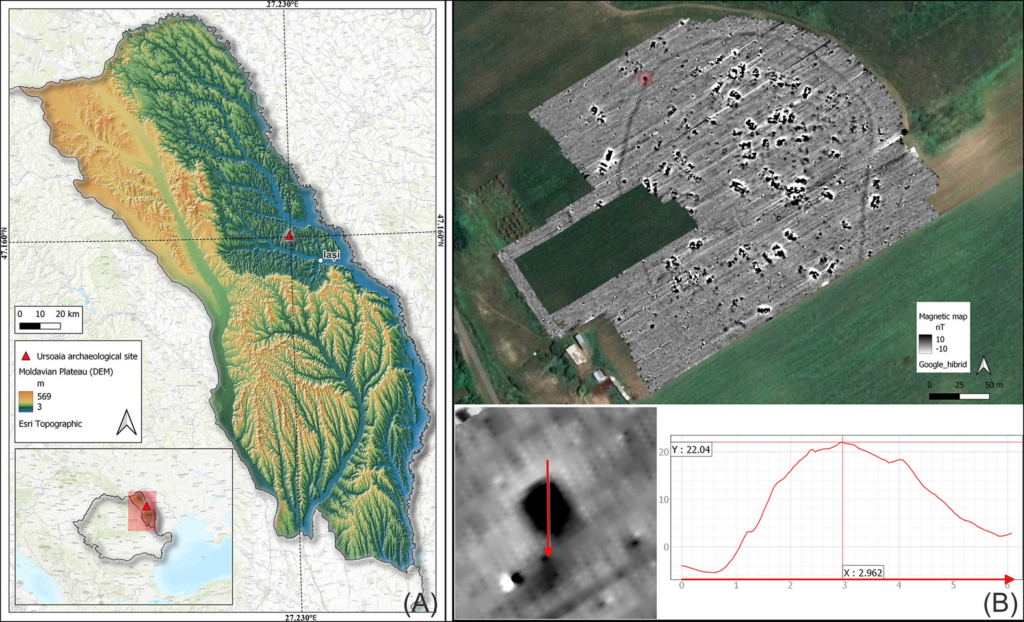
Ursoaia lies in Iași County, on a hilltop in the Moldavian Hilly Plain where the Ursoaia and Roșior streams meet. Before excavation began, a magnetometer survey carried out in 2024 revealed that the settlement covered almost eight hectares and was enclosed by a ditch.
The survey identified approximately 60 burnt dwellings arranged in small clusters, numerous pits and at least eight kilns. The settlement layout and its richly decorated pottery place the site within the Cucuteni B1/Trypillia BII–CI phase, around the beginning of the fourth millennium BCE, a chronology also supported by radiocarbon dating.
One particularly strong magnetic anomaly near the settlement ditch drew archaeologists’ attention. Targeted excavation showed that the anomaly belonged to a remarkably well-preserved bicameral updraught kiln.
Rather than placing the installation on a flat open surface, its builders cut it into the inner slope of the settlement ditch. The position offered structural stability, shelter from wind and controlled access to the firing area, suggesting that the location itself formed part of the kiln’s design.
Four radiocarbon dates obtained from animal remains associated with the installation indicate that the kiln was used during the second half of the 40th century and into the 39th century BCE. In broad terms, the structure was therefore operating close to 6,000 years ago.
A Prehistoric Kiln Engineered for Capacity
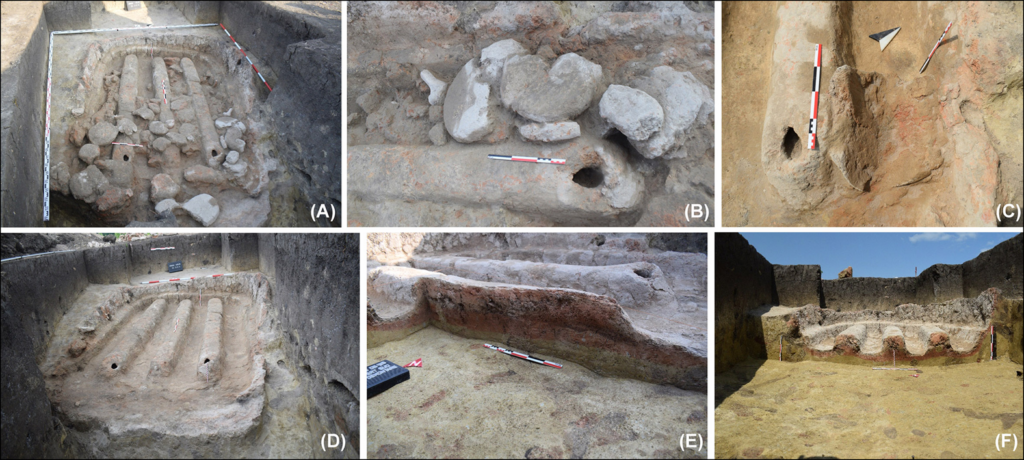
The lower chamber measured approximately 3.10 by 2.40 metres. Four long fire channels ran through it, divided by three substantial supports that had been carved directly from natural clay and then carefully shaped and levelled with an additional clay lining.
Above them sat a removable platform made from modular clay slabs. Each slab measured roughly 60 centimetres long, 35 centimetres wide and eight centimetres thick. Together they created a permeable grate separating the combustion area below from the chamber in which pottery vessels were fired.
The system was not simply large. Its internal layout helped distribute heat more evenly while reducing thermal stress on the structure. Hot gases travelled through the channels below the slabs before rising into the firing chamber, creating an updraught system in which the vertical movement of heated air maintained circulation through the kiln.
Based on the surviving remains and collapsed pieces of its vaulted superstructure, the researchers cautiously estimate that the complete kiln stood around 2.2 to 2.5 metres high. Its upper chamber may have enclosed approximately 12 cubic metres of space, providing considerable capacity for loading ceramic vessels.
Repairs preserved on the clay floor, walls and structural supports are particularly revealing. Patches of secondary clay and locally thickened surfaces indicate that the kiln was maintained rather than abandoned after only a few firings. Its builders appear to have expected the installation to operate through repeated production cycles.
Temperatures Approached 1,100°C in Parts of the Kiln
Microscopic and chemical examination of the kiln lining, floor slabs and associated pottery provides further evidence for prolonged use at high temperatures. Researchers used scanning electron microscopy combined with energy-dispersive X-ray spectroscopy to examine changes caused by firing.
The floor slabs appear consistent with exposure to temperatures of approximately 800–900°C. Some fragments from the kiln vault, however, showed early vitrification, while glassy areas on structural supports may indicate local temperature peaks between roughly 950 and 1,100°C.
The researchers caution that these figures should not be treated as exact firing temperatures because factors including raw materials, firing duration, and atmospheric conditions can alter how clay reacts to heat. Even so, the differences observed across the kiln suggest controlled but uneven exposure inside a very large firing system.
Taken together, the evidence is compatible with relatively long firing sequences involving gradual preheating, staged loading, extended periods at high temperature and controlled cooling. Such procedures required knowledge not only of fire but also of airflow, clay behaviour and the thermal limits of the structure itself.
Far Larger Than Most Cucuteni–Trypillia Kilns
The scale of the Ursoaia installation becomes clearer when compared with other known pottery kilns.
Across Cucuteni–Trypillia settlements, most published firing surfaces measure about two to four square metres. Even the relatively large kiln at Stolniceni I reached only around 4.6–4.8 square metres. Ursoaia’s approximately 7.5-square-metre surface therefore establishes a new upper limit among securely documented installations of this tradition.
Its size is unusual even when placed in a broader prehistoric Eurasian context. A comparative dataset of 238 Early and Middle Chalcolithic kilns from Southwest Asia found average firing-chamber areas of only about 1.5–1.8 square metres. Installations exceeding seven square metres are rare, with only a small number of examples from sites such as Tell Abada, Tell Ziyada and Yunus reaching comparable or greater dimensions.
That does not mean Ursoaia housed a prehistoric factory in the modern sense. The researchers are careful not to claim that the settlement already possessed a formally organised community workshop.
The combination of the kiln’s exceptional size, sophisticated construction and evidence for repeated high-temperature use nevertheless suggests that pottery production was moving beyond ordinary household requirements. The presence of several kilns within the same relatively compact settlement reinforces the possibility that ceramic manufacture had become a more concentrated and specialised activity.
For archaeologists, this is what makes Ursoaia particularly important. The discovery provides physical evidence for the technological investment required when pottery production began increasing in scale: larger firing chambers, more carefully controlled airflow, replaceable structural elements and regular maintenance.
Further excavation will be needed to establish who operated the kilns, how pottery production was organised and whether Ursoaia supplied ceramics beyond the immediate settlement. For now, however, its enormous kiln offers an unusually clear glimpse of how sophisticated pottery production had become in south-eastern Europe nearly six millennia ago.
Vornicu, D. M., Tencariu, F.-A., Asăndulesei, A., Drob, A., Pîrnău, R.-G., Ciobanu, M.-C., … Groapă, C. (2026). The Ursoaia Kiln (north-eastern Romania): a benchmark for Chalcolithic specialised pottery production. Antiquity, 1–10. doi:10.15184/aqy.2026.10428
