

A routine gardening project in northern Denmark has uncovered the largest known Viking Age silver hoard ever found in the country: 18.5 kilograms of silver comprising around 700 objects and fragments.
The discovery was made in a private garden near Rebild, where the owner was preparing the ground for a new terrace. What initially appeared to be pieces of old iron and pottery soon gave way to silver bars, jewelry and coins buried more than a thousand years ago. According to Nordjyske Museer, the hoard was deposited in a clay vessel sometime during the 10th century.
Its scale alone makes the find exceptional. Denmark’s previous largest known Viking Age silver hoard, the Terslev Hoard, weighed about 6.5 kilograms. The newly discovered Rebild hoard is therefore almost three times heavier.
But archaeologists say its importance lies in more than its record-breaking weight. The unusual concentration of silver bars, cut silver and jewelry provides evidence for an economy in which silver itself — rather than the face value of a coin — could function as money.
A Viking fortune measured by weight
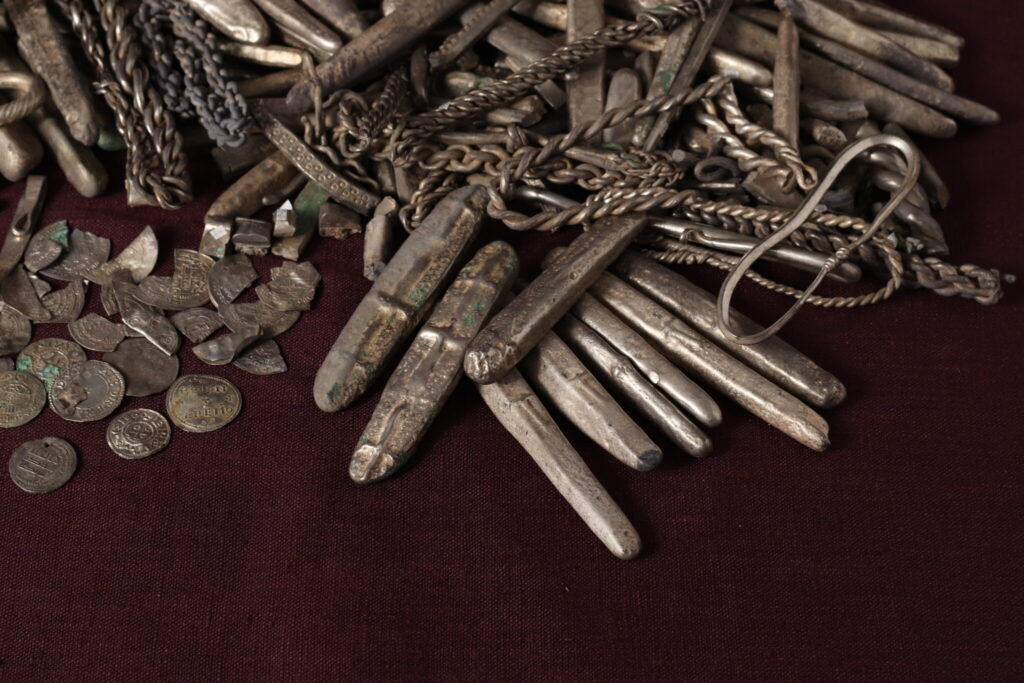
The hoard contains numerous silver ingots and bracelets, pieces of deliberately cut silver, a small Thor’s hammer and 47 coins and coin fragments. Around 320 objects weighing 6.4 kilograms were still inside the remains of the clay vessel, while the rest were recovered from the surrounding soil.
This composition is particularly significant because coins account for only a small proportion of the hoard’s total weight. Instead, silver bars and fragments dominate the assemblage.
Torben Sarauw, archaeologist and head of cultural heritage at Nordjyske Museer, said the objects appear to belong to a structured system of value rather than representing an accidental collection of precious metal. Several ingots cluster around particular weight groups, and similar patterns can be seen among some bracelet fragments and pieces of hacksilver.
That pattern fits what is already known about Viking Age commerce. The National Museum of Denmark notes that silver increasingly became important in trade during the Viking Age and circulated as coins, ingots, jewelry and fragments. Transactions could be calculated by weighing the metal with portable balances and standardized weights, meaning a foreign coin could effectively be treated as a measured quantity of silver rather than simply as currency issued by a distant ruler.
The Rebild hoard offers an unusually large archaeological snapshot of that system. Jewelry could be cut apart, coins divided and silver melted or recast because the metal retained value even when the original object lost its form.
One silver bar carries a mysterious runic inscription
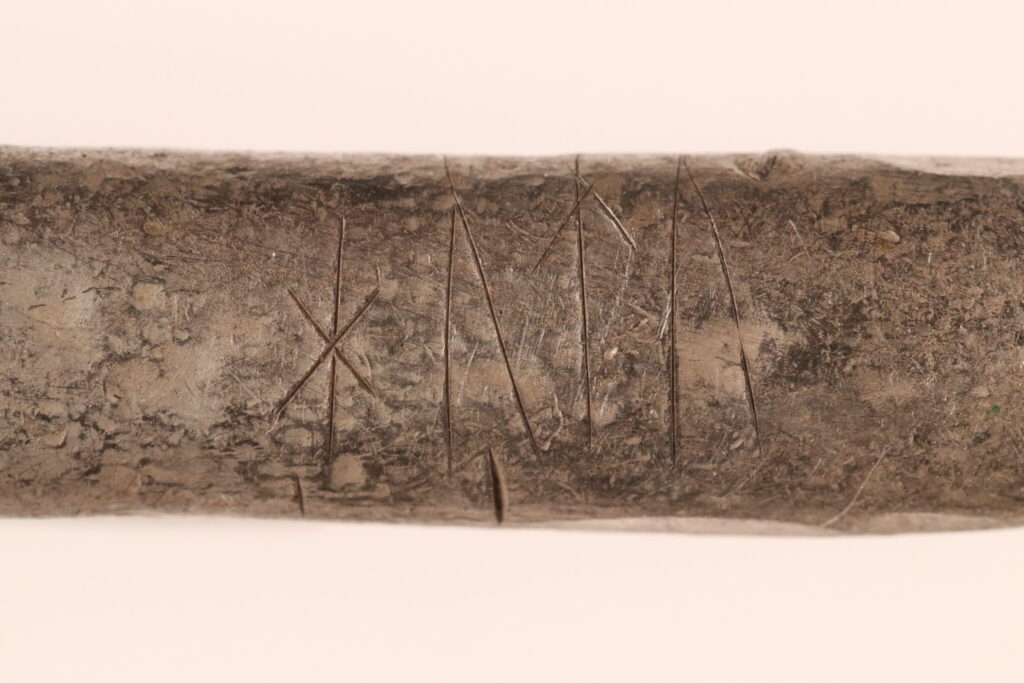
Among the hundreds of pieces is an ingot that stands apart for another reason. Runes have been scratched into its surface, forming an inscription that may read “hutu.”
Researchers have not yet established what the word means. Nordjyske Museer says it could represent a personal name, an ownership mark or another form of meaningful identification.
The inscription raises a question that the metal alone cannot answer: whether some of these standardized pieces of silver also carried personal identities or histories before they entered the hoard.
Further study may eventually clarify whether the inscription has parallels elsewhere in the Viking world.
Coins connect Rebild with England and the Islamic world
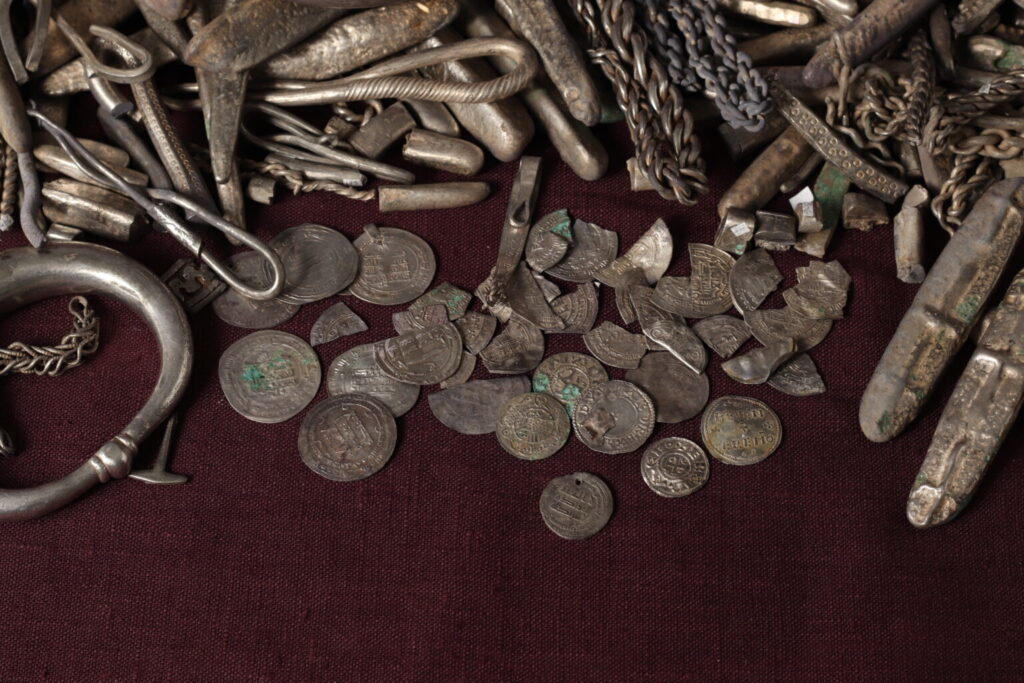
The coins add another dimension to the Rebild hoard. Both Arabic silver dirhams and Anglo-Saxon coins are represented, showing that some of the silver buried in northern Jutland had circulated through networks extending far beyond Denmark.
Dirhams reached Scandinavia in large numbers through eastern trade routes during the Viking Age. Many were cut into smaller pieces and valued according to their silver content rather than their original monetary denomination. Several coin fragments in the Rebild hoard fit this broader pattern of a weight-based silver economy.
An especially important coin points in the opposite direction, toward Viking-controlled England. According to Kirstine Pommergaard, curator at the National Museum of Denmark, the youngest identified coin in the hoard was minted at York between 921 and 925, when the city was under Viking rule.
That date provides archaeologists with a useful chronological marker. The hoard cannot have been buried before the coin was struck and entered circulation, although the coin alone does not establish exactly when the silver was deposited.
The coin belongs to the St. Peter coinage of Viking-ruled York. Its design combines a sword and a hammer with an inscription referring to St. Peter. Pommergaard interprets this combination within a period when Christian and Old Norse symbols could appear alongside one another in the cultural landscape of Viking York.
Taken together, the Islamic and English coins reveal more than the owner’s wealth. They show how silver reaching northern Denmark could move through economic networks stretching east toward the Islamic world and west across the North Sea, before eventually being weighed, divided and stored in a Viking Age hoard at Rebild.
Rebild has now produced several major Viking treasures
The new discovery becomes even more intriguing when placed on the map. Another large Viking silver hoard was discovered in the Rebild area in 1971. That assemblage contained roughly four kilograms of silver, including ingots, fragmented jewelry, and smaller pieces that had originally been wrapped in animal hide.
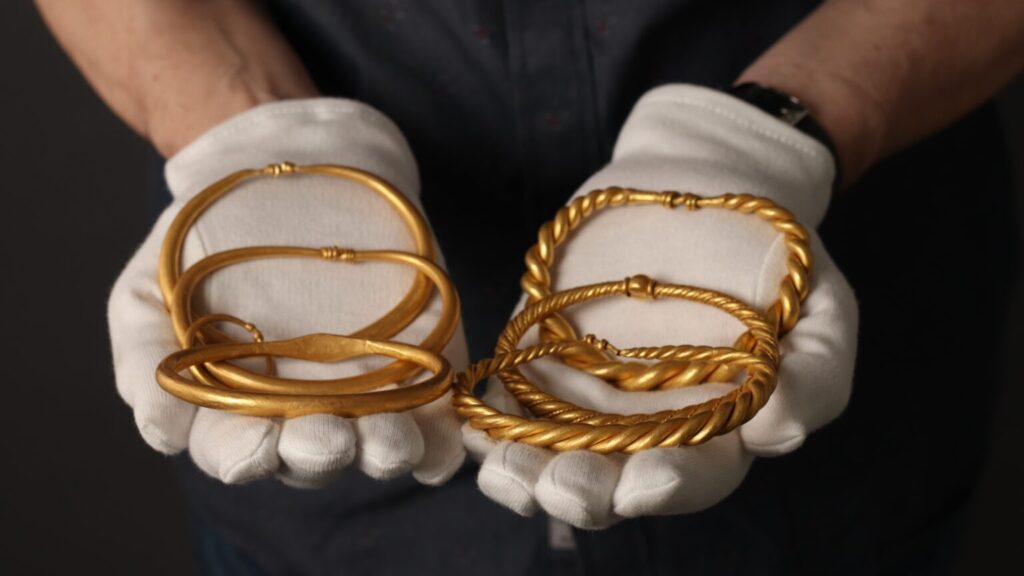
Then, only months before the announcement of the new silver hoard, another extraordinary discovery emerged nearby. The Rold Hoard consists of six intact Viking Age gold arm rings weighing a combined 762.5 grams.
The three finds are very different. The silver assemblages strongly reflect an economy based on weighed precious metal, while the intact gold rings are more readily associated with conspicuous wealth, elite status and power.
Their concentration in the same broader region nevertheless gives archaeologists a reason to look more closely at Rebild’s role during the 10th century.
Nordjyske Museer argues that the finds challenge any view of the area as peripheral to Viking Age economic networks. At the same time, archaeologists cannot yet identify the exact circumstances in which the newly discovered hoard was buried.
Why was 18.5 kilograms of silver buried?
The findspot now lies within a modern developed area, which prevents archaeologists from carrying out a large-scale excavation around the deposit. This leaves one of the discovery’s biggest questions unresolved.
The hoard may have been concealed close to a Viking Age settlement, beside a contemporary route or deliberately away from occupied areas. Without a broader archaeological context, researchers cannot yet determine which explanation is most likely.
Whatever prompted its owner to bury such an enormous reserve of wealth, no one appears to have returned successfully to retrieve it.
The hoard will now undergo assessment by the National Museum of Denmark under the country’s danefæ system, which governs significant archaeological objects considered part of the national cultural heritage. Nordjyske Museer hopes that it may eventually be displayed at the Viking Museum Fyrkat together with the recently discovered Rold gold rings.
For archaeologists, however, the Rebild hoard represents much more than a spectacular cache of Viking treasure. Its 18.5 kilograms of silver preserve evidence of how wealth was measured, divided, transported and stored across a Viking world connected from York to the Islamic East.
