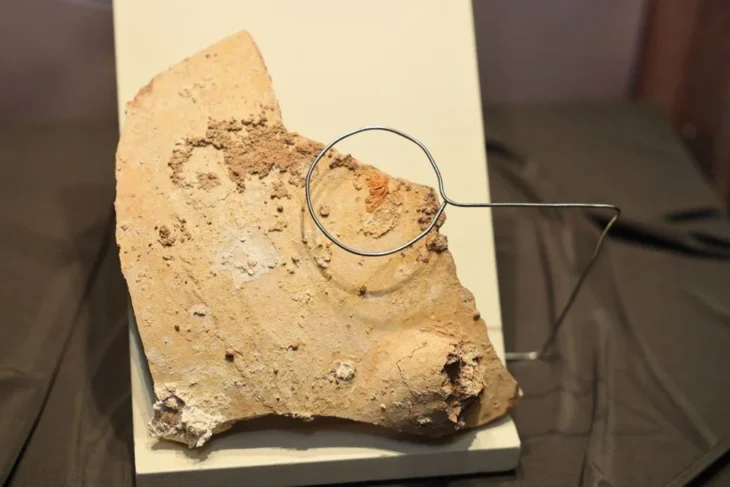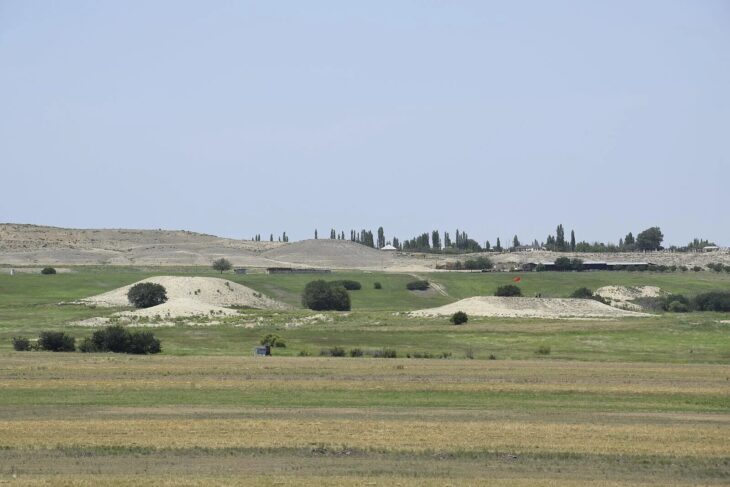
Archaeologists uncover over 800 structures at Ruyaulcourt, Pas-de-Calais, revealing Iron Age farms, Roman-era houses, metallurgical activity, and a 1st-century child’s tomb with a touching figurine.
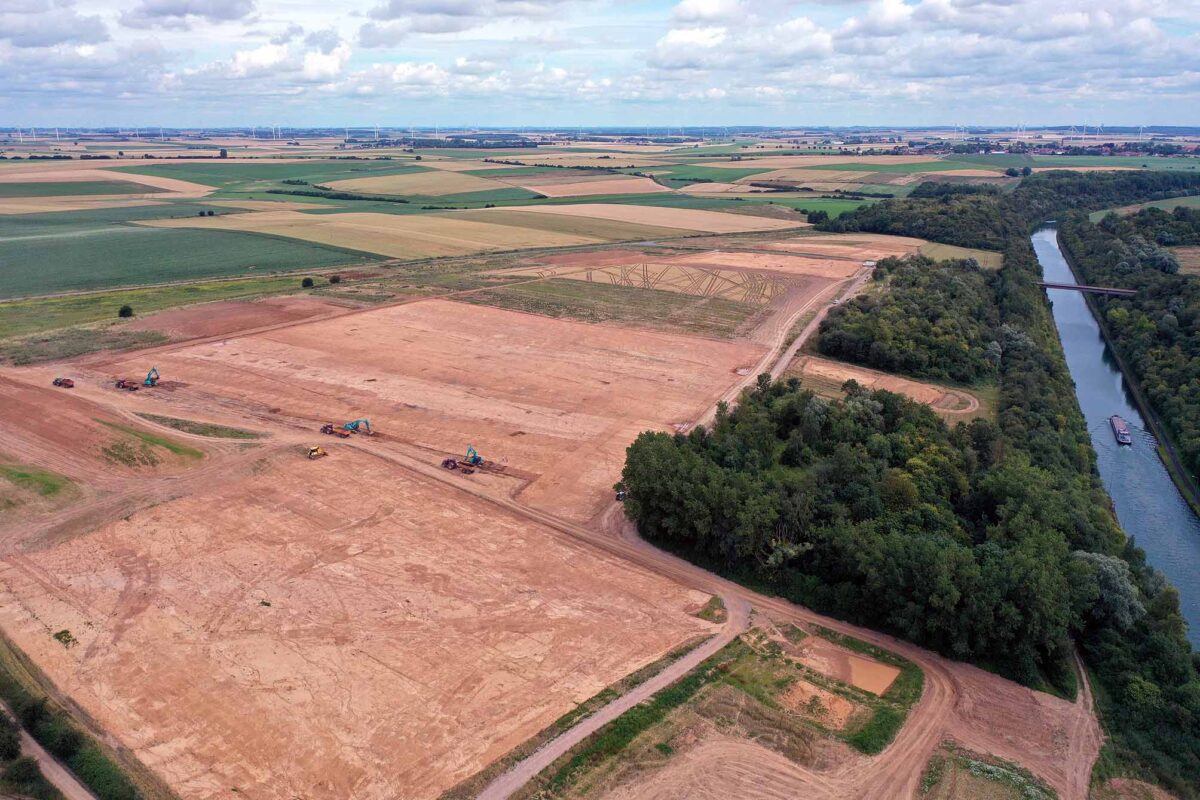
A major archaeological excavation in northern France has uncovered a remarkably detailed picture of rural life spanning nearly a millennium. Conducted by Inrap as part of the Canal Seine-Nord Europe development, the dig at Pas-de-Calais extends across 13.2 hectares and has revealed over 800 archaeological features. These findings provide rare insight into evolving agricultural practices, settlement organization, funerary customs, and economic activity from the Iron Age through the Late Roman Empire.
A Strategic Rural Setting
The excavation site lies on a natural elevation bordered by two dry valleys—one now occupied by the Canal du Nord and the other by a modern roadway. This advantageous position appears to have attracted human activity over centuries. Archaeologists identified two main clusters of occupation: one in the northeast and another in the southwest, each containing multiple enclosures that evolved over time.
Although traces of human presence date back to the Late Bronze Age, it is during the La Tène period (circa 400–30 BCE) that the first clearly structured settlements emerge. These early farming communities organized their land using ditched enclosures, which varied in shape depending on the phase. Earlier examples were curvilinear, while later ones adopted more rectilinear, quadrangular layouts, reflecting changing land-use strategies and possibly social organization.
Farming Life and Storage Systems
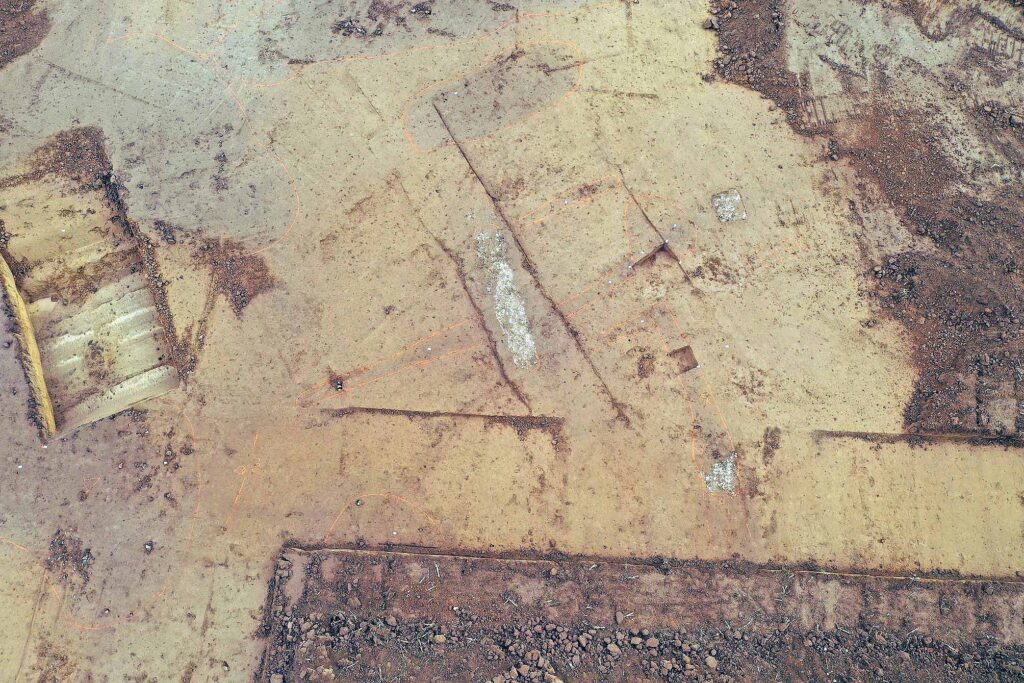
Evidence suggests that these early inhabitants relied heavily on agro-pastoral activities. Deep storage pits, or silos, were among the most prominent features discovered. Measuring up to two meters in diameter and 1.5 meters deep, these structures were initially used to store crops.
📣 Our WhatsApp channel is now LIVE! Stay up-to-date with the latest news and updates, just click here to follow us on WhatsApp and never miss a thing!!
Over time, many of these silos were repurposed as refuse pits, preserving a wide range of everyday materials. Archaeologists recovered ceramic fragments, animal bones, and functional objects linked to domestic and craft activities. Among them were loom weights and spindle whorls, indicating textile production, as well as small metal tools likely used in leatherworking.
Despite the limited preservation of residential structures—largely due to erosion—the evidence clearly points to small, self-sufficient farming units forming the backbone of the settlement.
Roman Reorganization and Expansion
By the early 1st century CE, under Roman influence, the settlement underwent significant transformation. In the southwestern sector, earlier enclosures were abandoned and replaced with more regular, quadrangular systems. This reorganization coincided with an increase in occupation density, suggesting a more structured and possibly more productive rural landscape.
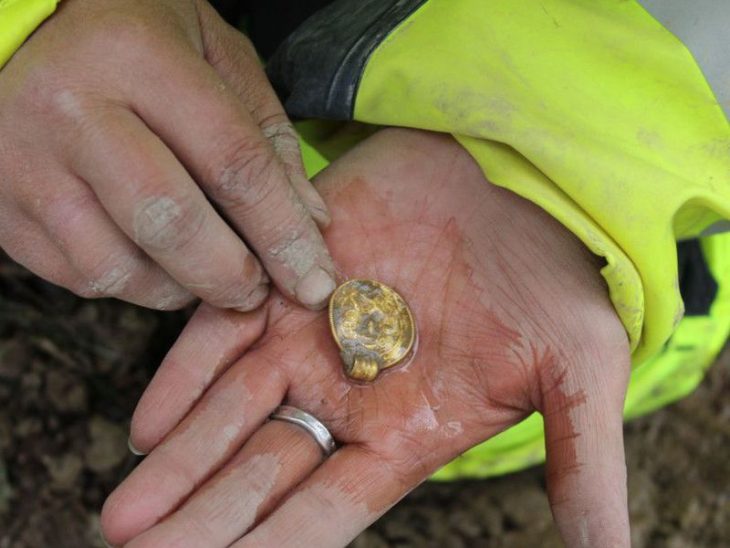
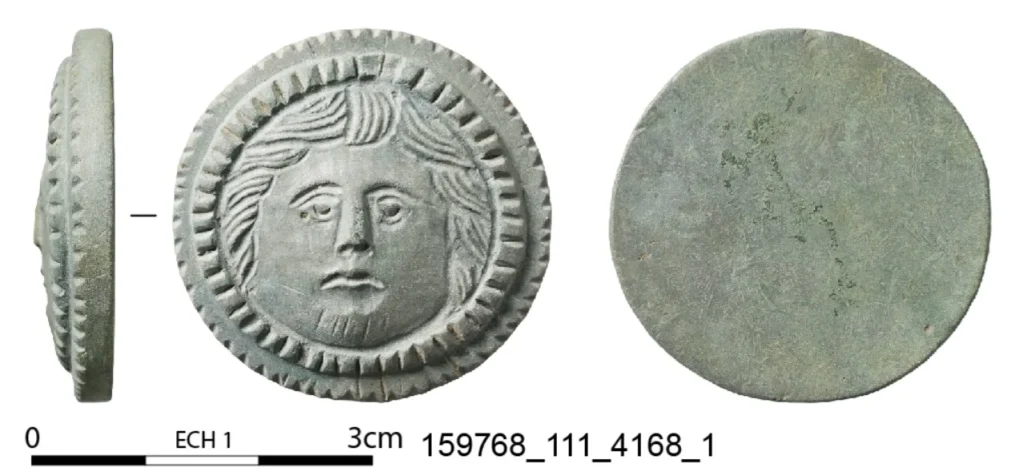
Although building remains are sparse, several discoveries point to permanent habitation. A cellar with reinforced walls and a nearby well likely formed part of a residential complex. Within this structure, archaeologists uncovered coins and a decorative fitting depicting a Gorgon, reflecting both economic activity and cultural integration into the Roman world.
Nearby pits yielded fragments of sandstone millstones, including one likely powered by animals, indicating advances in agricultural processing and efficiency. Additional finds such as a wheel hub and metal fittings suggest transport activities and local trade connections.
Funerary Practices and Social Insights
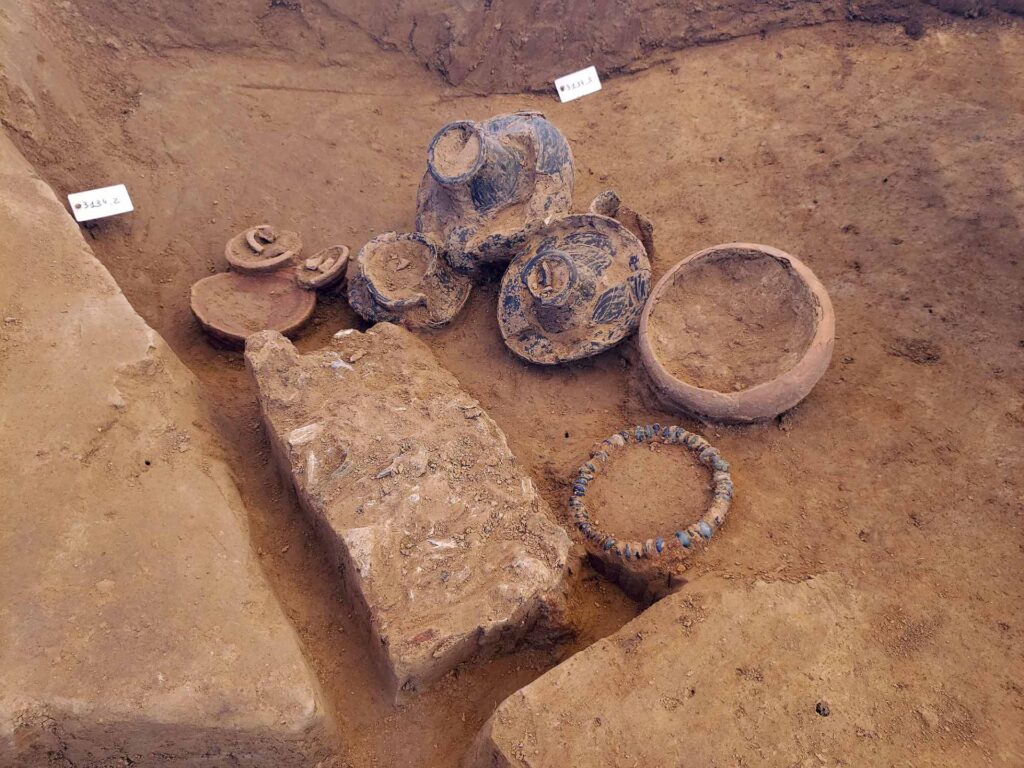
One of the most remarkable aspects of the excavation is the discovery of multiple funerary areas dating to the 1st century CE. In the northeastern sector, a group of eight cremation burials was found aligned along an ancient path. The cremated remains were placed in rectangular wooden containers, often accompanied by grave goods.
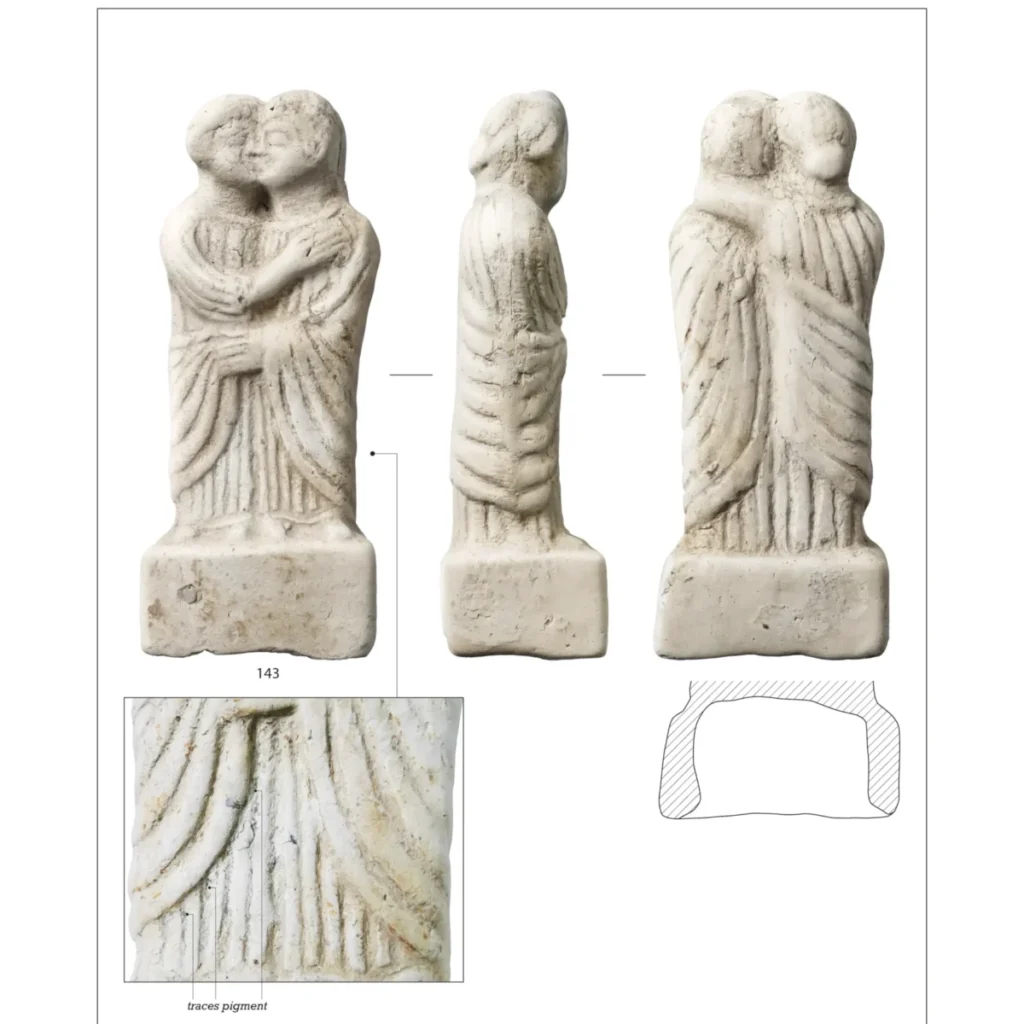
Among these burials, one stands out: the grave of a child under two years old. This burial contained a terracotta figurine depicting a couple embracing and kissing, widely interpreted as representing the child’s parents. The figurine likely symbolized protection or companionship in the afterlife. The grave also included miniature ceramic vessels, suggesting carefully structured ritual practices.
A second burial group nearby showed a different organization, with graves arranged in small clusters, possibly reflecting family units. The variation in grave goods is notable: one burial contained as many as 19 ceramic vessels, while others included only a few, indicating possible social or symbolic differences.
In the southwestern sector, funerary remains were more dispersed but not randomly placed. Burials were often located at the corners of enclosures, either individually or in small groups. These included cremation burials, urns, and pits containing ash and charcoal. Some graves contained symbolic objects such as miniature hearth implements, highlighting the importance of domestic ritual in funerary contexts.
Metallurgical Activity and Resource Use
The site also provides clear evidence of metallurgical production during the 2nd and 3rd centuries CE. Large quantities of slag—waste material from metalworking—were discovered in pits and ditches, indicating the presence of a long-term forging activity.
Although the workshop itself has not been identified, the volume of waste suggests sustained production that likely contributed to the local economy. Notably, early analysis indicates the use of mineral coal as fuel, which was relatively uncommon during this period. This may reflect deliberate resource management strategies or environmental conditions such as reduced woodland availability.
Late Occupation and Long-Distance Exchange
During the 4th century CE, the settlement entered a phase of decline, with reduced spatial extent and fewer structures. However, archaeological evidence confirms continued occupation.
Finds from this period include metal objects such as coins, fibulae, and tools, as well as more unusual items like a spearhead and a wool comb that may have originated from northern Europe, possibly including regions such as Germany or Denmark. These artifacts suggest that the site remained connected to broader exchange networks even in its later phases.
A Site of Continuing Questions
The excavation at Ruyaulcourt offers an exceptional opportunity to reconstruct long-term rural development in ancient Gaul. From Iron Age farming systems to Roman economic integration and eventual decline, the site reflects continuous adaptation to changing social and environmental conditions.
Ongoing research aims to answer key questions: Why were multiple burial systems used simultaneously? Do they reflect distinct communities or varying social practices? And how did this rural settlement integrate into wider regional and economic networks?
As post-excavation studies continue, Ruyaulcourt is set to become a key reference point for understanding the complexity of rural life in ancient Europe.
Cover Image Credit: F. Audouit – Inrap