
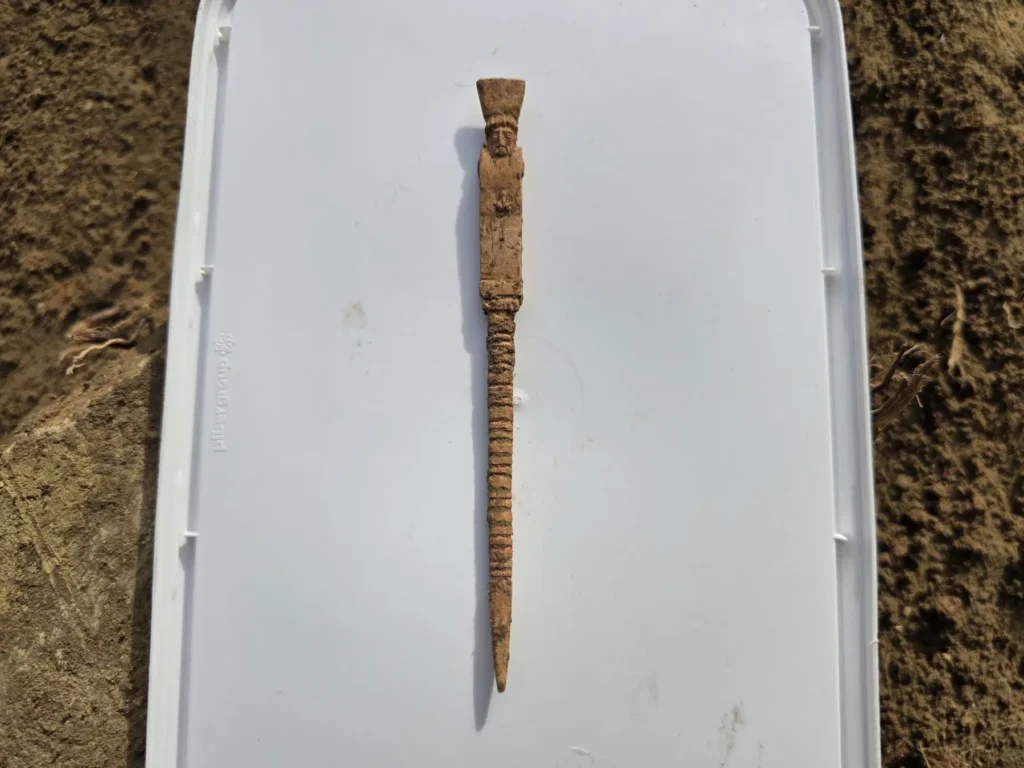
An extraordinary archaeological discovery in southern Sicily is reshaping scholarly understanding of ancient Greek craftsmanship and ritual symbolism. Excavations in the Orto Fontanelle area of ancient Gela have revealed a rare bone potter’s stylus dating to the 5th century BC, an object whose provocative iconography—combining Dionysian imagery and explicit phallic symbolism—sets it apart from any known parallel.
The stylus was unearthed during preventive archaeological investigations connected to the construction of Gela’s new Palazzo della Cultura, under the supervision of the Soprintendenza for Cultural Heritage of Caltanissetta. Scientific direction of the excavation is led by archaeologist Gianluca Calà, working on behalf of the Municipality of Gela. The artifact emerged from an ancient urban context that has already yielded evidence of a large Hellenistic-period neighborhood devoted, at least in part, to artisanal production.
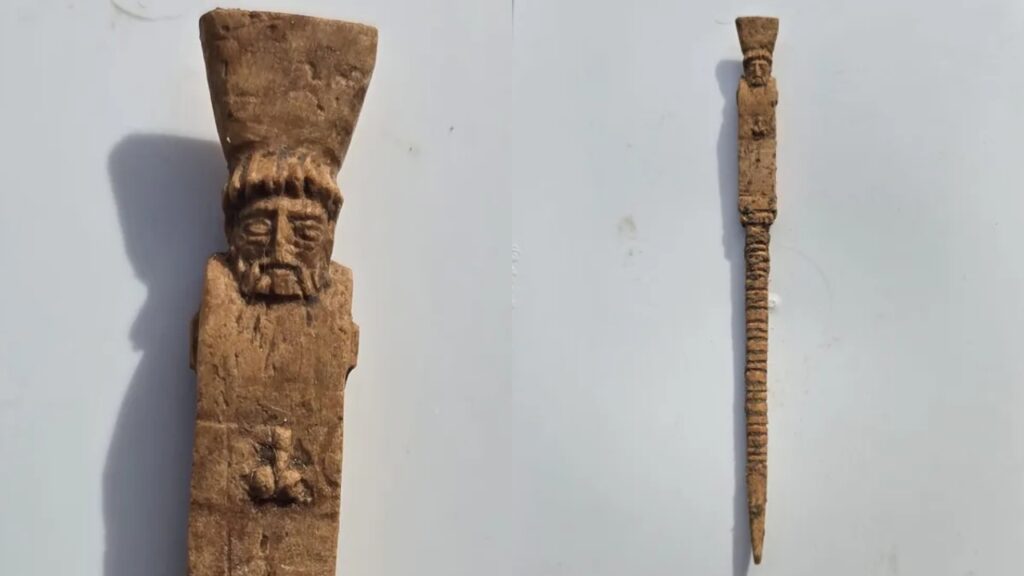
Measuring 13.2 centimeters in length, the stylus is carved from bone and preserved in exceptional condition. What makes the object remarkable is not only its rarity as a ceramic tool, but the complexity of its decoration. The upper section features a carved male head, widely interpreted as a herm of Dionysos, while the central portion displays a clearly defined erect phallus, rendered with deliberate emphasis.
In ancient Greek culture, such imagery was neither decorative nor trivial. Dionysos, far from being merely the god of wine, embodied fertility, transformation, creative energy, and the dissolution of boundaries—qualities deeply connected to artistic production. Phallic symbolism, meanwhile, functioned as a powerful apotropaic sign, believed to protect spaces, ensure productivity, and ward off destructive forces. Their combined presence on a craftsman’s tool strongly suggests that this stylus carried ritual and symbolic meaning far beyond its practical function.
Styli were typically used by potters to incise designs, guidelines, or inscriptions into soft clay before firing. However, the fragile nature of bone and the refined workmanship of this example make it unlikely that it served as a routine workshop implement. Archaeologists increasingly interpret the stylus as a status object or votive item, possibly dedicated to a deity or kept within the workshop as a protective and inspirational symbol.
“This stylus represents a true unicum in the archaeological record,” said Daniela Vullo, Superintendent for Cultural Heritage in Caltanissetta. “Its iconography and material suggest that it may have been conceived as an offering to the divinity, linked to creative fertility and divine favor rather than daily manual use.”
The artifact’s date coincides with a period of extraordinary prosperity for Gela, one of the most important Greek colonies in Sicily. Founded in 688 BC by settlers from Rhodes and Crete, Gela became a dominant political and military power during the 5th century BC, controlling extensive territories and influencing regional affairs. The city was also a major center of ceramic production, exporting pottery across the Mediterranean and sustaining a network of highly skilled artisans.
Within this context, the stylus offers rare insight into the belief systems of ancient craftsmen. While workshops are usually interpreted as purely economic spaces, this find suggests they were also imbued with religious meaning. The act of shaping clay—transforming raw earth into functional and artistic objects—may have been understood as a process requiring divine assistance, protection, and ritual acknowledgment.
According to excavation director Gianluca Calà, the stylus can be compared to a modern luxury fountain pen: technically usable, but primarily valued for its symbolic and representational power. Such objects reflect the identity, aspirations, and spiritual concerns of their owners, offering a human dimension often missing from archaeological narratives.
The preservation of the stylus is itself the result of a fortunate sequence of events. The area where it was found shows evidence of a structural collapse in antiquity, after which debris was reused as fill material. This secondary use created a sealed context that protected the delicate bone artifact for more than 2,500 years. Stratigraphic analysis confirms a 5th-century BC date, consistent with the object’s stylistic features.
Beyond the stylus, ongoing investigations at Orto Fontanelle have revealed paved surfaces, collapsed buildings, and traces of artisanal activity, reinforcing the interpretation of the area as a productive quarter of ancient Gela. Excavations in the immediate vicinity of the find have been temporarily suspended to allow for further study and conservation.
The stylus is currently undergoing restoration and cleaning, essential steps to stabilize the bone and fully reveal the carved details. Once conservation is complete, authorities have confirmed that the artifact will be displayed to the public, becoming a key piece in the archaeological narrative of Gela.
As regional councillor for Cultural Heritage Francesco Paolo Scarpinato noted, discoveries like this highlight Gela’s enduring capacity to illuminate the ancient world. More than a simple tool, this stylus stands at the crossroads of craft, religion, and symbolism, revealing how deeply intertwined creativity and belief were in the lives of ancient Greek artisans.
