

Archaeologists at Çatalhöyük have uncovered the remains of eight infants, none older than about six months, beside an unusual mortuary complex known by excavators as the “House of the Dead.” The discovery comes from a part of the 9,000-year-old settlement that is revealing a striking change in how its last Neolithic inhabitants organized death, ritual and communal space.
The infant burials were found in the East Area of the eastern mound at Çatalhöyük, the UNESCO World Heritage site on the Konya Plain in central Türkiye. The area appears to have been occupied during the final centuries of the East Mound, shortly before settlement shifted toward the neighboring West Mound.
What makes the discovery particularly significant is its archaeological setting. For much of Çatalhöyük’s history, the dead were not separated from the living. People commonly buried relatives beneath the floors and raised platforms of houses that continued to be occupied. But excavations in the eastern part of the mound are now revealing something different: a group of buildings apparently created for activities that were not primarily domestic.
A building devoted to the dead
Excavators gave one of these structures the evocative name “House of the Dead” after finding 18 human burials within its small internal compartments.
Çatalhöyük excavation director Prof. Ali Ozan told Anadolu Agency that the complex does not appear to have been used for ordinary daily life. According to Ozan, the burials were found in cells associated with a structure arranged around an open area.
The eight newly identified infant skeletons were discovered immediately beside it. Anthropological examination indicates that all belonged to babies, with the oldest estimated to have been only around six months old. Researchers are now studying both the remains and their archaeological context to determine what was happening in this part of the settlement during Çatalhöyük’s final phase.
The “House of the Dead” is not simply a label invented for the latest announcement. Earlier research by the team working in Çatalhöyük’s East Area has identified the structure as Building 173, interpreted in academic publications as a charnel or mortuary house.
Researchers from Adam Mickiewicz University in Poznań report that the building was not used as a conventional residence. Its interior changed through time and was gradually divided into a series of smaller rooms or cells, some associated with human burials.
That makes the building unusual even at Çatalhöyük, a settlement famous for keeping its dead remarkably close.
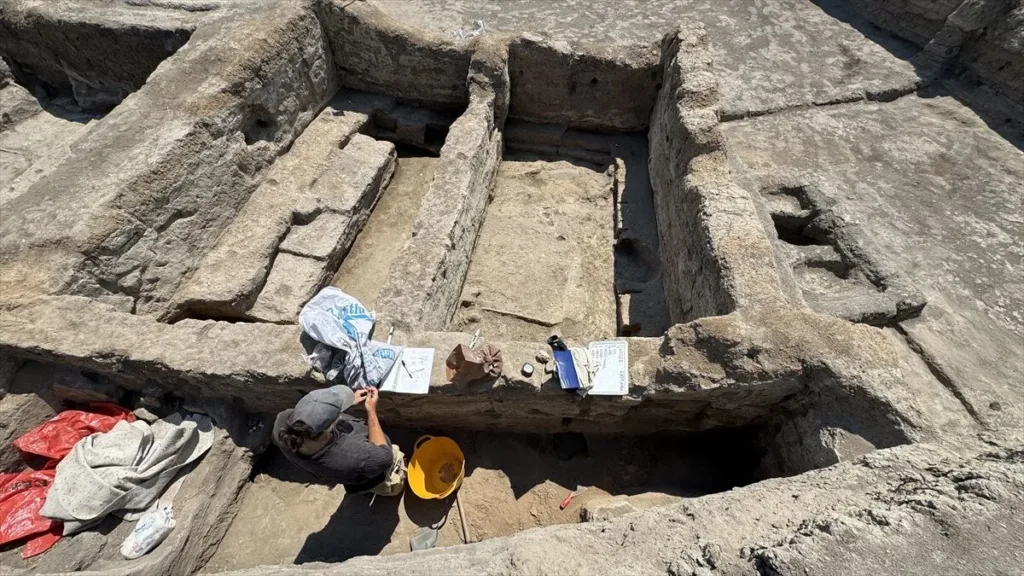
Eight infant skeletons, none older than about six months, have been discovered beside Çatalhöyük’s unusual “House of the Dead.” Credit: Abdullah Doğan / AA
At Çatalhöyük, people normally lived above their dead
Hundreds of burials excavated across Çatalhöyük have shown that death was woven into domestic life.
A 2025 study of the site’s mortuary record notes that human remains were commonly placed beneath house floors and platforms, often while the buildings themselves were still inhabited. Adults frequently occupied graves beneath raised platforms, while infants and very young children could be buried in a broader range of locations within houses.
Bioarchaeological research has documented hundreds of individuals from the site. Most primary burials involved bodies placed in tightly flexed positions inside pits beneath domestic floors. Rather than creating cemeteries at a distance, Çatalhöyük’s inhabitants repeatedly incorporated the dead into the architecture of everyday life.
Against that background, a building apparently devoted primarily to the dead takes on greater importance.
A ritual building stood across the open space
The mortuary structure was only one part of a much larger transformation.
Ozan told Anadolu Agency that excavators have identified another unusual building across the nearby open area. Platforms, wall decoration, installed animal horns and clay reliefs have led archaeologists to consider whether it served a ritual or ceremonial purpose. Academic research from the East Area provides further detail.
The structure, identified as Building 174, contained numerous platforms and benches along with decorated architectural elements. Researchers from Adam Mickiewicz University have described it as a unique discovery within the long-running Çatalhöyük excavations, noting that no closely comparable structure had been documented at the site during the previous three decades of fieldwork.
A conference presentation by Arkadiusz Marciniak goes further, describing the East Area during Çatalhöyük’s final centuries as a non-residential quarter built around a large open plaza. It included a mortuary building, a ceremonial structure and another building containing an unusual concentration of deliberately deposited objects.
This wider context changes how the eight infant burials can be understood. They were not simply found beside another Neolithic house. They lay beside a cluster of buildings increasingly associated with death, ceremony and activities set apart from ordinary domestic life.
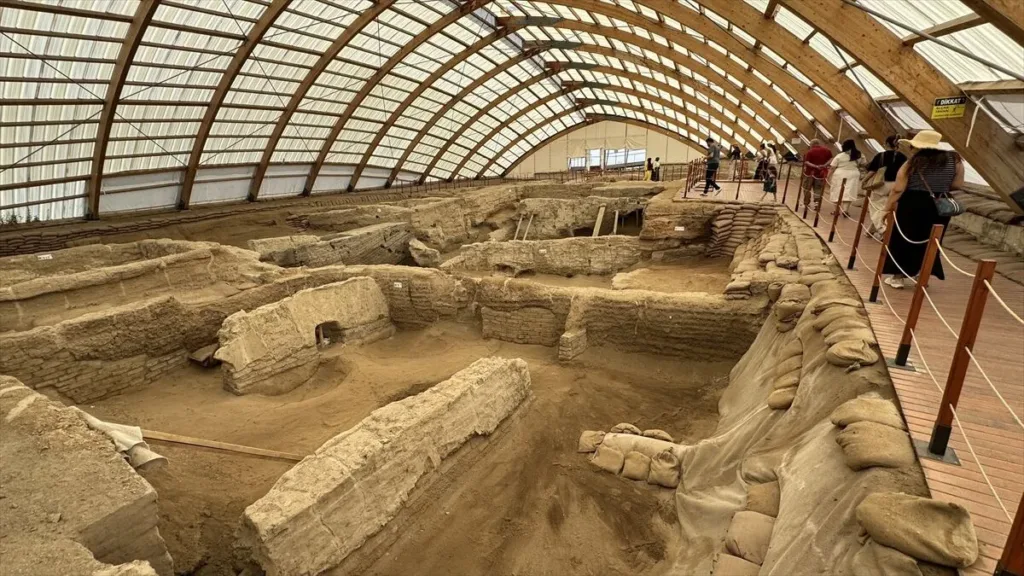
Çatalhöyük was changing before the East Mound was abandoned
The discoveries date to a crucial period in Çatalhöyük’s history.
Ozan told Anadolu Agency that the excavated part of the East Area began to be occupied around 6250 BCE. For a short period, activity on the East Mound overlapped with occupation of the emerging West Mound before the eastern settlement was eventually abandoned.
UNESCO dates the main Neolithic occupation of the East Mound broadly to between about 7400 and 6200 BCE, while the West Mound preserves the continuation of settlement into the Chalcolithic period. The eastern mound contains 18 major occupation levels and preserves the famous densely packed mud-brick houses for which Çatalhöyük is known.
Yet research on the East Area indicates that during the settlement’s last centuries, this familiar urban pattern was beginning to change. Dense blocks of houses increasingly gave way in some areas to more separated and specialized buildings.
The House of the Dead, the neighboring ceremonial structure, and now the eight infant burials may therefore belong to a broader reorganization of life at Çatalhöyük shortly before one of the world’s best-known Neolithic settlements shifted westward.
For the moment, the infant skeletons themselves leave the central question unanswered. Archaeologists have not established why eight very young children were buried together in this particular location, whether their deaths were connected, or how their graves related chronologically to the mortuary complex.
Those questions will depend on further archaeological and anthropological analysis.
