
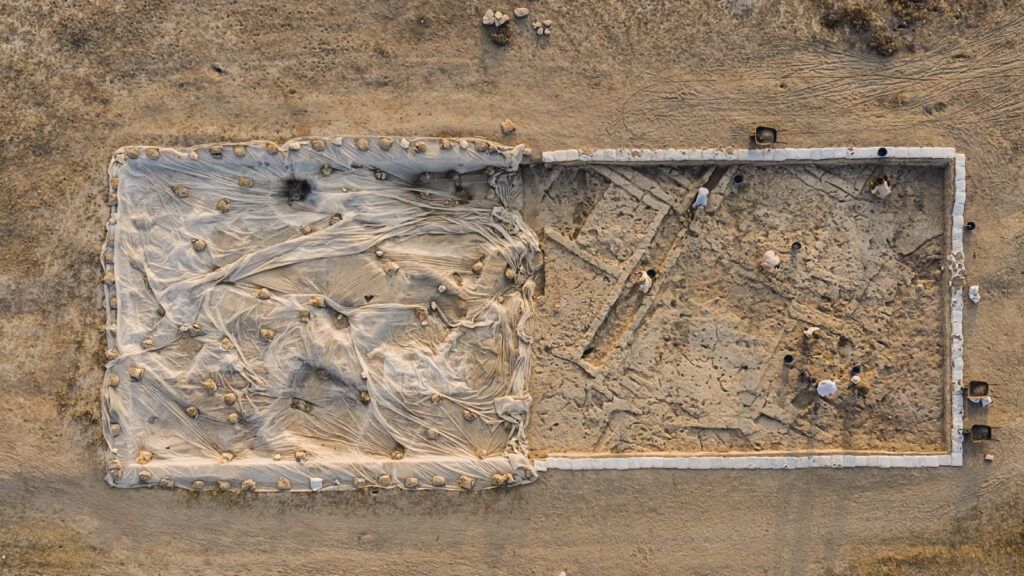
For more than half a century, Canhasan sat on the edge of one of archaeology’s biggest Neolithic stories, known but not fully understood. Now, renewed excavations in Karaman, Türkiye, are bringing the site back into focus, and the results suggest that this long-overlooked settlement may help explain how the symbolic world of Central Anatolia developed before Çatalhöyük became famous for its wall paintings, ritual spaces, and densely packed mudbrick houses.
The Canhasan excavations, restarted in 2021 after nearly 50 years of silence, are not simply reopening an old trench. They are returning to a key archaeological landscape with modern tools, new questions, and a far broader understanding of the Neolithic period than researchers had in the 1960s. The first four seasons, carried out between 2021 and 2024, show that Canhasan may be one of the most important missing links in the long cultural sequence of the Konya Plain.
Canhasan is located northeast of Karaman, near the modern village of Alaçatı, in a region once marked by fertile land and abundant water. Today, that landscape has changed dramatically, with increasing aridity and a much lower water table. Yet during the Neolithic and Chalcolithic periods, this area appears to have been part of a dynamic cultural zone connecting Central Anatolia with Cappadocia, Southeastern Anatolia, the Mediterranean, and possibly Northern Mesopotamia.
A forgotten site returns after 50 years
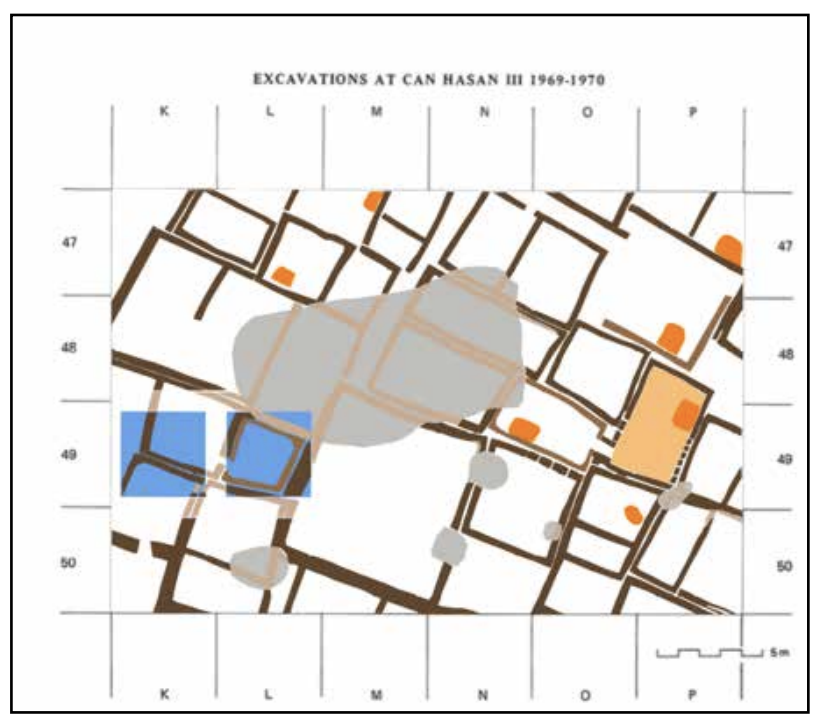
Canhasan was first excavated in the 1960s by British archaeologist David French, at the same time when James Mellaart was transforming global knowledge of the Neolithic through his work at Çatalhöyük. French worked mainly at Canhasan I between 1960 and 1967, then shifted attention to Canhasan III in 1969 and 1970.
His work was promising but incomplete. At Canhasan III, the excavation reached about four meters below the surface before high groundwater forced the work to stop. French later moved to dam rescue projects in eastern Anatolia and never returned to Canhasan. As a result, Canhasan I became known mostly for its Chalcolithic material, while the deeper Neolithic potential of Canhasan III remained largely locked inside preliminary reports and unpublished data.
That changed in 2021, when a new project led by Assoc. Prof. Dr. Adnan Baysal of Ankara University began a second phase of research. The goal was not merely to continue French’s work, but to reassess the entire site with modern excavation methods, digital documentation, geophysical survey, archaeobotany, zooarchaeology, GIS, drone mapping, photogrammetry, 3D recording, and future aDNA and isotope studies.
A Settlement at the Heart of the Konya Plain’s Neolithic Story
The significance of Canhasan lies in its position within a rare archaeological sequence. When sites such as Pınarbaşı, Boncuklu Höyük, Çatalhöyük, Canhasan, Süberde, and Erbaba are considered together, the Konya Plain becomes one of the few regions in Central Anatolia where the long transition from Epipaleolithic lifeways to the Neolithic, Chalcolithic, and later periods can be followed in unusually broad detail.
Canhasan is especially valuable because it contains evidence for both Pre-Pottery Neolithic and later Neolithic and Chalcolithic phases. This makes it a potential bridge between early village life, the rise of settled agricultural communities, and the more complex social and symbolic systems later visible at Çatalhöyük.
The site also stands near the Göksu Valley, a natural route that could have linked Central Anatolia with the Mediterranean world. That position gives Canhasan importance beyond the local landscape. It may have been part of broader networks through which materials, ideas, symbols, and technological traditions moved across regions.
A possible prelude to Çatalhöyük
The most striking detail from the renewed research is the evidence from Canhasan III. Archaeologists have identified coloured pigments in plaster layers and traces of black and red paint on house floors. This matters because Çatalhöyük’s symbolic world, especially its wall paintings and elaborate interior spaces, has long appeared unusually rich and advanced.
Canhasan may help explain what came before.
The new study suggests that Canhasan III, dated hundreds of years earlier than Çatalhöyük, could preserve a stage in the development of painted architectural traditions in Central Anatolia. The abandonment of Canhasan III around 7200 BC nearly coincides with the earliest estimated foundation of Çatalhöyük. That chronological overlap is important. It raises the possibility that Canhasan was not a peripheral settlement, but part of the cultural background from which Çatalhöyük’s more elaborate symbolic system later emerged.
This does not mean that Canhasan “created” Çatalhöyük. The evidence is more careful than that. But it does suggest that the symbolic and architectural traditots across the Konya Plain than previously understood.
Painted floors, clean houses and carefully organized spaces
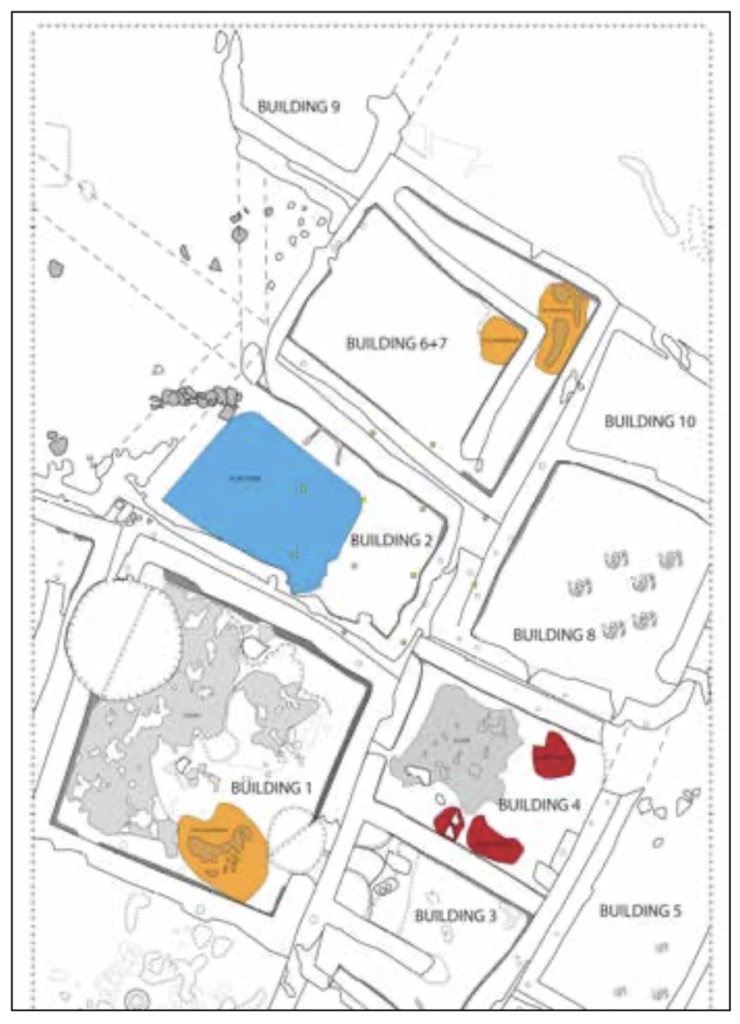
Excavations at Canhasan III have revealed rectangular mudbrick structures with interior plastering, hearths, silos, partition walls, and floors that sometimes bear traces of paint. Some walls were plastered repeatedly, creating thick accumulations over the life of a building. In certain structures, red, black, and orange pigments were observed between plaster layers.
One structure, identified as Structure 1, appears to have been among the last houses occupied before the site was abandoned. Its floor was hard and carefully made, while traces of red and black paint suggest deliberate treatment of domestic surfaces. The hearth inside the structure had been renewed several times, showing that the house was not a short-lived shelter but part of a settled and maintained domestic environment.
Another notable feature is the relative absence of objects inside many houses. Archaeologists suggest that the buildings may have been deliberately emptied before abandonment, or cleared before later construction phases. This detail gives the site an added human dimension. These were not spaces simply destroyed and forgotten. They may have been closed, cleaned, or reorganized as part of a deliberate social practice.
Decorated obsidian and long-distance connections
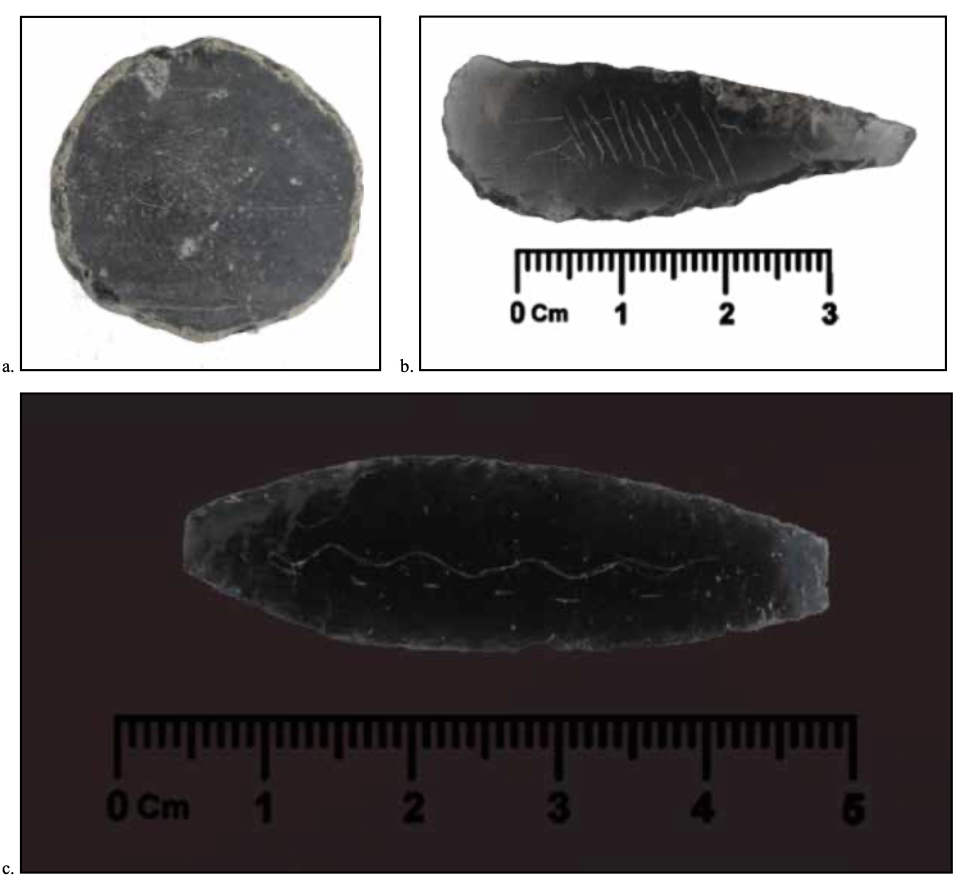
Canhasan also stands out for its obsidian tools, including blades and arrowheads. Obsidian is common at many Central Anatolian Neolithic sites, but Canhasan is notable for incised decoration on some obsidian pieces. Researchers have raised questions about why such decoration appears so prominently in Canhasan examples and what this might reveal about identity, symbolic expression, or exchange networks.
The article also notes that motifs on incised arrowheads from Canhasan III may point to possible symbolic relationships with Southeastern Anatolian cultures. Meanwhile, pottery from Canhasan I has previously been compared with Halaf-style ceramics, suggesting some degree of contact, influence, or shared visual tradition with Northern Mesopotamia.
These connections remain under study. Still, they show why Canhasan should not be treated only as a local settlement. It may have been a node in wider prehistoric networks stretching across Anatolia and beyond.
Modern archaeology revisits an old excavation
The renewed Canhasan project also highlights how much archaeology has changed since the 1960s. French’s excavations were advanced for their time, and Canhasan was among the early Anatolian excavations to include botanical studies. But today’s work can go much further.
The new team uses total stations, laser scanners, drones, photogrammetry, georadar, digital databases, GIS mapping, 3D documentation, archaeobotanical and zooarchaeological sampling, and cloud-based data systems. This allows daily interpretation of finds and contexts, rather than waiting until years after excavation.
The project has also focused on heritage protection. When the team returned in 2021, parts of the site had been damaged by agriculture, Canhasan I had accumulated more than 70 tons of waste, and the old mudbrick excavation house built during French’s era had been heavily vandalized. One of the project’s goals is to transform that structure into a cultural and visitor center, linking archaeological research with local heritage and tourism.
A key settlement in the Central Anatolian Neolithic
The first four renewed seasons at Canhasan do not provide all the answers yet. They do something more important: they show where the right questions should now be asked.
Who were the people of Canhasan III? Did they have genetic or cultural links with Boncuklu, Çatalhöyük, or other communities of the Konya Plain? Did their painted floors and plaster traditions form part of the background to Çatalhöyük’s famous symbolic world? What role did Canhasan play in obsidian exchange, regional movement, and long-distance communication?
For decades, Çatalhöyük dominated the story of the Central Anatolian Neolithic. Canhasan now suggests that the story was wider, older, and more connected than one famous site alone can explain.
After 50 years of silence, Canhasan is no longer just an archaeological footnote. It is becoming one of the key places where researchers may finally trace how early farming communities in Central Anatolia built homes, organized space, expressed symbols, exchanged ideas, and helped shape one of the most important cultural landscapes of the Neolithic world.
Baysal, A. (2026). Recent Archaeological Investigations at Canhasan, Karaman – Türkiye (2021-2024). Türk Arkeoloji ve Etnografya Dergisi, 91, 85-112. https://izlik.org/JA35LK62CJ
