
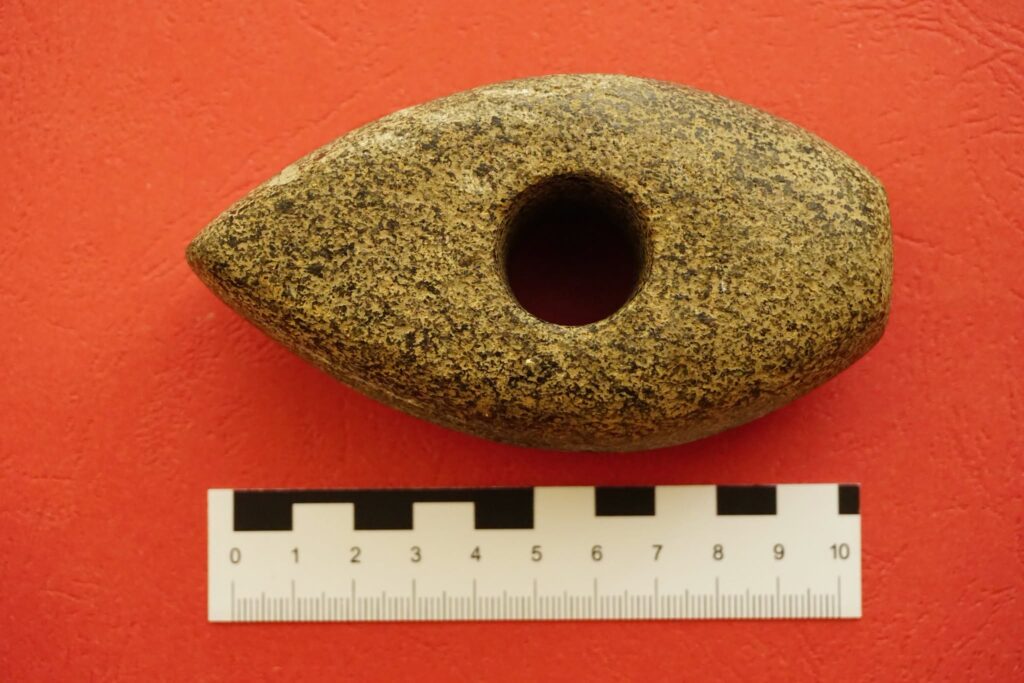
A compact stone axe handed over to heritage officials in Lublin, eastern Poland, has turned out to be more intriguing than its modest size suggests. Although its shape recalls stone axes associated with the Corded Ware culture, several details may instead point to the Early Bronze Age Mierzanowice culture.
The object was donated by Roman Szymajda, according to a statement by the Lublin Provincial Conservator of Monuments. It is expected to be transferred soon to one of the museums in the Lublin Voivodeship, where it can be preserved and studied further.
The axe was made from crystalline rock and has a compact pentagonal shape with rounded edges. It measures 11 cm in length, 5.7 cm in width and 4.6 cm in height, with a butt width of 2.7 cm. A 2 cm-wide shaft hole was placed almost centrally through the body of the object.
Its blade, 4.2 cm long, has a curved outline, while the butt is nearly flat. Conservators noted that the cutting edge does not show clear signs of use. The butt, however, bears traces of surface damage. These marks may have resulted from use, although the office also noted that secondary use cannot be ruled out.
The form of the axe is close to Type IIIA examples known from stone axes associated with the Corded Ware culture in central and northern parts of the Lublin region. It also resembles Type H1 examples identified from the Małopolska Upland.
That similarity makes the object difficult to classify at first glance. Corded Ware communities, active across large parts of Europe in the late Neolithic, are well known for their distinctive stone battle-axes, many of which appear in burial contexts or as isolated finds.
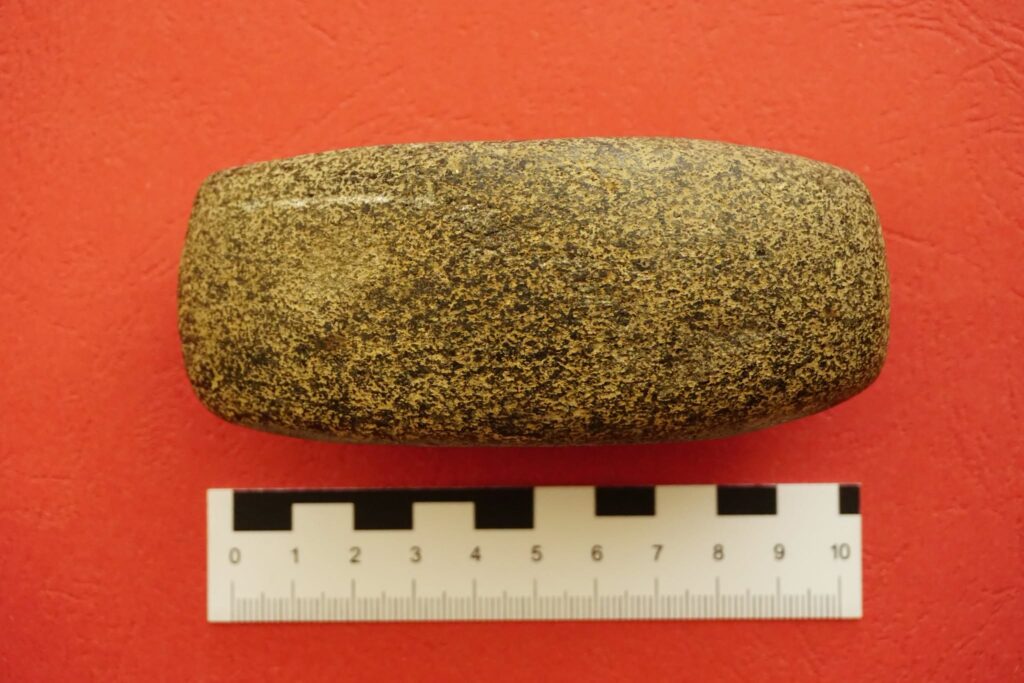
However, the Lublin heritage office noted that some features of the newly donated axe point in another direction. In particular, its blade does not widen in the way expected for many Corded Ware forms. This detail may connect the object instead with the Mierzanowice culture, an Early Bronze Age cultural group known from south-eastern Poland and neighbouring regions.
A comparable axe is known from a Mierzanowice culture grave at Wojciechowice, site 1, in Opatów County. Archaeological studies of Mierzanowice graves show that stone axes of this kind were not everyday finds. In burial contexts, they are usually interpreted as objects with social or symbolic meaning, rather than simple tools.
The find is also important because the Lublin region sits within a wider archaeological zone where late Neolithic and Early Bronze Age traditions overlapped. Objects such as this axe can therefore be difficult to assign with certainty without precise findspot data, context, or further specialist analysis.
For now, the object should be treated cautiously: it is not simply “a Corded Ware axe,” nor can its exact function be reconstructed from shape alone. But its form, material and possible cultural attribution make it a valuable addition to the prehistoric record of eastern Poland.
Once the axe enters a museum collection in the Lublin region, it may offer researchers another opportunity to examine how older stone-axe traditions continued, changed or were reinterpreted during the transition into the Early Bronze Age.
Lubelski Wojewódzki Konserwator Zabytków
Cover Image Credit: Lubelski Wojewódzki Konserwator Zabytków via Facebook
