
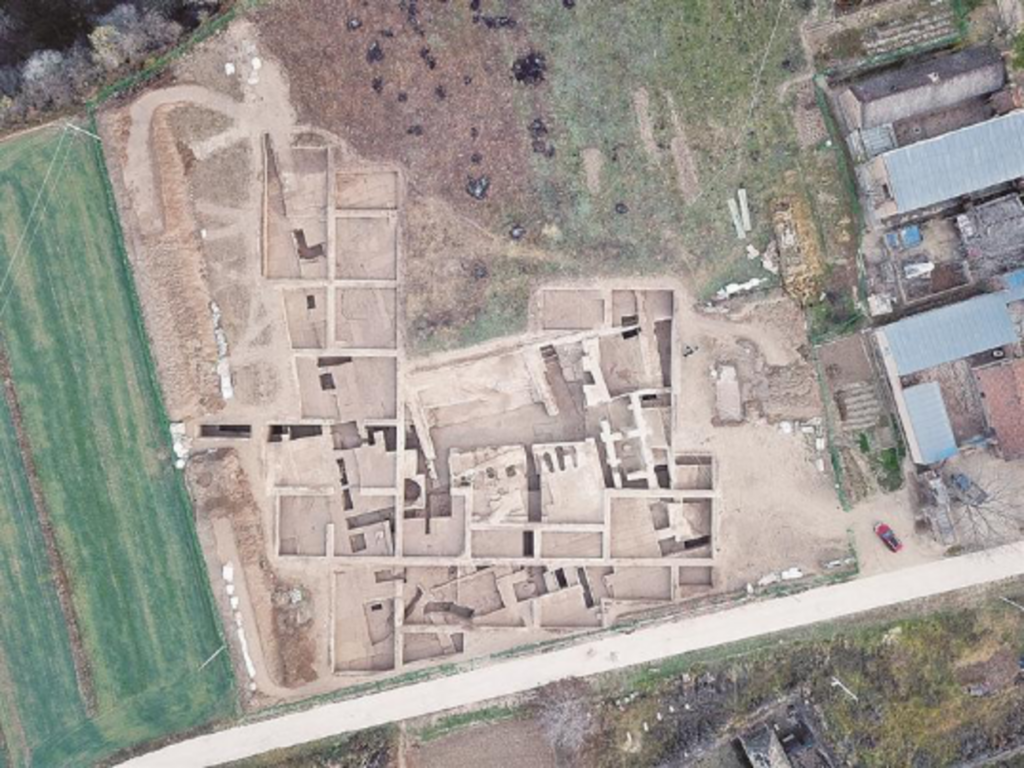
Around 5,000 years ago, the inhabitants of a powerful prehistoric settlement dismantled their monumental palace, removed its valuable wooden columns and beams, and deliberately buried much of the complex beneath compacted earth. The extraordinary operation preserved its walls and ceremonial spaces for thousands of years, but archaeologists are still trying to understand why a community capable of such ambitious construction chose to conceal one of its most important buildings.
The discovery comes from Nanzuo, a vast settlement in China’s Gansu Province that researchers identify as one of the country’s earliest known capital-like centers. Covering approximately six square kilometers, it may have supported more than 10,000 inhabitants and possessed an elaborate architectural layout organized around a monumental palace.
A Prehistoric Capital of More Than 10,000 People
Nanzuo lies near Qingyang on the Loess Plateau, where archaeologists have uncovered remains dating to approximately 5,100–4,700 years ago, during the Late Yangshao period. Although researchers first identified the site in 1957, a new excavation campaign launched in 2021 revealed the scale of a settlement unlike an ordinary Neolithic farming village.
Its monumental center occupied approximately 300,000 square meters, surrounded by residential districts that extended across the plateau. Nine massive rammed-earth platforms formed an inverted U-shaped arrangement around the central precinct, while substantial ditches separated major architectural areas from the surrounding settlement. Beyond this ceremonial core, archaeologists identified residential compounds, including courtyard dwellings partly excavated into the ground.
At the center stood a palace-style courtyard covering approximately 4,000 square meters. Its principal building, designated F1, contained a front hall and a larger rear chamber connected by three doorways. According to Guangming Daily, the structure covered approximately 824 square meters. Thick rammed-earth walls, multiple layers of white lime plaster, and a circular fire installation measuring 3.2 meters in diameter demonstrate the sophistication of its construction.
The entire architectural arrangement followed a carefully organized central axis. Zhang Xiaoning, a field director at Nanzuo, describes it as the earliest known central-axis layout among China’s prehistoric capital-like settlements. Archaeologist Han Jianye of Renmin University estimates that the settlement may have housed more than 10,000 people, reasoning that its monumental construction projects required thousands of laborers working over several years. The population figure remains an estimate, but the scale of the site suggests an unusually powerful regional center.
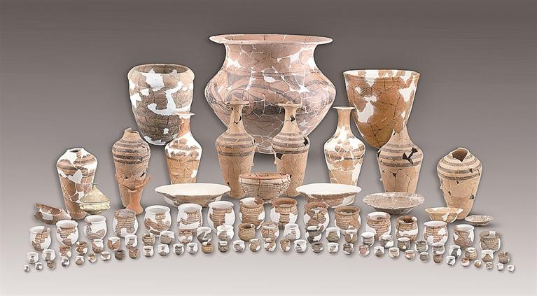
Pottery vessels unearthed at the Nanzuo archaeological site in Gansu Province, where archaeologists uncovered evidence of a large prehistoric capital-like settlement. Credit: Gansu Provincial Institute of Cultural Relics and Archaeology.
An Extraordinary Decision to Bury the Palace
The most puzzling discovery concerns what happened when the original palace ceased to function. Archaeologists found that its inhabitants had removed reusable structural components, including columns and beams, before filling much of the complex with compacted earth. In the front hall, alternating deposits of dark brown and pale yellow soil formed a dense artificial fill over the earlier floors.
This was not the gradual accumulation of earth around an abandoned building. The careful removal of construction materials and the deliberate filling of architectural spaces point to an organized operation requiring considerable labor. By raising and levelling much of the palace precinct, the inhabitants fundamentally altered the appearance and function of their monumental center.
The excavation team has found no clear evidence that an attack or violent catastrophe destroyed the original palace. Instead, the archaeological sequence suggests a planned transformation, although the reasons behind it remain unclear. The filling also explains the building’s exceptional preservation: the compacted earth supported its walls and protected architectural details that might otherwise have disappeared.
The inhabitants may have intended to prepare the site for new construction, mark the end of an important ceremonial period, or combine both objectives. Archaeologists now have substantial evidence of how the palace was buried, but determining the motivation behind the decision requires a closer examination of the objects left inside.
Broken Ceramics and Possible Rituals of Closure
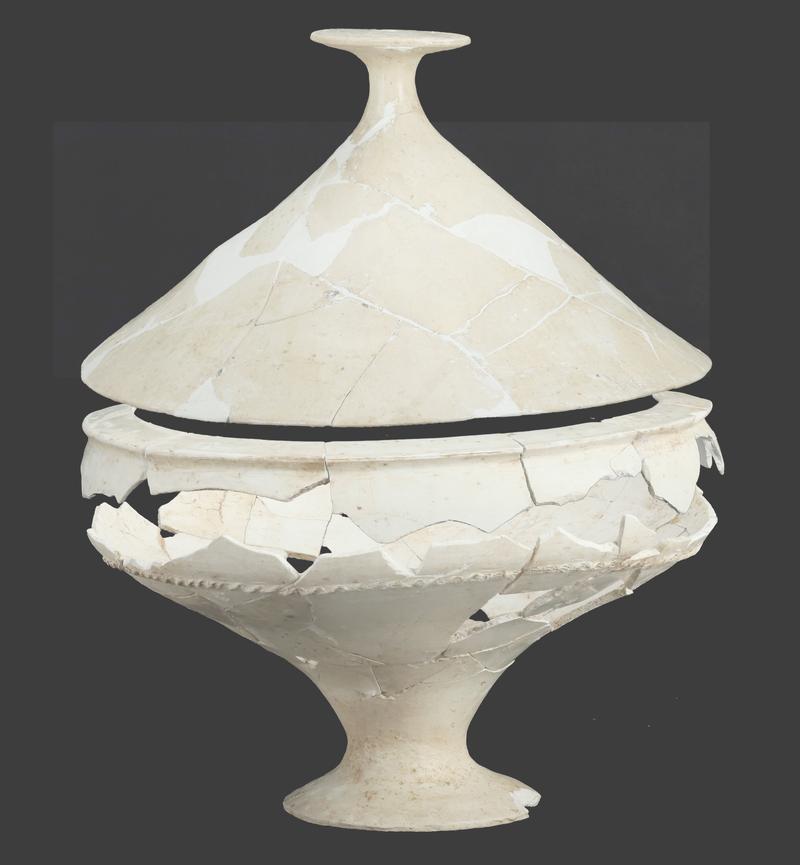
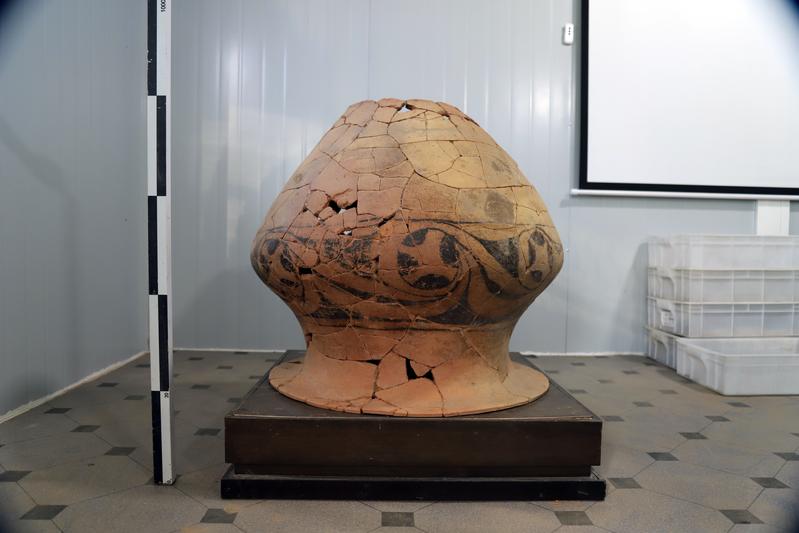
One of the most revealing discoveries came from F2, an approximately 70-square-meter ceremonial space immediately east of the main hall. Excavators uncovered hundreds of small white decorated pottery jars, nine painted ceramic bottles, a lidded white vessel, and a large painted jar standing nearly 70 centimeters tall. Some objects formed recognizable groups, while others lay broken among animal remains and traces of burning.
Researchers believe that F2 may have retained a ceremonial function during the transformation of the palace precinct. A September 2025 archaeological field assessment also reported intact pig skulls, white pottery fragments, and cinnabar-decorated vessels within deposits associated with the site. These finds raise the possibility that some of the filling activities involved ritual offerings or the deliberate deposition of significant objects.
Near F2, archaeologists identified an artificial winding channel with at least twelve bends within an area of approximately 15 square meters. They also recovered millions of carbonized rice grains from the ceremonial precinct east of F1, alongside substantial quantities of pig bones.
The presence of rice is particularly striking in a region where millet cultivation played an important role in prehistoric agriculture. Such concentrations may reflect offerings, food storage, communal consumption, or activities carried out over an extended period. These discoveries suggest that rituals may have accompanied the palace’s burial, although their exact purpose remains unclear.
New Buildings Above the Buried Palace
Archaeologists found traces of later buildings above the buried palace, indicating that the site remained occupied after the original complex fell out of use. However, little survives of these structures, making it difficult to reconstruct their original layout.
According to Zhang Xiaoning, the original palace remained in use for approximately 300 years, while occupation at Nanzuo continued for nearly another 200 years. Archaeological evidence suggests that people constructed new buildings over parts of the former palace complex during this later period. Zhang believes that the ruling group may have moved elsewhere, leaving part of the population behind.
The reasons for these changes remain unclear. The community may have needed new buildings, or the burial may have accompanied changes in political leadership or ceremonial traditions. For now, archaeologists have found no evidence that establishes which of these factors led to the palace’s abandonment.
Did Nanzuo’s People Move North to Shimao?
The question of what happened after Nanzuo’s decline has prompted a broader hypothesis from Han Jianye. Han suggests that some inhabitants may have migrated toward northern Shaanxi as Nanzuo lost its importance. Several centuries later, major centers such as Shimao emerged farther north, raising the possibility that cultural traditions from Nanzuo continued to influence communities elsewhere on the Loess Plateau.
Shimao, which flourished approximately between 2300 and 1800 BCE, became one of prehistoric northern China’s most impressive settlements. Its stone fortifications enclosed an area of more than four square kilometers, including monumental gates, substantial defensive walls, and a central complex that archaeologists associate with elite or ceremonial activities. Unlike Nanzuo’s predominantly rammed-earth architecture, Shimao developed an extensive stone-built defensive system.
The two sites belong to different archaeological contexts, and no direct evidence currently demonstrates that migrants from Nanzuo established Shimao. Nevertheless, Han’s hypothesis draws attention to the possibility that the decline of one major center did not necessarily mean the disappearance of its population, knowledge, or cultural influence.
Longdong, the eastern Gansu region where Nanzuo stands, may therefore have played an important role in the movement of people, materials, and ideas across the Loess Plateau.
Before China’s First Dynasties and Emperors
Nanzuo also challenges traditional assumptions about where China’s earliest complex societies emerged. Scholars have long focused considerable attention on the Yellow River’s middle and lower reaches and the Yangtze River basin, particularly sites such as Liangzhu. Nanzuo demonstrates that communities on the eastern Loess Plateau were also constructing monumental buildings and organizing large settlements around 5,000 years ago.
Wang Wei, a leading scholar involved in research into the origins of Chinese civilization, has compared Nanzuo’s importance with that of Liangzhu. He argues that the scale and organization of the settlement point toward an early form of state-level political authority. However, the precise character of Nanzuo’s institutions remains debated, particularly because archaeologists have not yet discovered large elite tombs that could reveal more about its leadership and social hierarchy.
Nanzuo predates the major Bronze Age centers associated with later early Chinese states, including Erlitou, which flourished during the second millennium BCE and features prominently in debates about the origins of the Xia dynasty. China’s first unified empire emerged much later, under the Qin dynasty in 221 BCE. Although archaeologists cannot trace a direct political line from Nanzuo to those later states, its architecture demonstrates that important foundations of organized political and ceremonial life existed millennia before imperial unification.
A Buried Palace and an Unfinished Story
The excavations at Nanzuo have revealed far more than an unusually well-preserved prehistoric building. They have uncovered a monumental center whose inhabitants mobilized large workforces, developed sophisticated architectural techniques, and participated in ceremonial activities involving elaborate pottery, valuable materials, and agricultural resources.
Yet the palace’s deliberate burial remains difficult to explain. Archaeologists can identify the removal of structural elements, the carefully compacted earth, the ceremonial deposits, and the subsequent rebuilding, but they cannot yet determine whether practical needs, changing political authority, or ritual traditions ultimately drove the decision.
Future investigations will focus on Nanzuo’s monumental center and the surrounding settlements of the Dongzhi Plateau and Malian River basin. Such work may clarify the relationship between the palace’s abandonment, possible population movements, and the rise of later regional centers.
