

Three unusual shapes carved across the upper part of Göbekli Tepe’s famous Pillar 43 have been compared to handbags, baskets and buckets for years. A new interpretation proposed by Turkish lecturer and interior architect Bora Uluurgun suggests that they may represent something far more consequential: schematic views of buildings, potentially pushing the history of architectural representation back thousands of years.
The idea is striking, but it should be treated as a hypothesis rather than a decipherment. What makes it worth examining is that the architectural interpretation itself is not without precedent. Archaeologists have previously suggested that the same three enigmatic forms could depict Göbekli Tepe’s monumental buildings, although no consensus has been reached over what the images actually mean.
Göbekli Tepe, in southeastern Türkiye, was used between roughly 9600 and 8200 BCE. Its monumental round, oval, and later rectangular structures contain massive T-shaped limestone pillars, many carved with humans, wild animals, and abstract signs. UNESCO describes the site as one of the earliest manifestations of human monumental architecture, although recent research has complicated the older popular description of Göbekli Tepe simply as the world’s first “temple.”
Pillar 43, often called the Vulture Stone, stands inside Building D and has become one of the most discussed objects from the site. Birds, a scorpion, snakes, geometric signs, and a headless human figure appear across its surface, imagery that researchers have connected particularly with death, ancestors, and Early Neolithic ritual practices. Near the top, however, sit three repeated rectangular forms capped by curved arches — the shapes popularly described as “handbags.”
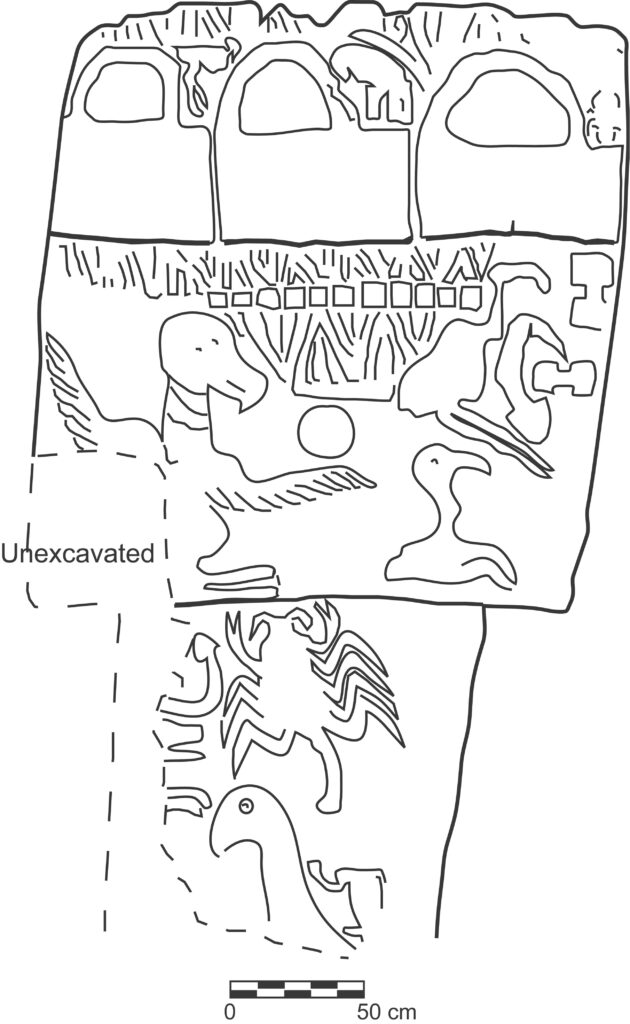
A building hidden inside a ‘handbag’?
Uluurgun argues that the resemblance to a modern bag is misleading. In his architectural reading, the curved upper part represents a roof or dome profile, the vertical sides correspond to structural supports or perimeter walls, and elements within the motif can be read in relation to the central T-shaped pillars and the space enclosed around them.
He takes the argument further by proposing that the three symbols represent separate monumental spaces at Göbekli Tepe and may function almost like simplified architectural sections. Their symmetry, interrupted by associated animal figures, is interpreted as meaningful rather than decorative, potentially identifying entrances or distinguishing individual structures.
If that interpretation is correct, the carvings would not be architectural drawings in the modern technical sense of scaled plans with measurements. They could instead represent something more fundamental: an attempt to reduce three-dimensional built space into a recognizable two-dimensional graphic form.
That distinction matters. A symbolic image of a building, an architectural elevation, a sectional representation, and a construction plan are not interchangeable concepts, and identifying the Göbekli Tepe symbols as one of them requires more than visual resemblance.
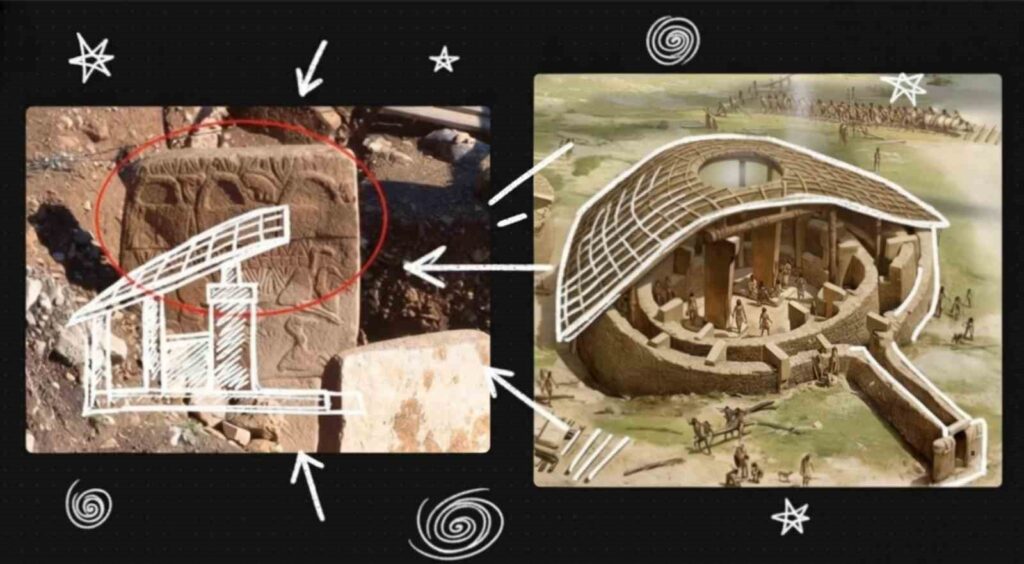
The architectural idea has an important precedent
The strongest argument in favor of taking the possibility seriously comes from earlier archaeological research.
In 2011, archaeologist Edward B. Banning suggested that the three “box-like objects with handle-like attachments” on Pillar 43 might actually depict Göbekli Tepe’s buildings. In his interpretation, the rectangular portions could represent walls, while the curved elements above them could show vaulted or domed roofs. Animals beside the structures might have functioned as emblems identifying particular groups or buildings.
Oliver Dietrich and Jens Notroff, researchers closely associated with the Göbekli Tepe project, subsequently entertained a closely related possibility. Discussing the motifs in 2016, they noted that the rectangular forms topped by “cupola-like arches” might show the enclosures from the side, with the rectangles representing perimeter walls and the arches indicating roofs. They nevertheless stressed that the meaning remained difficult to determine.
This changes how Uluurgun’s proposal should be understood. The possibility that the so-called handbags represent architecture is not entirely new; what is more distinctive is his attempt to decode individual components as architectural elements and connect the three images to a larger cosmological system.
There is also archaeological reason to believe that the builders of Göbekli Tepe were capable of sophisticated spatial planning. A 2020 study by Gil Haklay and Avi Gopher identified an underlying geometric relationship linking Buildings B, C, and D, and argued that the three monumental structures may have been conceived within a single architectural project. That does not prove that architectural drawings were used, but it demonstrates that complex geometric planning preceded or accompanied construction.
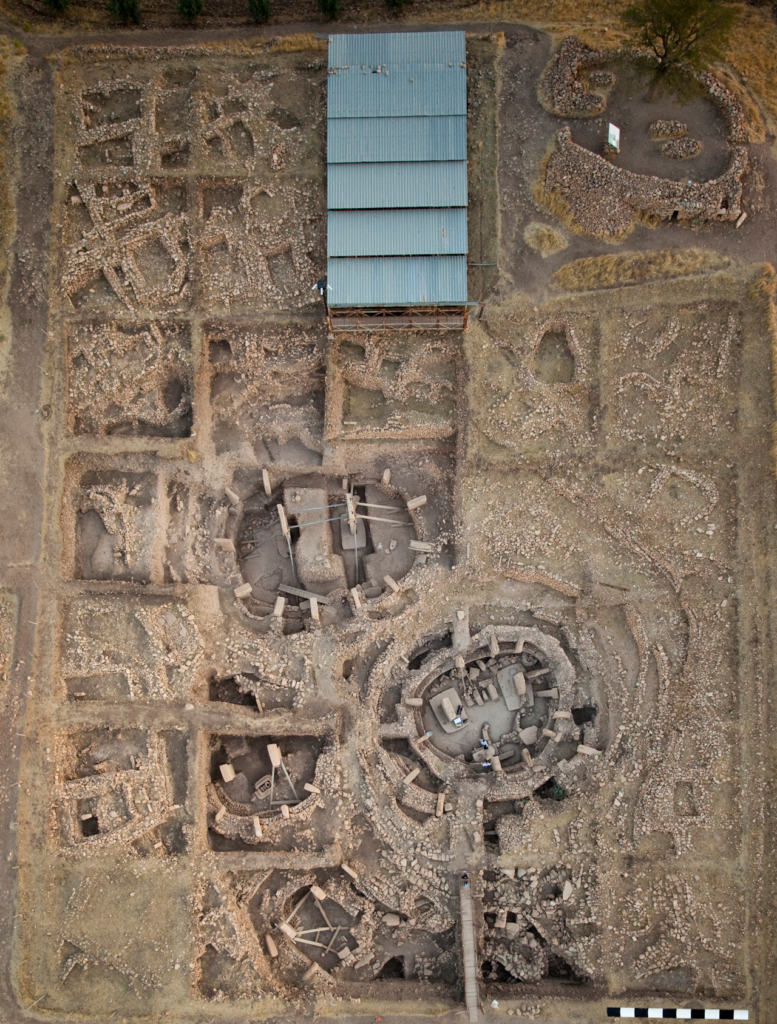
Why the case is still far from proven
Several problems prevent the “world’s oldest architectural drawing” interpretation from being accepted at face value.
The first is iconographic. The small animals associated with the three shapes have previously been interpreted as possible emblems connected with particular buildings or social groups, rather than architectural representations of entrances. Uluurgun’s reading therefore assigns a more specific structural meaning to details that archaeologists themselves have left unresolved.
There is also no surviving Neolithic key explaining how these symbols should be read. Unlike later Mesopotamian architectural plans, the Göbekli Tepe carvings contain no dimensions, labels, or written instructions that would establish their function as technical representations.
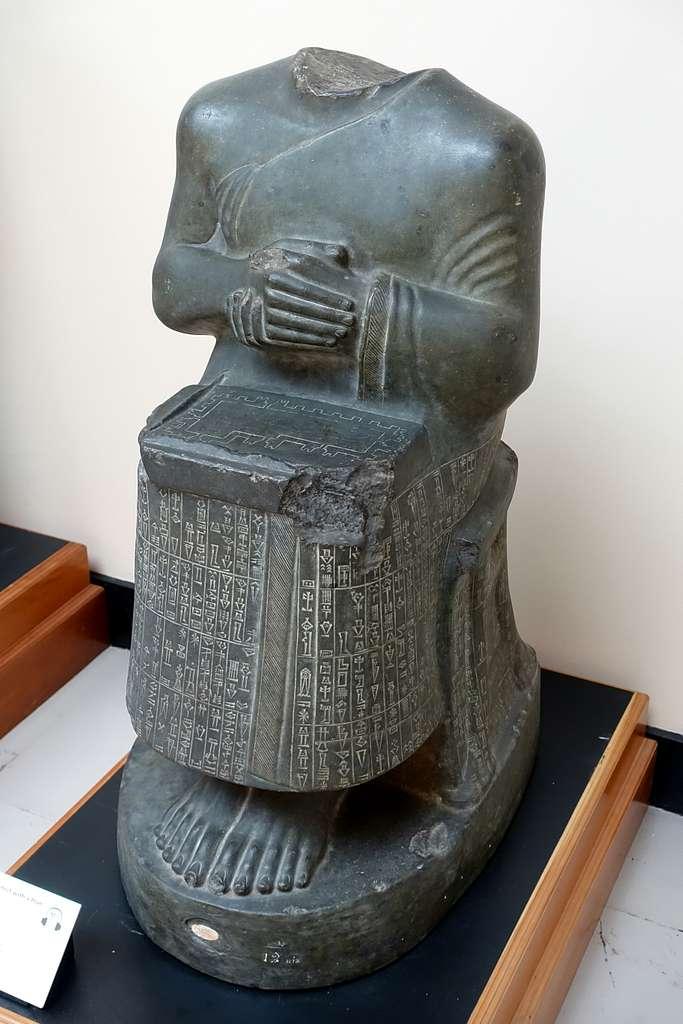
The comparison with later architectural drawings illustrates the problem. Around 2120 BCE, the Sumerian ruler Gudea was depicted with an unmistakable architectural plan laid across a tablet on his lap, complete with a graduated rule and stylus. The Louvre identifies the object explicitly as an architectural plan — evidence separated from Pillar 43 by roughly seven millennia but far less ambiguous in function.
An even earlier candidate comes from Çatalhöyük in central Anatolia. A wall painting dating to approximately the seventh millennium BCE has famously been interpreted as a plan of the settlement beneath an erupting volcano, although that interpretation remains contested; another scholarly reading identifies the supposed volcano as a leopard skin and the “houses” as geometric decoration. The controversy demonstrates how difficult it is to distinguish schematic representation from symbolic art in prehistoric contexts.
If the Pillar 43 motifs could eventually be demonstrated to represent actual buildings, however, they would predate the debated Çatalhöyük image by several thousand years.
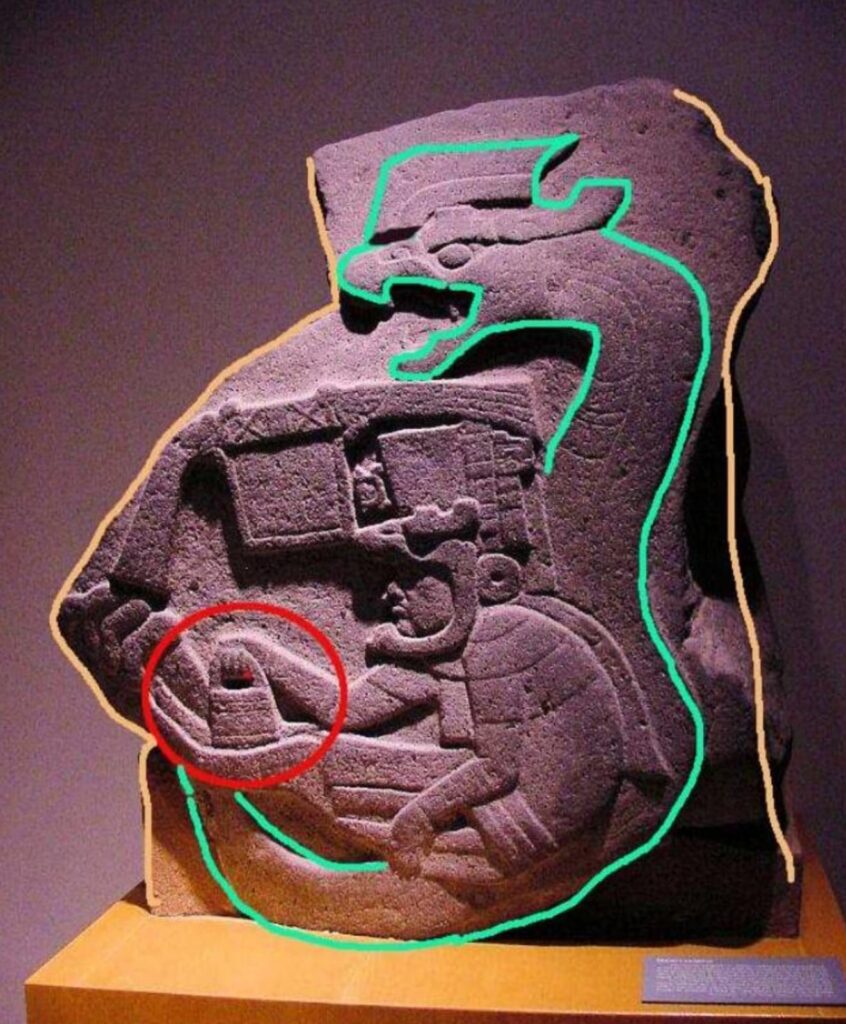
What about the famous ‘handbags’ elsewhere?
Similar-looking objects have often been brought into discussions of Göbekli Tepe, particularly Neo-Assyrian reliefs from Mesopotamia. Winged protective figures from the palace of Ashurnasirpal II at Nimrud, dating to the ninth century BCE, frequently carry objects that look remarkably like small handbags.
Here the archaeological evidence creates a problem for simple cross-cultural comparisons. The Assyrian object has a name: banduddû. Museum records and ancient textual evidence identify it as a bucket or pail associated with purification rites, often carried together with a mullilu, or sprinkler. In other words, although its silhouette resembles the Göbekli Tepe motif, the much later Assyrian example really was a container.
A handbag-like object also appears on the much later Olmec Monument 19 from La Venta in Mexico. The monument shows a human figure enclosed by a large feathered serpent and holding what researchers have described as a bag, sometimes interpreted as a ritual or incense container. Once again, similarity of shape does not demonstrate that the object represented architecture.
The Māori tradition of Tāne obtaining three baskets of knowledge from the heavens provides another intriguing numerical parallel to the three Göbekli Tepe forms. Yet the geographical and chronological distance is enormous, and no archaeological mechanism connects the traditions. Such examples can be useful when exploring how humans repeatedly used containers, tripartite systems and layered cosmologies as symbols, but they cannot establish the meaning of a carving made in southeastern Anatolia thousands of years earlier.
An architectural drawing remains possible, but not demonstrated
The most defensible conclusion is therefore more interesting than either extreme.
Calling the three shapes on Pillar 43 simply “handbags” risks imposing a familiar modern object onto an Early Neolithic visual system that remains only partly understood. At the same time, declaring them definitive architectural sections goes beyond what the archaeological evidence currently allows.
An architectural interpretation is nevertheless plausible enough to have been discussed independently by archaeologists for more than a decade. Göbekli Tepe’s builders clearly possessed sophisticated knowledge of geometry, structural organization and monument construction; representing those structures symbolically would not be inherently surprising.
What remains unknown is whether Pillar 43 preserves that knowledge in graphic form.
If the three enigmatic carvings really are representations of buildings, they would not merely change the interpretation of one famous Neolithic stone. They could represent one of the earliest surviving moments when humans transformed architecture from something built in physical space into something that could also be conceived — and recorded — as an image.
Sources
Banning, E. B. (2011). So fair a house: Göbekli Tepe and the identification of temples in the Pre-Pottery Neolithic of the Near East. Current Anthropology, 52(5), 619–660. https://doi.org/10.1086/661207
Banning, E. B. (2023). Paradise found or common sense lost? Göbekli Tepe’s last decade as a pre-farming cult centre. Open Archaeology, 9(1), 1–25. https://doi.org/10.1515/opar-2022-0317
Dietrich, O., & Notroff, J. (2016). A decorated bone “spatula” from Göbekli Tepe: On the pitfalls of iconographic interpretations of Early Neolithic art. Neo-Lithics, 1/16, 22–31. https://www.exoriente.org/repository/NEO-LITHICS/NEO-LITHICS_2016_1.pdf
Haklay, G., & Gopher, A. (2020). Geometry and architectural planning at Göbekli Tepe, Turkey. Cambridge Archaeological Journal, 30(2), 343–357. https://doi.org/10.1017/S0959774319000660
