

A Roman shrine in Suffolk has revealed an unusual ritual landscape where worshippers built beside a burial mound already around 2,000 years old and deposited animals, coins and other offerings around it.
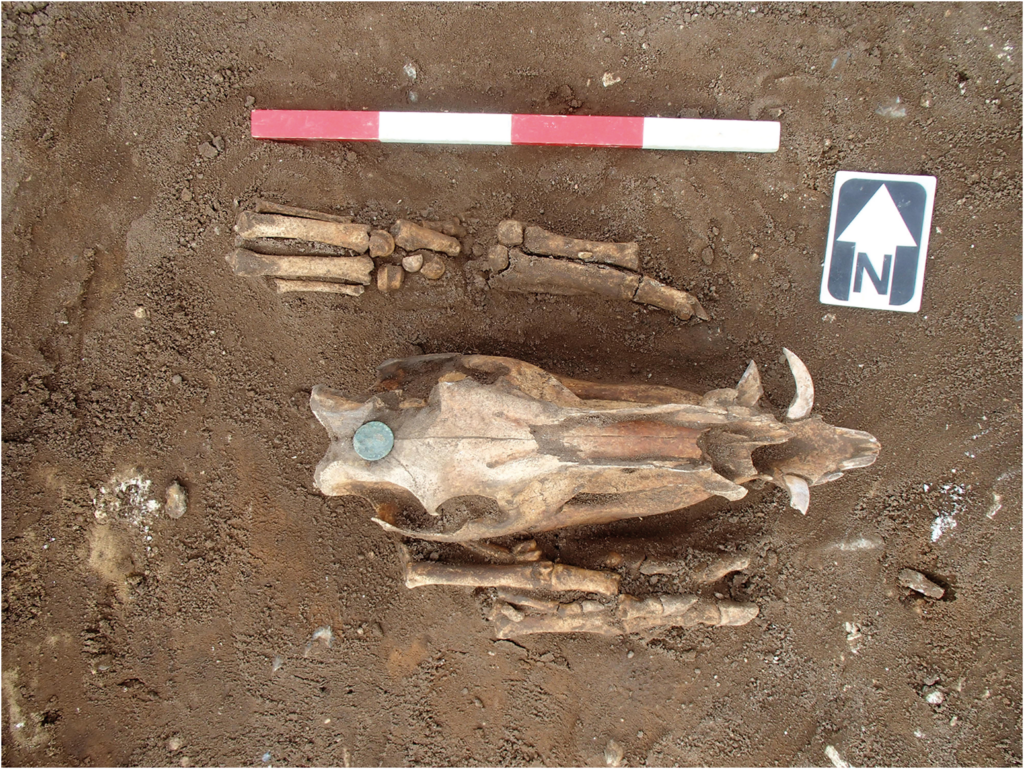
Among the most striking finds at Red Lodge were pig skulls deliberately placed facing the shrine. Roman coins rested on two of the skulls, while copper staining on another suggests that it may once have carried a coin as well. The discoveries offer a rare glimpse into ritual practices at a rural sanctuary that remained active for centuries.
The site was excavated by Archaeology South-East in 2016 ahead of residential development. Angus Forshaw has now published a detailed study of the complex in Britannia, revealing how a prehistoric funerary monument became the focus of Roman worship and later acquired yet another role in the medieval landscape.
A Roman Sanctuary Around an Ancient Burial Mound
At the centre of the site stood a large Early Bronze Age round barrow. Its surrounding ditch measured about 45 metres across, and dating of the lower deposits places its construction between roughly 2200 and 1600 BC. Farming later removed most of the mound itself, and no original burial survived.
The lack of other Bronze Age features nearby suggests that the surrounding ground may have been deliberately kept clear, allowing the monument to dominate the landscape. By the Roman period, its original meaning had almost certainly changed, but the mound remained conspicuous enough to attract renewed attention.
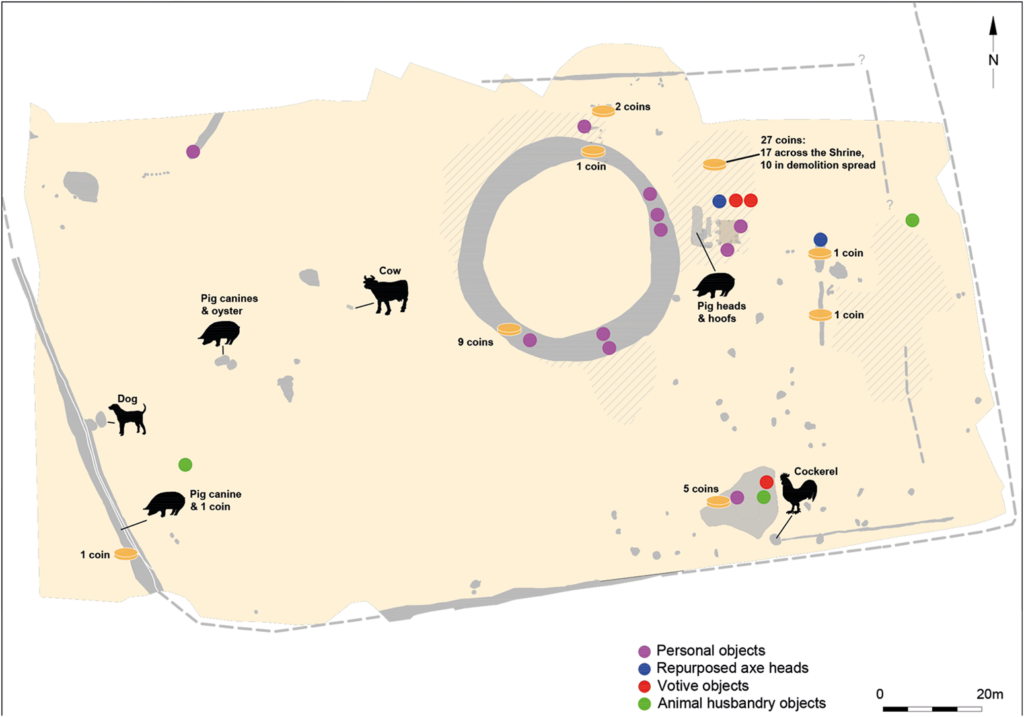
Probably in the early second century AD, a Roman community enclosed the barrow within a large rectangular temenos, or sacred precinct, measuring an estimated 200 by 160 metres. Archaeologists found no clear domestic settlement inside. Instead, internal boundaries, pits, animal deposits and a possible well point to a space organised around religious activity.
The Romans also maintained or recut the prehistoric ring ditch, showing that the old monument remained central to the sanctuary rather than simply surviving by chance.
A Small Shrine With Painted Walls
Immediately east of the barrow, excavators identified a small post-built structure interpreted as the sanctuary’s shrine.
The roughly rectangular building measured about 5 by 4.5 metres. Two possible column settings in its southeastern corner may have marked an altar, while the arrangement of the postholes suggests that visitors entering from the north could have faced this focal point directly.
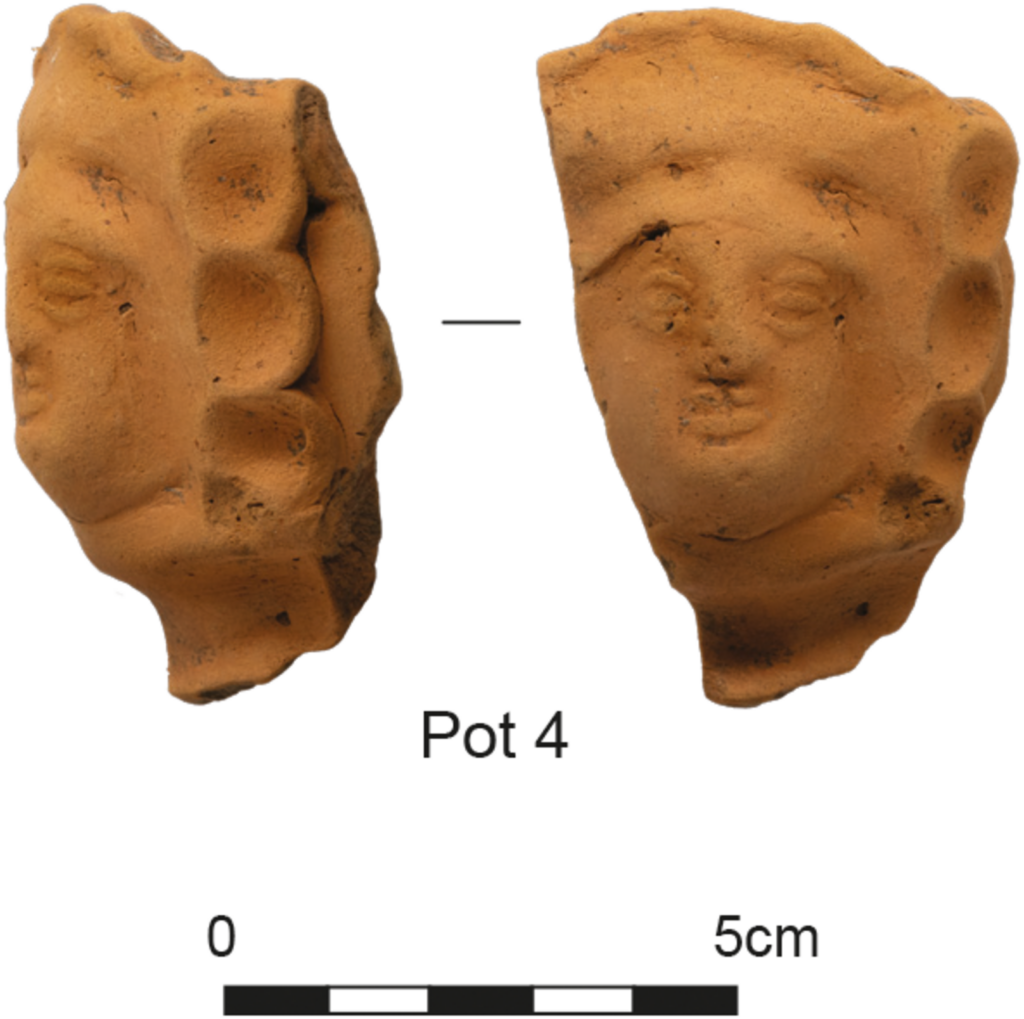
Although modest in size, the building was carefully finished. Archaeologists recovered around 48 kilograms of painted wall plaster, including fragments decorated mainly in white and red, with smaller areas of pink and green. More than 111 kilograms of roof tile found around the structure indicate that it probably had a tiled roof. Its scale and internal arrangement led Forshaw to compare it with a lararium-type shrine, though this example formed part of a much larger rural sacred complex.
Pig Skulls, Coins and Animal Offerings
The clearest evidence for ritual practice came from pits immediately west of the shrine.
Archaeologists uncovered six pig “head-and-hoof” deposits consisting of skulls accompanied by articulated limbs. All the skulls faced east toward the shrine, making deliberate placement difficult to doubt.
Two carried Roman coins on top. One was a sestertius of Antoninus Pius dated to AD 156/157, while another was a dupondius of Faustina from AD 142. Green copper staining on a third skull may mark the former presence of another coin.
The deposits accumulated over time rather than during a single ceremony. Different radiocarbon dates and later coins show that worshippers apparently reopened the pits and added new offerings repeatedly. One coin associated with the deposits dates to AD 345–350, indicating that the practice continued well into the fourth century. Most of the pigs were young adult males, and the articulated bones suggest that skin may still have connected the heads and feet when they entered the ground.
Other animal deposits show that pigs formed only part of the sanctuary’s ritual life. Near the probable entrance, archaeologists found a complete dog skeleton with a horse scapula. Elsewhere, a cockerel had been placed with a cattle scapula and deer antler, while a young cow was buried almost intact on the opposite side of the barrow. The cow showed no signs of butchery or consumption and dates to AD 238–384.
The diversity of these deposits makes it difficult to associate the sanctuary with one specific Roman deity. Forshaw suggests that the isolated rural shrine may instead have served a local cult or accommodated several forms of devotion.
Ritual Activity Extended Beyond the Shrine
Other features inside the enclosure help reconstruct how the sacred space may have functioned.
A deep shaft between the entrance and the barrow has been interpreted as a possible well. Its position along the route into the sanctuary raises the possibility that water played a role in cleansing or ritual preparation. Nearby, a pit contained around two kilograms of oyster shell and several pig canines. Although this does not prove that ceremonial feasting took place, the concentration stands out because oyster shell was rare elsewhere at the site.
A tile-lined flue north of the barrow may have belonged to an oven. It could have been used for preparing food or burning offerings, although no environmental evidence survived to confirm a ritual function.
Objects found around the shrine add another layer. Of 52 Roman coins recovered across the site, 27 came from the immediate vicinity of the building and another 11 from the nearby section of the Bronze Age ring ditch. Brooches, pins, tweezers and votive plaque fragments were concentrated in the same area.
Some objects were deliberately altered before deposition. A copper-alloy votive leaf had been folded, while one bracelet appears to have been intentionally broken. Archaeologists also found two Neolithic polished stone axes in Roman contexts. Such prehistoric tools sometimes acquired new meanings in Roman Britain and may have been regarded as curiosities, lucky objects or items with supernatural power.
From Sacred Ground to a Medieval Gallows Site
Activity at the sanctuary declined during the fourth century rather than ending in a sudden destruction. The latest finds suggest that regular use diminished around the middle of the century, although the place may have retained local significance after formal worship had ceased.
Centuries later, a man was buried face down in the upper fill of the former Roman enclosure ditch. Radiocarbon dating places him between AD 1169 and 1266. Documentary sources mention a gallows in this area during the 13th century, raising the possibility that the burial belonged to an execution victim.
No gallows structure survived, however, and the skeleton showed no trauma that could confirm hanging, so the connection remains a hypothesis rather than a proven identification.
Red Lodge therefore preserves an unusual sequence of changing beliefs around the same landmark. A Bronze Age community first raised a funerary monument there; Roman worshippers later enclosed it, maintained it and built a decorated shrine beside it; medieval authorities may then have chosen the same prominent location for punishment and execution.
For the Romans, the ancient mound seems to have mattered precisely because it already belonged to a distant past. The original stories surrounding it had probably been forgotten, but its age and position in the landscape gave it a new religious life — one preserved today in painted plaster, animal offerings and coins placed carefully on the skulls of sacrificed pigs.
Forshaw, A. (2026). A Reused Bronze Age Barrow and Roman Religious Shrine Site at Red Lodge, Suffolk. Britannia, 1–31. doi:10.1017/S0068113X26100841
