
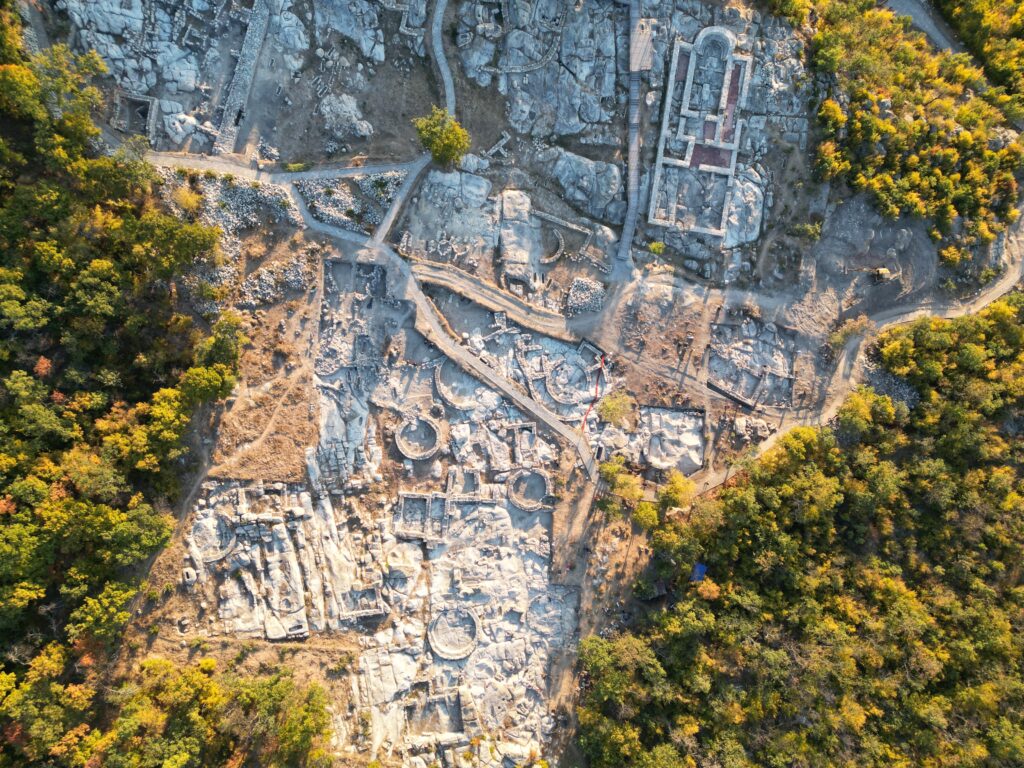
Perperikon is one of the most extensively excavated ancient sites in Bulgaria, yet archaeologists still know surprisingly little about the name its inhabitants used nearly 2,000 years ago. The city flourished during the Roman period, leaving behind monumental buildings, elaborate tombs and evidence of a prosperous community, but its identity in the written records of antiquity has remained uncertain.
The answer may lie in a name recorded by the second-century geographer Claudius Ptolemy. Archaeologist Prof. Nikolay Ovcharov first proposed the identification twenty years ago, when much of Perperikon’s Roman history was still emerging from the excavations. Now, drawing on the city’s archaeological remains and a closer examination of historical maps, he argues that the evidence for his interpretation has become considerably stronger.
A Forgotten City in Ptolemy’s Geography
The earliest name Ovcharov proposes for Perperikon is Pergamon, also known as Pergamos or Pergamum. It appears in Geography, the second-century work of Claudius Ptolemy, who recorded thousands of places throughout the ancient world and attempted to locate them using geographical coordinates.
Ptolemy placed a settlement called Pergamon in Inner Thrace, but finding its exact location has proved difficult. His geographical system differs from modern maps, and distortions in the surviving coordinates have complicated efforts to match ancient settlements with present-day archaeological sites.
Researchers have developed methods to correct these differences by comparing Ptolemy’s measurements with the known locations of ancient cities. Ovcharov points to work associated with the Technical University of Berlin and a project launched by Brady Kiesling in 2016, which have contributed to more precise interpretations of ancient geographical information.
When the position of Pergamon is considered alongside established reference points such as Philippopolis, modern Plovdiv, and Augusta Traiana, modern Stara Zagora, Ovcharov argues that its likely location moves toward the middle course of the Arda River. This places the mysterious settlement in the Eastern Rhodopes, near present-day Kardzhali, where the ruins of Perperikon stand.
Two Ancient Cities, One Possible Name
The proposed identification has an especially intriguing aspect. Pergamon was also the name of the famous ancient city in western Anatolia, which became the capital of the Attalid Kingdom and one of the great cultural centers of the Hellenistic world.
The two cities stood hundreds of kilometers apart, but their geographical settings share an important feature. Anatolia’s Pergamon developed around a steep, defensible hill crowned by an acropolis, while Perperikon occupies a commanding rocky height in the Rhodope Mountains, where generations of inhabitants carved buildings and sacred spaces directly into the stone.
This resemblance may help explain why both settlements could have carried the same name. Scholars have associated the ancient word Pergamon or Pergamos with pre-Greek linguistic traditions, and some interpretations suggest that it referred to a fortress, fortified height or acropolis. Although the word’s precise origin remains debated, its possible association with naturally defensible elevations is particularly relevant to these two sites.
Ovcharov also points to historical maps that place Pergamon in the Rhodope region. Cartographers including Abraham Ortelius in 1585, Johann Laurenberg in 1651, and André Male in 1683 reproduced the name while reconstructing ancient geography from Ptolemy’s writings.
One map in particular has attracted his attention. In 1801, Joseph-Romain Joly, a cartographer working at Napoleon’s headquarters, depicted the Arda River under the name Arpeskos and marked Pergamon near its middle course, close to modern Kardzhali.
These maps do not independently establish the city’s location, since they largely follow Ptolemy’s geographical tradition. Nevertheless, Ovcharov considers the repeated placement of Pergamon in the Eastern Rhodopes significant, particularly in light of Perperikon’s archaeological remains.
Twelve Mausoleums Reveal the Wealth of Roman Perperikon
The latest excavations at Perperikon have also revealed more about the city’s importance during the Roman period. Over four months of work in the Southern Quarter, Ovcharov’s team uncovered new monumental tombs and architectural remains that offer a closer look at the wealth and development of the ancient settlement.
Their work in the sacred funerary zone, known as Area Sacra, revealed three additional circular mausoleums dating between the third and sixth centuries AD. The team has now identified twelve of these monumental tombs, alongside rock-cut graves and sarcophagi that belonged to the city’s inhabitants.
Ovcharov describes the area as a Roman via sepulchralis, a road lined with funerary monuments. He compares its arrangement with the burial roads of Pompeii and the famous Appian Way outside Rome, where prosperous families constructed elaborate tombs to commemorate their dead.
The Perperikon mausoleums suggest a similarly wealthy urban community. Their size and architectural character also provide important evidence of the settlement’s development during the Roman and early Byzantine periods.
Not far from the tombs, excavators began investigating a previously unknown monumental building dating to the fourth century, during the reigns of Constantine the Great’s successors. Its builders used precisely dressed stone blocks, while the surviving entrance includes a carefully fashioned stone threshold.
The structure stands only twenty meters from an early Christian basilica measuring nearly forty meters in length. Ovcharov believes the building may have later served as a residence for the city’s bishops during the fifth and sixth centuries, although archaeologists have not yet established its original purpose.
A Byzantine Imperial Seal and an 11th-Century Christian Reliquary
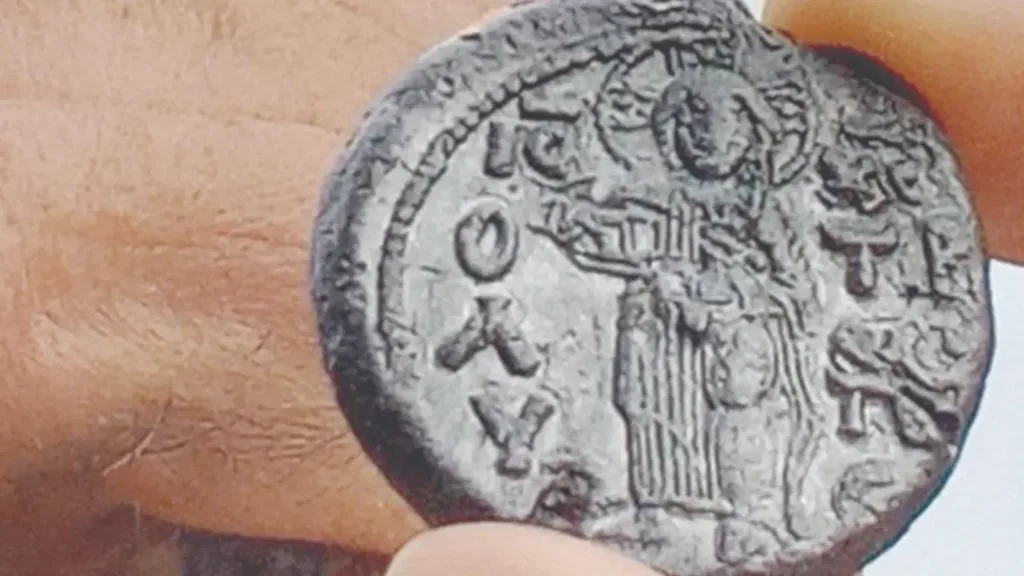
The 2026 excavations also uncovered Christian reliquary crosses, silver and bronze ornaments, and several statuettes. Among the most significant discoveries was a seal belonging to Irene Komnene Laskarina, wife of the 13th-century Byzantine emperor John III Doukas Vatatzes, reflecting Perperikon’s connections with the Byzantine imperial world.
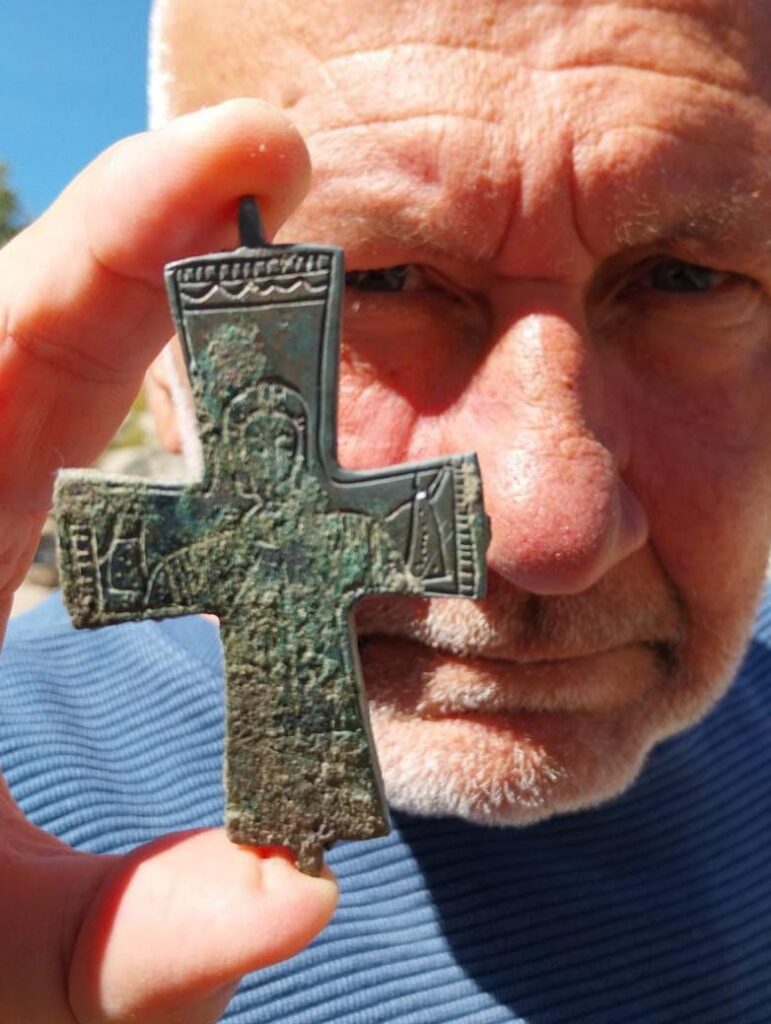
The reliquary crosses offer a glimpse into the personal religious practices of medieval Christians. In the Byzantine world, people often wore these crosses around their necks, sometimes carrying small sacred relics inside them. They regarded the objects as symbols of faith and spiritual protection. During the final days of excavation, the team also discovered an 11th-century bronze reliquary bearing an image of the Virgin Mary.
For Ovcharov, the growing archaeological record also strengthens his proposal that Perperikon was the Pergamon mentioned by Ptolemy nearly 2,000 years ago. Although no inscription has confirmed the identification, the possibility of a shared ancient name adds another dimension to the history of this remarkable rock-cut city.
Source: Prof. Nikolay Ovcharov
