
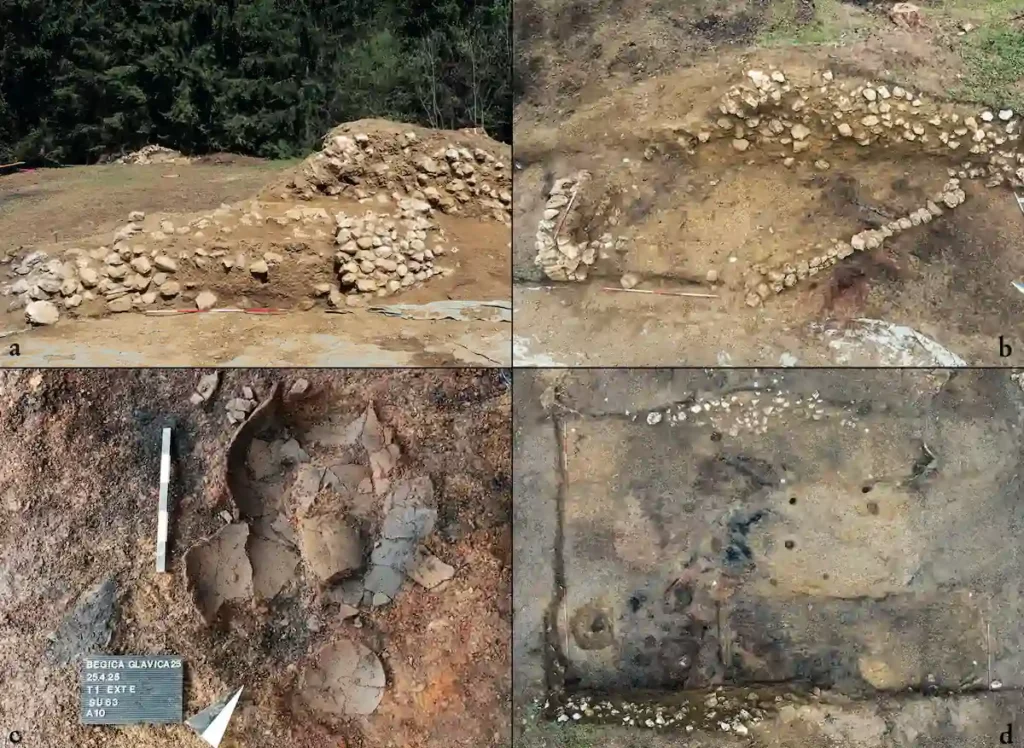
High above the Lašva River valley in central Bosnia, a quiet hilltop has begun to tell an unexpected story. What once appeared to be an unremarkable rise in the rugged Dinaric landscape is now emerging as one of the most unusual ritual sites discovered in the Balkans—an ancient sanctuary shaped not by defense, but by memory, fire, and centuries of human return.
Recent excavations at Begića Glavica, near the city of Travnik, have uncovered a Late Bronze Age ceremonial complex centered around a striking architectural feature: a massive L-shaped stone wall that encloses nothing, protects nothing, and yet dominates the entire site. Instead of serving a military function, archaeologists now believe it was built to seal and monumentalize something far more symbolic—a burned structure buried beneath it.
The findings, published in Archaeologia Austriaca, are reshaping how researchers understand ritual landscapes in prehistoric southeastern Europe.
A Discovery Triggered by Chance
The story of Begića Glavica began not with a planned survey, but with an unexpected find. In 2022, unauthorized metal detectorists uncovered a hoard of bronze objects along a visible stone rampart. The collection—later handed to the Regional Museum of Travnik—included hundreds of small metal items such as belt buckles, decorative fittings, and sheet fragments.
Initial analysis suggested that at least part of the assemblage dated to the 6th century BC. Yet this was only the latest chapter in a much longer story.
Intrigued by both the scale of the hoard and the unusual structure visible on the surface, archaeologists from the Austrian Archaeological Institute and Bosnian institutions launched systematic excavations in 2024 and 2025. What they uncovered went far beyond expectations.
A Wall Without a Defensive Purpose
At first glance, the wall resembles the fortifications typical of Bronze Age hilltop settlements across the Balkans. These “gradina” sites are usually positioned on elevated terrain, encircled by defensive barriers, and associated with long-term habitation.
But Begića Glavica breaks every rule.
Instead of forming a protective perimeter, the wall runs in an L-shape across the plateau, dividing it into two sections. Measuring roughly 63 meters in length and reaching up to three meters in height, it does not block access or guard a settlement. Rather, it appears to define a space—without enclosing it.
This architectural anomaly has no close parallel in the region.
Even more telling is how it was built. The structure incorporates whitish limestone not found locally, requiring transport from at least 1.5 kilometers away. The effort involved suggests a coordinated, labor-intensive project, likely carried out over multiple phases.
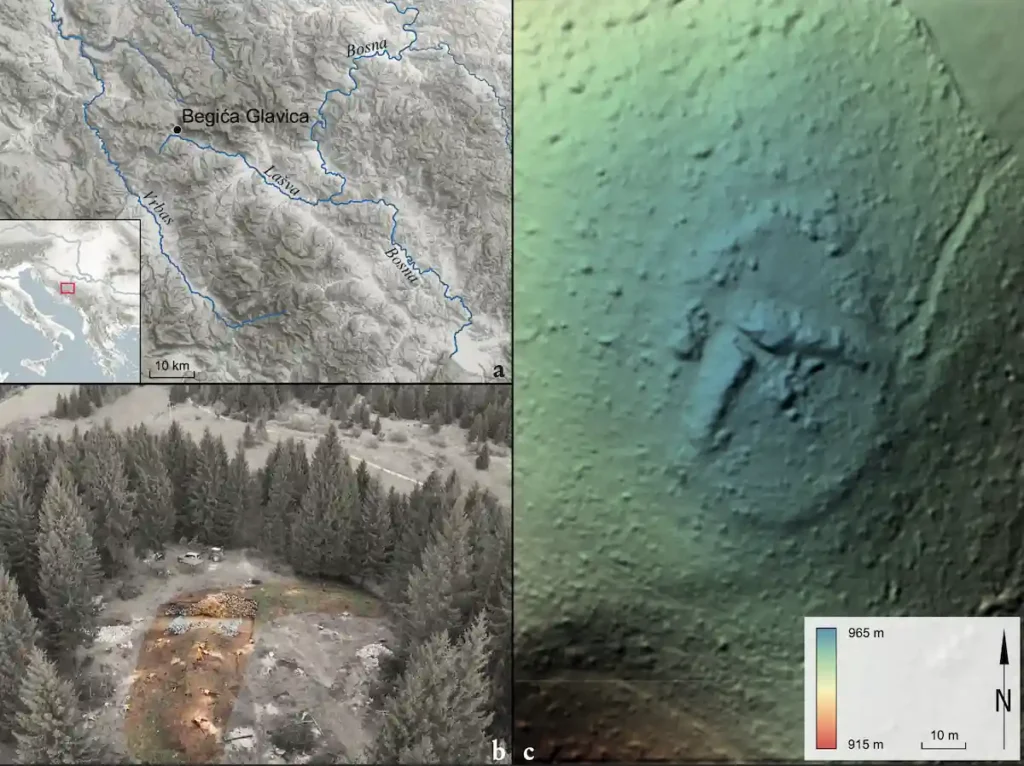
What Lies Beneath the Stones
The most revealing discovery came from beneath the wall itself.
Excavators uncovered the remains of a burned structure preserved in remarkable detail. Charred wooden planks, fragments of flooring, and a clearly defined walking surface were found exactly as they had been at the moment of destruction. Ceramic vessels remained in situ, frozen in time by the fire.
Two large storage jars stood out. One had collapsed and lay overturned; the other had been deliberately set upright into the ground. Their positions suggest intentional placement rather than random destruction.
Stratigraphic evidence leaves little doubt: the wall was constructed directly over these burned remains. It was not simply built nearby—it was designed to cover, seal, and perhaps commemorate what lay beneath.
This raises a fundamental question: why would a community bury its own past so deliberately?
Ritual Activity Over Centuries
Radiocarbon dating provides a timeline that stretches across centuries. Samples from animal bones indicate that the burned structure dates between the 11th and 9th centuries BC, while broader activity at the site spans from the 13th to the 9th centuries BC.
Yet the presence of later metal objects, including those from the 6th century BC, reveals that the site remained significant long after the original structure was destroyed.
This was not a one-time event. It was a place repeatedly revisited.
Archaeologists found no evidence of sustained domestic life on the plateau. Outside the buried structure, there are no houses, no hearths, no everyday debris. Instead, the material record points to intermittent gatherings—moments when people returned, deposited objects, and perhaps performed rituals tied to the memory of the site.
Metal finds reinforce this interpretation. Carefully arranged ornaments, including anklets, bracelets, and spirals, were placed deliberately within the wall’s structure. A broken spearhead and a decorated pin—types linked to Central European traditions—suggest connections that extend far beyond local cultural boundaries.
A Cultural Crossroads
The pottery discovered at Begića Glavica adds another layer of complexity. Unlike nearby hillforts, where incised geometric patterns dominate, this site is characterized by pottery with channelled and faceted decoration.
Such styles are more typical of the Urnfield cultural horizon, which spread across the Carpathian Basin and the Danube region during the Late Bronze Age.
This suggests that Begića Glavica was not an isolated local shrine. It may have functioned as a meeting point—a place where different cultural influences converged, and where communities from varying regions interacted.
The discovery of a small clay figurine combining human and animal features—possibly representing a masked or hybrid figure—further hints at symbolic or ritual practices that remain only partially understood.
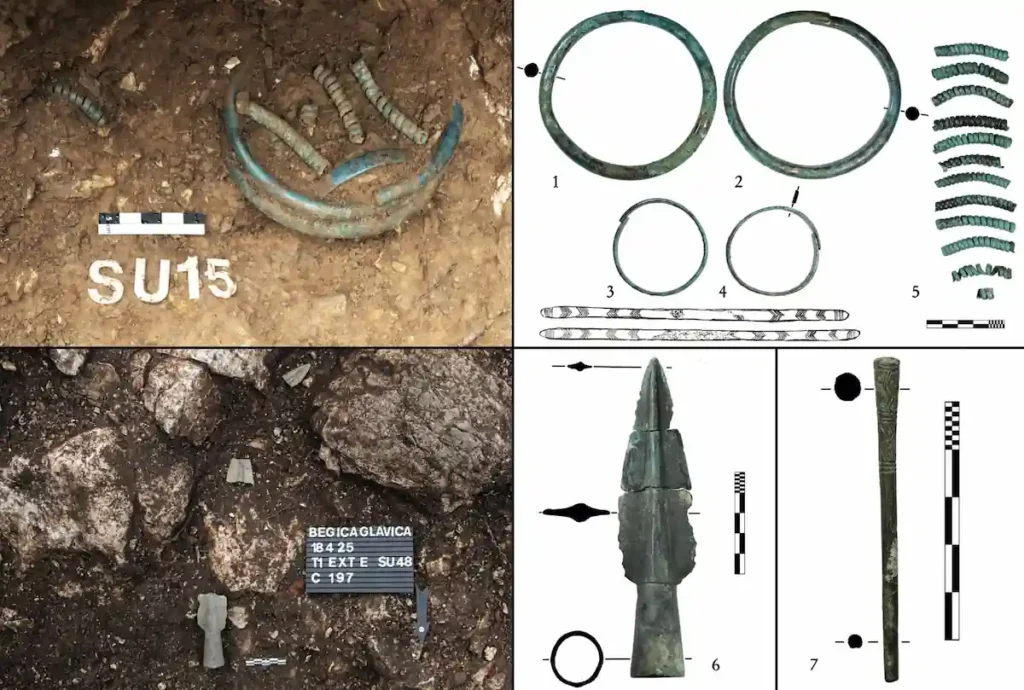
N. Mittermair). Credit: Gavranović et al. (2026), Archaeologia Austriaca
Fire, Memory, and Meaning
Perhaps the most compelling aspect of the site is its relationship with fire.
The burned structure beneath the wall was not erased. It was preserved, sealed, and integrated into the monument itself. This deliberate act suggests that the destruction—whether accidental, violent, or ritual—held lasting significance.
Archaeologists are considering multiple interpretations. The fire could represent a catastrophic event later memorialized by the community. Alternatively, it may have been part of a ritual act of destruction, followed by the construction of the wall as a form of commemoration or transformation.
Either way, the site became a focal point of collective memory.
Centuries after the initial event, people continued to return. They deposited metal objects, gathered for feasts, and maintained a connection to a place defined not by habitation, but by remembrance.
A Sanctuary Without Walls
Begića Glavica challenges long-standing assumptions about prehistoric architecture in the Balkans. It is neither a settlement nor a fortress. It is a structured landscape of meaning—an open sanctuary shaped by repeated human actions over generations.
Its wall does not defend. It defines.
Its center is not a building, but a memory sealed in stone.
As excavations continue, archaeologists expect that further work beneath the remaining sections of the wall will reveal additional layers of activity. Each new find has the potential to refine our understanding of how ancient communities in this region engaged with space, ritual, and the past.
For now, Begića Glavica stands as a rare and powerful example of how architecture can serve not as a barrier, but as a bridge—linking generations through shared memory, long after the fire has gone out.
Gavranović, M., Sejfuli, A., Petschko, I. M., & Mittermair, N. (2026). Begića Glavica, a Late Bronze and Early Iron Age sanctuary in central Bosnia. Archaeologia Austriaca, 110, I–VII. Österreichische Akademie der Wissenschaften.
Cover Image Credit: a. Rectangular core of the rampart (from the south); b. Rectangular core of the rampart and burnt layer underneath (from the south); c. Overturned pithos within burnt structure; d. Burnt structure under the rampart. Gavranović et al. (2026), Archaeologia Austriaca
