
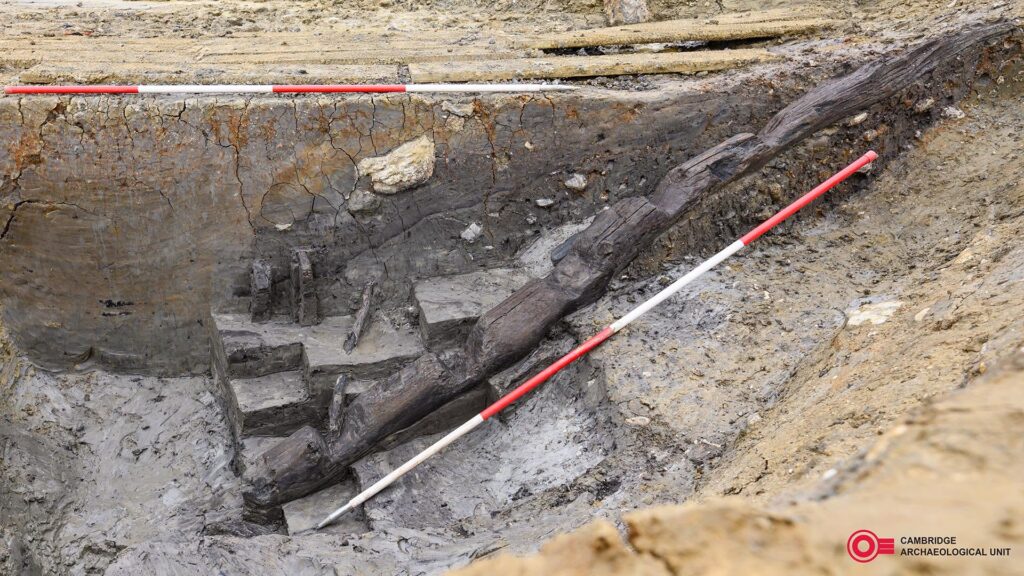
A waterlogged watering hole at West Cambourne in Cambridgeshire has produced a rare prehistoric wooden ladder, now described as the longest log ladder currently known from Britain.
The ladder survives to more than 3 meters in length and was found in a large watering hole associated with Late Iron Age activity. According to contextual information from the excavation, the object probably dates to the Late Iron Age, placing it in the final centuries before the Roman conquest of Britain. The Cambridge Archaeological Unit described the West Cambourne find as the “longest log ladder currently known from Britain.”
A rare wooden survival from an Iron Age watering hole
The find is important partly because of what it is not. It is not a ceremonial object, a rich burial good, or a monumental structure. It is a practical piece of rural technology: a wooden ladder used to access water.
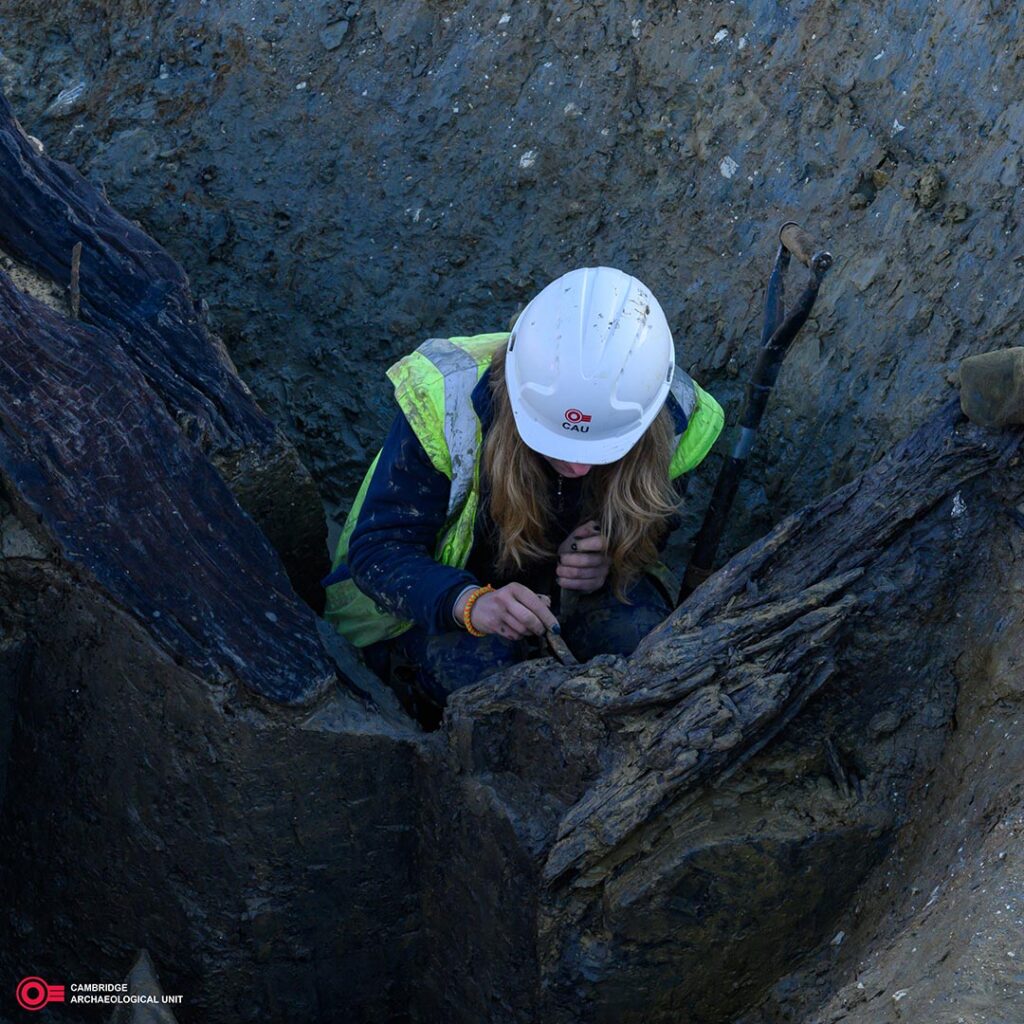
Organic materials such as wood rarely survive for long in most archaeological contexts. At West Cambourne, the ladder was preserved because it lay in waterlogged conditions, where reduced oxygen levels slowed decay. The feature itself was substantial. Cambridge Archaeological Unit material describes one of the largest archaeological features at West Cambourne as a watering hole measuring about 25 meters long and 14 meters wide.
Such watering holes were not minor landscape features. In Iron Age farming communities, they would have helped sustain livestock and manage access to water in heavy clay landscapes. The ladder suggests people were not merely digging pits and letting them fill naturally; they were maintaining and using these features in a controlled way.
West Cambourne was already a lived-in landscape
The discovery was made during archaeological work linked to the Burghley Green and Chivers Rise developments at West Cambourne. Excavations carried out by the Cambridge Archaeological Unit covered a five-hectare area and recorded more than 150 archaeological features dating back roughly 2,000 years, to Iron Age and early Roman communities.
Among the recorded features was a 24-meter circular enclosure, probably used by Iron Age communities to manage livestock. The excavation also produced everyday material, including pottery, animal bones, and burnt stones, suggesting cooking and routine domestic or agricultural activity. More than 780 pieces of Roman-period pottery were also recovered, pointing to early Roman activity on the same landscape.
These finds place the log ladder within a working settlement environment rather than an isolated discovery. The picture is of a rural community using the West Cambourne landscape for animals, fields, water management, and domestic life.
Earlier Cambourne finds add a wider context
West Cambourne is part of a wider archaeological landscape west of Cambridge. Earlier large-scale work at Cambourne by Wessex Archaeology recorded more than 1,000 years of settlement activity across about six square kilometers, with evidence spanning the Iron Age, Roman occupation, and Saxon periods.
Those earlier excavations showed that Cambourne had been occupied from around 800 BC to around AD 800, a long sequence that surprised archaeologists because the thick clay soils had once been thought unlikely to preserve substantial early settlement evidence.
The older Cambourne excavations produced Roman domestic items including cutlery, keys, tweezers, brooches, and pins. They also revealed later Roman burials, including skeletons placed in ditches and coffins, and one burial in which the head had been removed after death, a practice known from Roman Britain but still difficult to interpret in individual cases.
Other archaeological work west of Cambourne has also identified Middle Iron Age to Roman settlement activity, including enclosed settlements, roundhouses, metalled surfaces, middens, large boundary ditches, possible timber structures, and at least one feature interpreted as a waterhole.
What the ladder tells us
The West Cambourne ladder adds a rare wooden object to a landscape already known for Iron Age and Roman settlement. Stone, pottery, metal, and bone often dominate the archaeological record because they survive more readily. Wood usually disappears, leaving only stains, postholes, or indirect evidence.
Here, the preserved ladder gives a more direct view of how people physically interacted with a managed water source. It suggests maintenance, repeated access, and practical engineering at a small rural scale. That is precisely why the find matters: it shows ordinary infrastructure, not elite display.
The Late Iron Age communities of Cambridgeshire were not living in a static or marginal landscape. At West Cambourne, the evidence points to fields, livestock management, water control, cooking, pottery use, and later Roman adaptation. The log ladder is one object, but it belongs to a larger story of settlement and land use on the clay uplands west of Cambridge.
Cover Image Credit: Cambridge Archaeological Unit via Facebook
