The kings of Assyria made certain that history would remember them. Their victories covered palace walls, their names filled cuneiform tablets, and colossal stone guardians stood at the gateways of cities built to display their power. For much of modern archaeology, however, the women who shared that royal world remained little more than shadows beside them.
That changed dramatically beneath the floors of the Northwest Palace at Nimrud in northern Iraq. Iraqi archaeologists working there in the late 1980s uncovered a series of royal burials containing the remains and possessions of Assyrian queens, surrounded by extraordinary gold jewelry, precious stones, vessels, seals and ornaments that had survived for roughly 2,700 years.
The discovery ranks among the richest archaeological finds ever made in the ancient Near East. The University of Chicago’s Institute for the Study of Ancient Cultures, which later published the tombs with Iraq’s State Board of Antiquities and Heritage, concluded that their elaborate gold jewelry and other objects rivaled those from Egyptian royal tombs in both quality and quantity.
The comparison inevitably brings Tutankhamun to mind, but Nimrud tells a very different story. Instead of one young pharaoh preserved in a single famous burial, the palace concealed generations of royal women whose names — Yabâ, Banītu, Ataliya and Hama among them — suddenly emerged from beneath the floors of the Assyrian court.
A discovery hidden beneath a palace everyone thought they knew
Ancient Kalhu, now known as Nimrud, became an Assyrian royal capital under Ashurnasirpal II in the ninth century BC. His enormous Northwest Palace had attracted archaeologists since the nineteenth century, and later excavations uncovered its carved reliefs, ivories and monumental architecture, making it one of the best-known buildings of the Assyrian world.
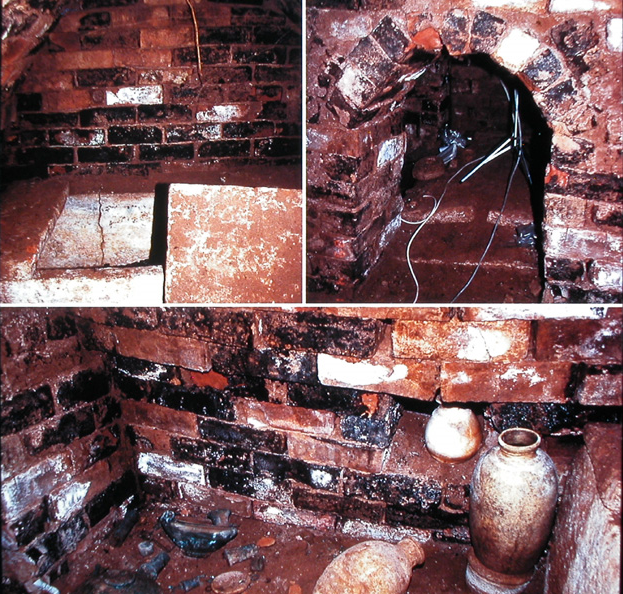
Yet part of its greatest secret remained below ground. When Iraqi archaeologist Muzahim Mahmoud Hussein and his team investigated the palace’s domestic quarters in 1988 and 1989, irregularities in the floors led them downward rather than outward, into stone-built burial chambers concealed beneath rooms once occupied by the royal household.
The discovery must have been particularly striking because earlier archaeologists had already worked extensively in the same palace. Beneath a building familiar from generations of excavation lay sealed spaces containing a side of Assyrian court life that monumental inscriptions had barely preserved.
Archaeologists eventually documented several burial structures beneath this area of the palace. Some contained more than one individual, and the relationship between the bodies, inscribed objects, and original tomb owners remains complex, but the inscriptions made one fact unmistakable: women of the Assyrian royal house had been buried here.
For scholars, that mattered almost as much as the gold. Assyrian kings such as Tiglath-Pileser III, Sargon II and Shalmaneser V occupy entire chapters of Near Eastern history, while their queens appear far less frequently in surviving records. The graves offered something unusually intimate — their bodies, jewelry, personal objects and, in several cases, their names.
Gold covered the bodies from head to foot
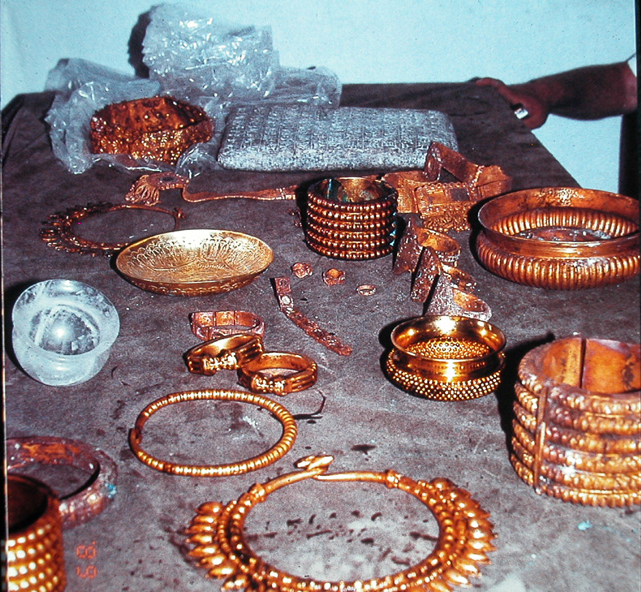
Nothing, however, prepared the excavators for the richness of some of the burials. Tomb II in particular contained two female bodies surrounded by hundreds of objects, many of them made from gold and arranged in or around layers of clothing.
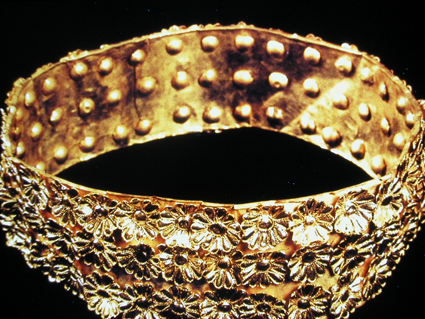
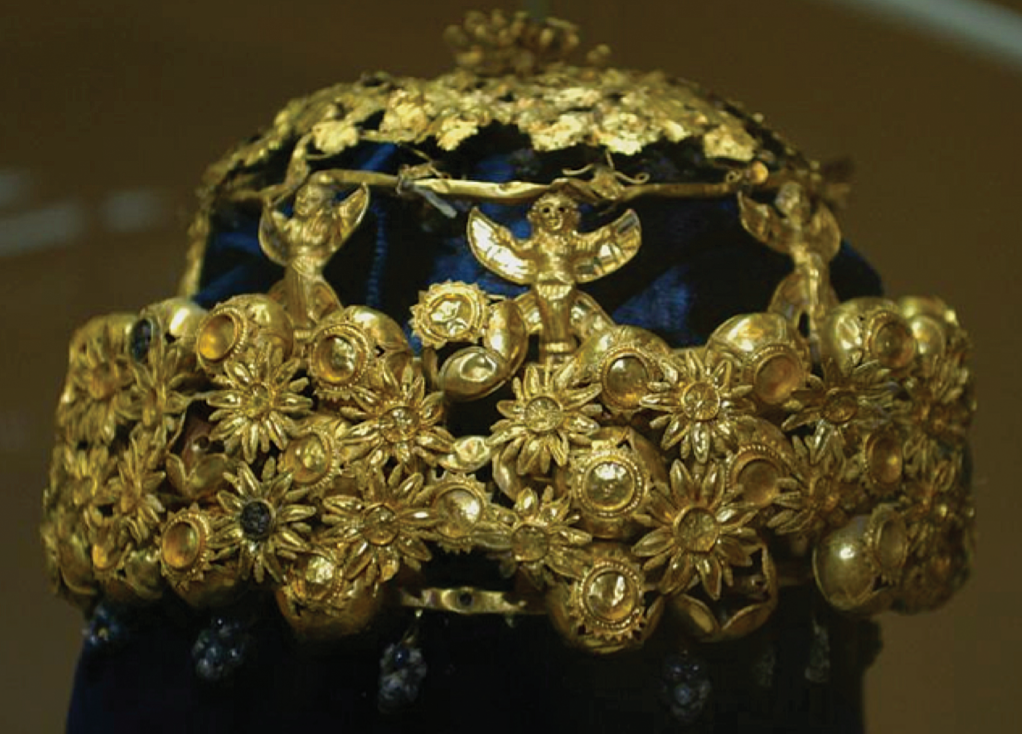
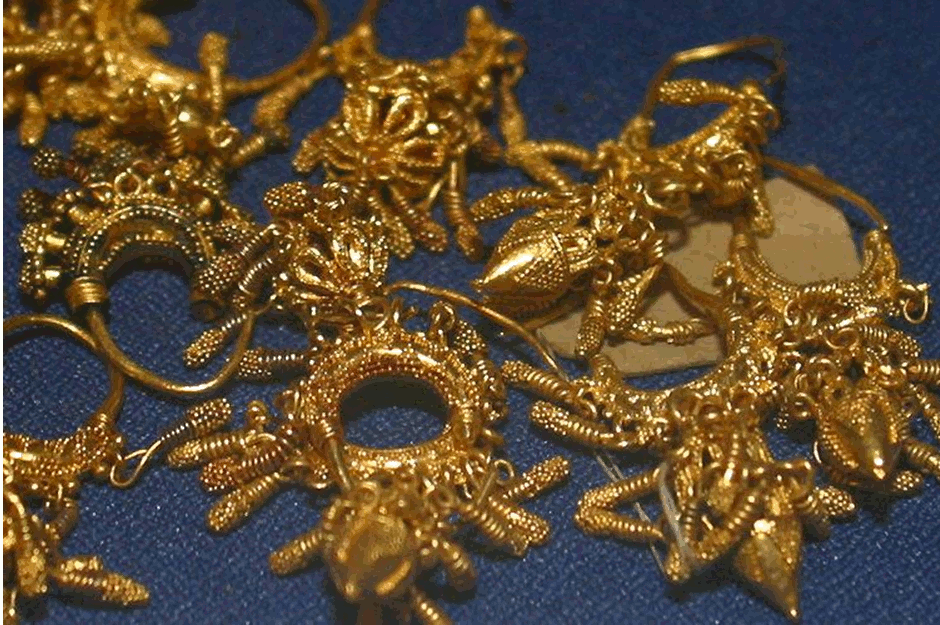
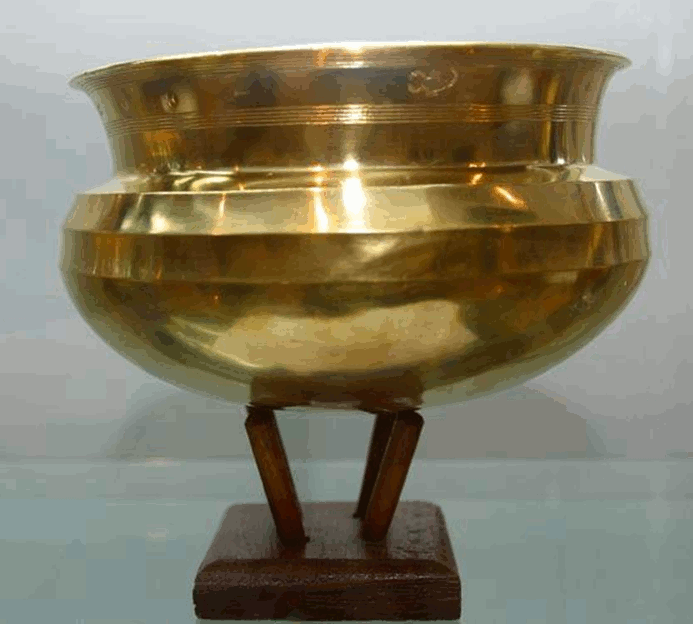
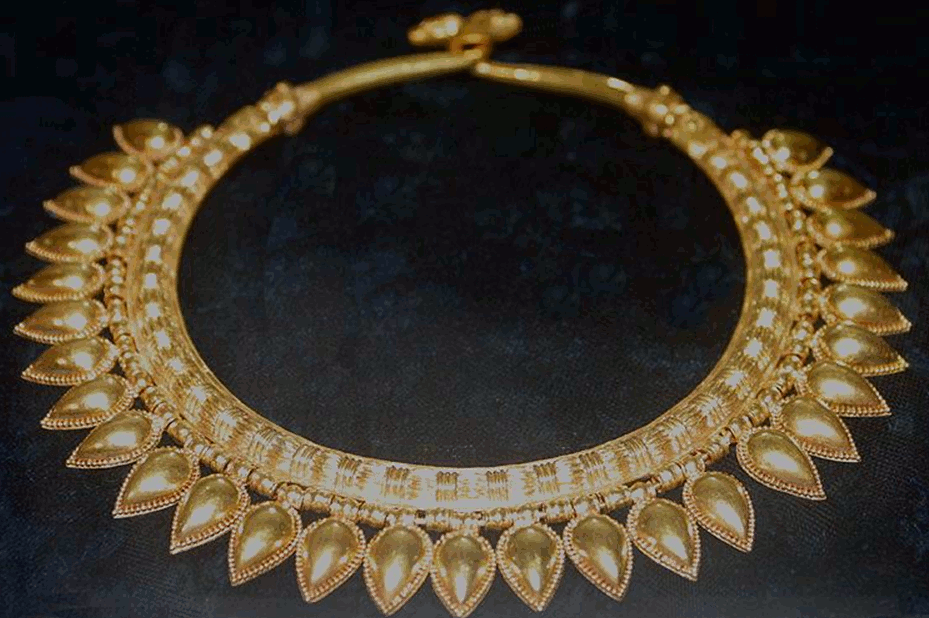
A gold bowl carrying the name of Queen Ataliya lay on the breast of the upper body. Near the skulls were a crown and an extraordinarily elaborate gold diadem, while earrings, a gold neck torc, finger rings, bracelets and anklets completed an ensemble that had once covered the body from head to foot.
The diadem alone demonstrates the skill of the craftsmen who supplied the Assyrian court. Woven gold bands joined decorated sections set with stones, while dozens of tiny gold braids ended in pomegranate-shaped beads. Rosettes, granulation, and carefully constructed hinges turned the object into something far more sophisticated than a simple display of precious metal.
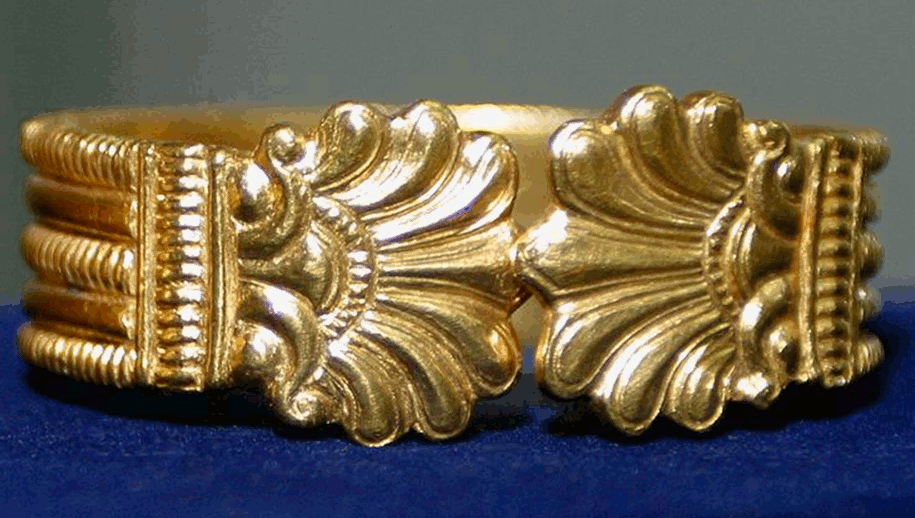
The bracelets could be equally elaborate. Some showed kneeling supernatural figures beside sacred trees and incorporated colored inlays, creating miniature versions of imagery familiar from Assyrian palace art. Gold appliqués shaped as rosettes, stars, leaves and geometric forms probably once glittered across garments that have long since disappeared.
Gold was only part of the visual effect. Agate, carnelian, lapis lazuli and other valuable materials appeared throughout the royal adornments, many of them resources brought to Assyria through trade, tribute or imperial networks extending far beyond Mesopotamia.
The Metropolitan Museum of Art has described the jewelry from the Nimrud burials as among the most impressive and informative surviving groups of ancient Near Eastern jewelry. The tombs therefore reveal not simply extraordinary wealth, but how women at the highest level of the Assyrian court presented royal identity through clothing, materials and imagery.
Three queens and a mystery inside one tomb
The names attached to Tomb II make the story more complicated and more interesting. Objects from the burial refer to Yabâ, wife of Tiglath-Pileser III; Banītu, wife of Shalmaneser V; and Ataliya, wife of Sargon II, three kings who ruled Assyria in succession during the eighth century BC.
Yet archaeologists did not find three straightforward, separately labeled burials waiting to be identified. Two principal female bodies occupied the sarcophagus, while objects bearing the names of different queens appeared together, creating a puzzle that scholars continue to interpret through skeletal evidence, inscriptions, and the position of the grave goods.
One possibility is that valued royal possessions passed from one woman to another before eventually entering the tomb. Researchers have also debated whether some remains placed elsewhere in containers within the chamber could belong to another queen, showing why attaching every magnificent object to a single named woman would oversimplify the evidence.
The uncertainty does not diminish the discovery. In some ways, it makes the tomb more revealing because it hints at a royal household in which jewelry, ceremonial objects and perhaps even burial spaces accumulated histories across several reigns.
Elsewhere in the complex, researchers have connected another extraordinary burial with Hama, queen of Shalmaneser III. Taken together, these women transformed the archaeological understanding of Assyrian queens from largely textual figures into individuals whose physical remains and personal ornaments survived.
The queens tried to protect their graves forever
The women of Nimrud apparently understood that wealth could attract unwanted visitors. One of the most memorable discoveries was an inscription associated with Queen Yabâ that placed a curse on anyone who disturbed her grave or placed another person within it.
Such texts were not theatrical additions created for modern audiences. In Assyrian belief, protecting the integrity of a burial mattered deeply, and the threat of supernatural punishment extended that protection beyond the authority of any living king.
The irony is difficult to miss. The tomb eventually contained more than one individual, and archaeologists entered it roughly 2,700 years later, not as robbers searching for gold but as researchers trying to understand people whose identities had nearly disappeared from history.
Those inscriptions also changed the meaning of the treasure. Gold tells us that these women occupied the highest levels of imperial society, but a curse written for the afterlife brings us much closer to the people themselves — to their expectations of death, memory and what should happen to their bodies when the palace above them was no longer standing.
The treasure survived wars that devastated Nimrud
The modern history of the treasure became almost as dramatic as its ancient one. Plans to exhibit the finds internationally collapsed amid war and sanctions, leaving much of the collection far less familiar to the public than treasures from Egypt, even though scholars regarded its quality as exceptional.
For protection, Iraqi authorities eventually placed the most valuable objects in underground vaults at Iraq’s Central Bank. When Baghdad descended into chaos in 2003, and the Iraq Museum suffered catastrophic looting, many feared that the Nimrud gold had disappeared with countless other antiquities.
It had not. Investigators eventually entered the flooded Central Bank vaults and found the sealed containers holding the Nimrud treasure intact, allowing one of Iraq’s most important archaeological collections to emerge from another war largely secure.
Nimrud itself was less fortunate. Islamic State forces deliberately devastated major parts of the ancient city in 2015, including the Northwest Palace above the royal tombs, using heavy machinery and explosives. The destruction added a grim final layer to the story of burials that had already survived the collapse of the Assyrian Empire and more than two and a half millennia underground.
The gold removed by the Iraqi excavators had escaped that destruction, preserving some of the finest objects ever recovered from Assyria. What survives is more than a spectacular treasure, however: it is rare evidence for women who lived at the center of an empire but occupied only a small place in the history written around its kings.
Tutankhamun became one of archaeology’s most recognizable names because his tomb preserved the astonishing material world of an Egyptian pharaoh. Beneath the palace at Nimrud, the lost queens of Assyria left something comparably powerful — enough gold and craftsmanship to rival royal Egypt, but also names, bodies, and personal objects that allowed several nearly forgotten women to step out of the shadows of their kings.
Source: Hussein, M. M. (2016). Nimrud: The queens’ tombs (M. Altaweel, Trans.; M. Gibson, Ed.). Iraqi State Board of Antiquities and Heritage & The Oriental Institute of the University of Chicago. https://doi.org/10.83354/c2xe-2113
Collon, D. (2010). Getting it wrong in Assyria: Some bracelets from Nimrud. Iraq, 72, 149–162. https://doi.org/10.1017/S0021088900000619
Gansell, A. R. (2016). Imperial fashion networks: Royal Assyrian, Near Eastern, intercultural, and composite style adornment from the Neo-Assyrian royal women’s tombs at Nimrud. In J. Aruz & M. Seymour (Eds.), Assyria to Iberia: Art and culture in the Iron Age. The Metropolitan Museum of Art.