
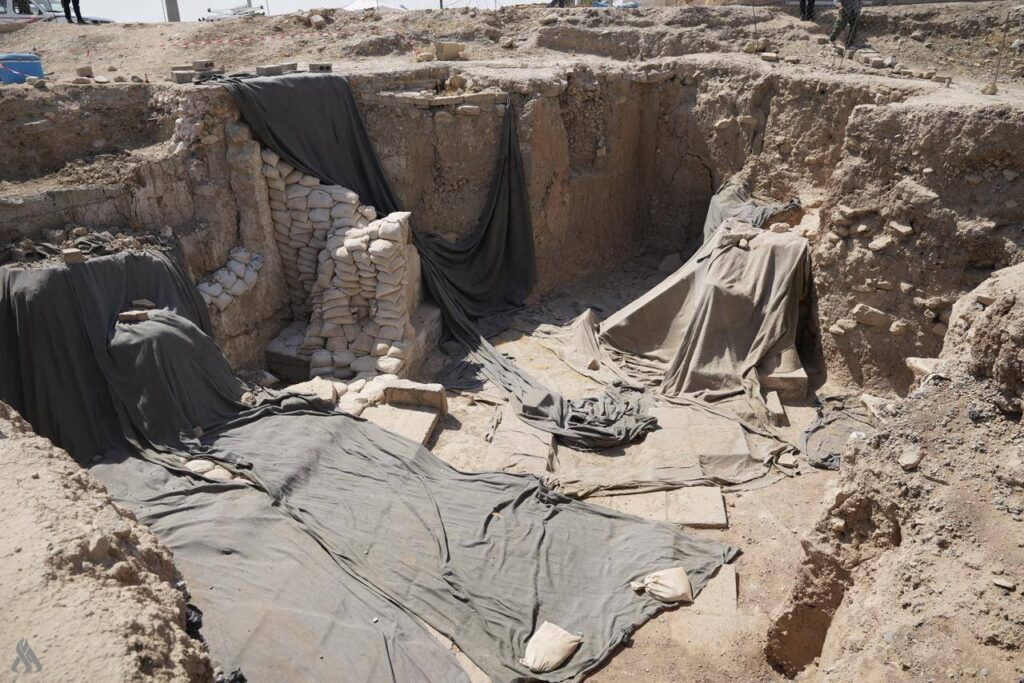
Iraq’s cultural authorities have revealed a discovery that could redefine the scale of Assyrian art: a six-meter-tall winged bull, or lamassu, recently uncovered in Mosul. The find, announced by Culture Minister Ahmed Fakkak al-Badrani on Iraqia News, dates to the reign of King Esarhaddon in the 7th century BCE (681–669 BCE), when the Neo-Assyrian Empire stretched from the Persian Gulf to Egypt.
Situated within the ruins of Esarhaddon’s throne hall at the Nabi Yunus site in Mosul, part of ancient Nineveh, the colossal sculpture is believed to be the largest lamassu ever recorded. More than an archaeological marvel, it is a rare emblem of Assyria’s imperial grandeur and a potential turning point in the study of Mesopotamian heritage.
A Monumental Discovery in Mosul
Iraq’s Minister of Culture, Ahmed Fakkak al-Badrani, announced on state television (Iraqia News) the discovery of what he described as the largest Assyrian winged bull in history, measuring around six meters in height. The colossal figure, known as a lamassu, was uncovered inside the royal throne hall of King Esarhaddon’s palace, located beneath the Prophet Jonah Mosque in Mosul.
“This discovery, which reaches nearly six meters, carries great archaeological and historical significance,” the minister declared. He added that excavations also point to the existence of smaller copies and have allowed researchers to better estimate the size and layout of the throne room—one of the most important architectural spaces of the Assyrian Empire.
Largest Lamassu Ever Found
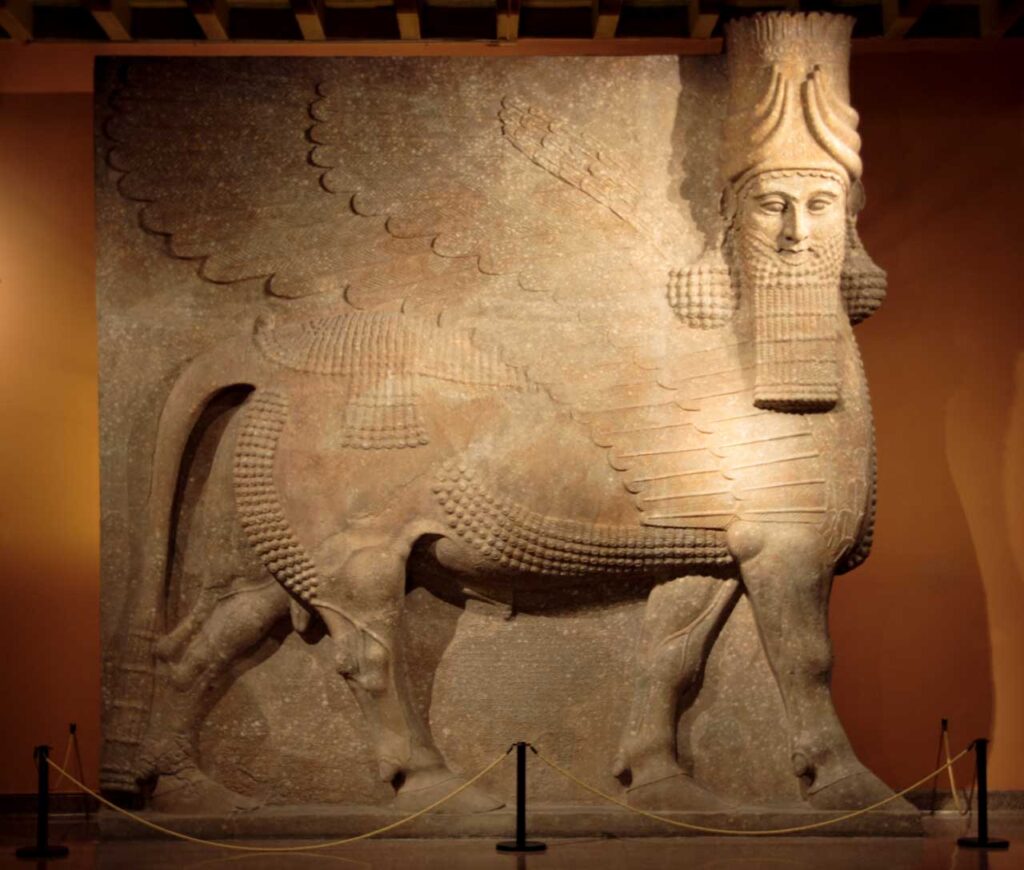
Lamassu, hybrid creatures with the body of a bull or lion, wings of an eagle, and human heads, served as protective deities in Mesopotamian culture. They were typically placed at palace gateways, meant to ward off evil and display royal power.
The most famous examples stand today in the British Museum (from Khorsabad) and the Louvre (from Dur-Sharrukin), typically measuring between 3.5 and 4.2 meters in height. Even the colossal lamassu discovered in Nimrud in the mid-19th century rarely exceed these dimensions.
By comparison, the newly uncovered Mosul bull at approximately six meters would surpass all previously known specimens, representing not only the largest lamassu ever unearthed but also a major milestone in Assyrian archaeology.
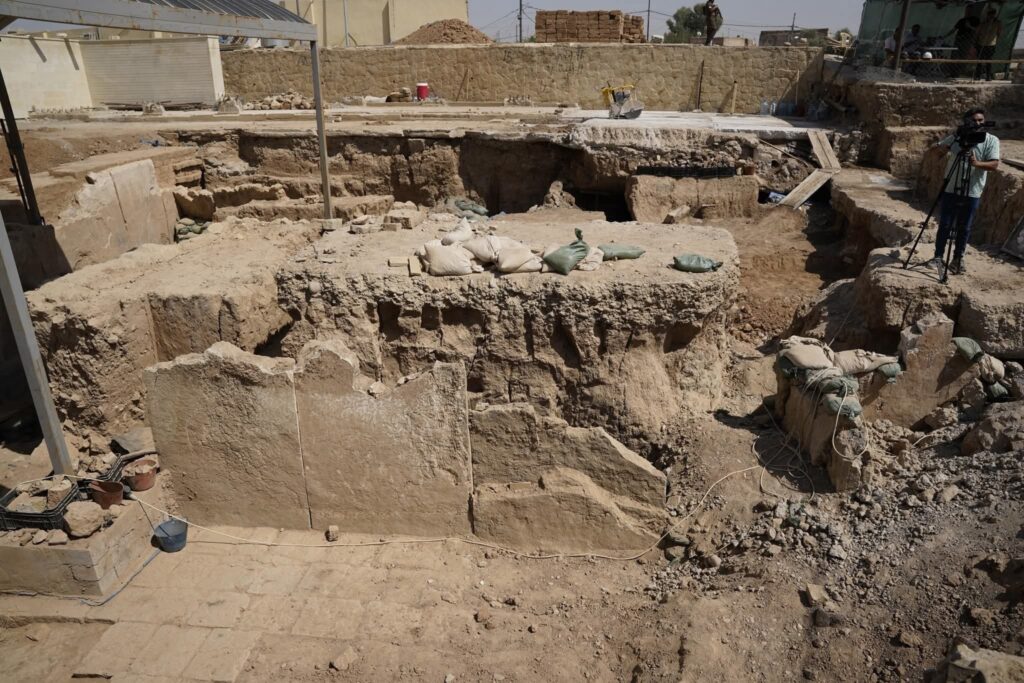
Inside Esarhaddon’s Throne Hall
The discovery has been located in the ruins of King Esarhaddon’s palace (reigned 681–669 BCE), one of the most powerful rulers of the Neo-Assyrian Empire. Esarhaddon is remembered for rebuilding Babylon, campaigning in Egypt, and expanding Assyrian dominance across the Near East.
According to Badrani, the palace’s architecture includes multiple adjoining halls leading to the throne room, each guarded by lamassu pairs at their entrances. Archaeologists believe the newly revealed statue was one of a matching pair flanking the main gate to the throne hall.
Earlier Finds and Renewed Excavations
This is not the first lamassu to be uncovered at the site. A smaller specimen was found in the 1990s on the left side of the palace, measuring just under four meters. In 2021, Iraqi authorities announced the discovery of another large winged bull, though smaller than the new find. The most recent excavation, however, has brought to light the largest ever recorded, making the site a focal point for the study of Assyrian monumental sculpture.
Ruwaid Muwafaq, Director of the Nineveh Antiquities and Heritage Inspectorate, emphasized that “this discovery will greatly enhance the archaeological and touristic importance of the site.”
International Cooperation and Future Museum
Excavations are being carried out by Iraq’s antiquities authority in cooperation with Germany’s Heidelberg University. Plans are underway to transform the Nabi Yunus site into a museum complex that will integrate Assyrian finds with the Islamic heritage of the Prophet Jonah Mosque above.
“The aim is to link Assyrian history with the Islamic cultural layer of Mosul,” Muwafaq explained, noting that a detailed plan will be announced soon.
Peter Nicholas, an archaeologist at Heidelberg University, told the Iraqi News Agency (INA) that excavation teams also uncovered numerous cuneiform tablets inscribed with the writings of kings Sennacherib, Esarhaddon, and Ashurbanipal—three of the most prominent rulers of the Neo-Assyrian Empire. Additional artifacts appear to represent spoils of war taken from Egypt and the Levant, offering a richer picture of Assyria’s far-reaching campaigns.
Cultural and Political Significance
The announcement comes at a time when Iraq is investing in the rehabilitation of Mosul’s cultural heritage, much of which was damaged or destroyed in recent conflicts. The discovery of the largest lamassu yet not only reaffirms Mosul’s centrality in Assyrian history but also strengthens the case for heritage-driven tourism and international cultural exchange.
For Assyriologists, the six-meter figure raises new questions: Was it a unique commission for Esarhaddon, or part of a larger tradition now mostly lost? How was such a colossal sculpture carved, transported, and installed within the throne hall? And what does its scale reveal about the king’s vision of authority at the height of the empire?
A New Chapter in Assyrian Archaeology
While the minister’s announcement on state television has captured global headlines, scholars caution that detailed scientific documentation is still pending. Precise measurements, 3D scans, and conservation plans will be needed to fully confirm the discovery’s dimensions and context.
Nevertheless, the find underscores the continuing archaeological richness of Nineveh and the Nabi Yunus site. If verified, the six-meter lamassu would represent an unprecedented piece of Assyrian monumental art, rivaling and surpassing the iconic examples now held in Western museums.
As Iraq prepares to present the discovery to the world, the lamassu once again fulfills its ancient role: projecting the enduring strength and majesty of a civilization that flourished nearly 2,700 years ago.
Cover Image Credit: Iraqi News Agency
