
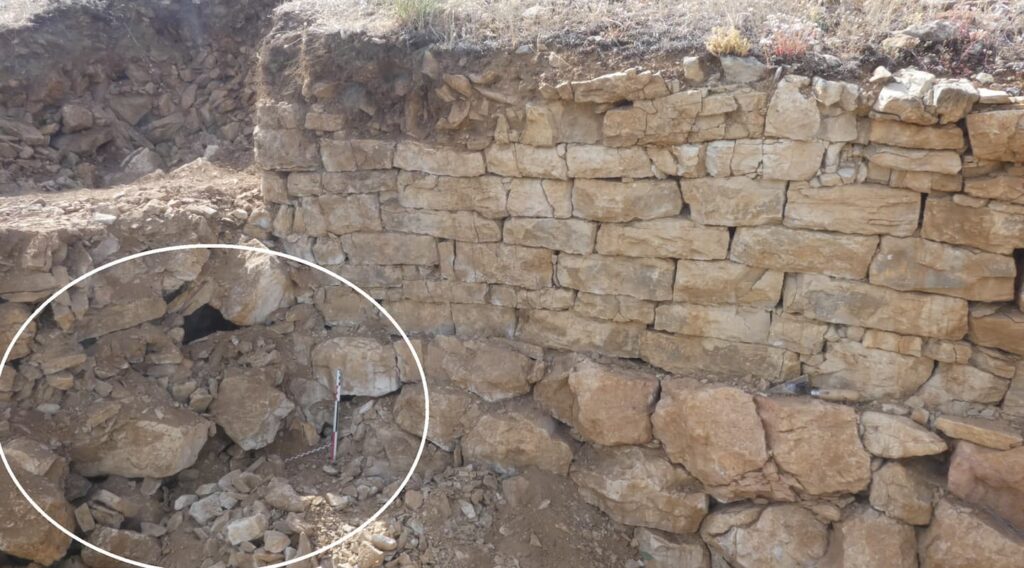
When archaeologists began excavating the fortified Iron Age hilltop of La Loma in northern Spain, they expected to uncover weapons, fortifications, and everyday objects left behind after Rome’s push into Cantabrian territory. What they did not expect was one of the most revealing human remains ever found from the Cantabrian Wars—a fractured skull buried beneath collapsed stones, preserved at the exact spot where Rome’s northernmost campaign reached its violent climax.
The skull, discovered in 2020 and now analyzed in detail, belongs to a local Cantabrian man who fought during the Roman siege of La Loma between 26 and 25 BCE. Scientific evidence from radiocarbon dating, taphonomic analysis, and ancient DNA converges on a striking conclusion: this man’s head had been severed and publicly displayed by Roman soldiers as a symbol of victory before the fortifications were intentionally destroyed. The find offers an unusually vivid window into the tactics, symbolism, and human cost of Rome’s final conquest of the Iberian Peninsula.
La Loma, located in the modern province of Palencia, was once a hillfort belonging to the Camarici, a Cantabrian people who resisted Roman rule fiercely. Historical sources describe the Cantabrian Wars, fought from 29 to 16 BCE, as a prolonged and exhausting effort by Emperor Augustus to subdue the last independent Celtic regions of western Europe. The geography of northern Iberia—mountainous, forested, and difficult for large armies to maneuver—made the campaigns notoriously challenging. Yet Augustus mobilized elite generals, multiple legions, and substantial resources to accomplish what had eluded Rome for generations.
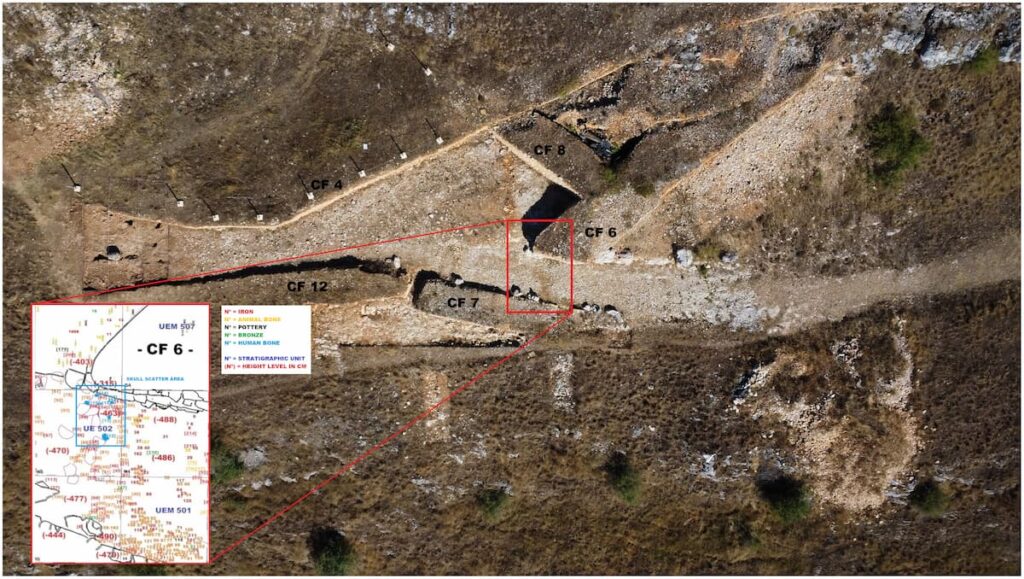
Archaeology at La Loma shows how methodically the Roman military approached the task. Excavations uncovered a vast network of structures surrounding the indigenous hillfort: a main camp, secondary castella, and long defensive lines forming both contra- and circumvallation. These works reflected a full-scale siege. Evidence indicates that the final attack was concentrated against the northeastern entrance, where archaeologists recovered dense clusters of arrowheads, caligae nails, broken blades, and debris from hand-to-hand combat. The distribution of this material corresponds to intense fighting on the ramparts, eventually resulting in the Roman capture of the fort.
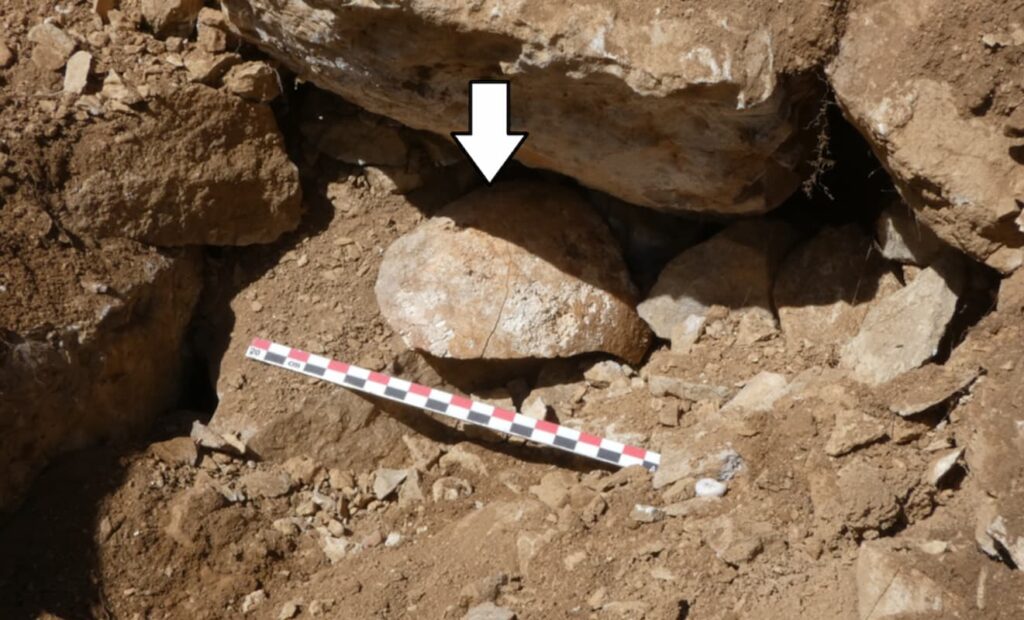
It was in this same area—beneath rubble from the collapsed walls—that researchers uncovered the fragmented skull. The bones showed no sign of being part of a burial, nor were they found in association with a full skeleton. Instead, the fragments were scattered in a tight area where collapsing stones had fallen during or shortly after Roman demolition. Scientific dating placed the remains firmly around the time of the Roman siege.
Anthropological assessment identified the man as an adult, likely in his forties, based on cranial suture closure. Ancient DNA analysis reinforced this profile, confirming a male individual with genetic ancestry typical of Iron Age populations from northern Iberia. His paternal lineage, R1b-DF27, is widely associated with the indigenous peoples of the region since the Bronze Age. These results leave little doubt that the man was one of the Cantabrian defenders—someone who lived and died in the land Rome was determined to dominate.
The most revealing clues, however, come from the bone damage itself. The skull had been broken into many pieces by high-energy impacts, yet the fractures showed patterns typical of dry bone, not fresh. This suggests the skull had been exposed long enough to lose soft tissue before being shattered by falling stones. Weathering marks—sun bleaching, surface cracking, and minor erosion—indicate that the head remained outdoors, likely mounted on a wall or similar structure. Abrasion marks consistent with trampling occurred after the skull dried but before the rubble sealed it. Together, these features create a highly specific scenario: the head was displayed, then fell or was discarded near the wall, and finally became trapped beneath the fortification when the Romans destroyed the site to prevent reoccupation.
Displaying severed heads was not only a Roman practice but also a deeply rooted Mediterranean military symbol. Roman troops often showcased enemy heads on stakes or walls as both propaganda and intimidation, a motif that appears clearly in reliefs such as those on Trajan’s Column. For the legions stationed temporarily at La Loma, leaving the decapitated head of a defender on the surviving walls would have communicated dominance to any who approached. The archaeological evidence suggests that Roman occupation of the site after the siege was brief—perhaps only months—before the army dismantled the fortifications and moved deeper into Cantabrian territory.
Beyond its symbolic meaning, the skull is scientifically significant because human remains from the Iron Age in northern Spain are extremely rare. Cultural practices in the region favored cremation for older children and adults, with only infants occasionally buried within settlements. As a result, skeletal remains capable of yielding DNA or anthropological data are practically nonexistent. The La Loma skull therefore represents one of the most complete and informative biological samples currently known from Cantabrian communities of the period.
Its discovery enriches the broader picture of the Cantabrian Wars, providing a tangible human link to a conflict known mostly through later historical summaries and archaeological traces of Roman military engineering. It reveals, in stark terms, the intimate violence that accompanied Rome’s northern campaigns and the fate that could await those who resisted. At the same time, it offers researchers a rare chance to study the ancestry, health, and lived experience of a Cantabrian fighter whose final moments were shaped by one of the defining conflicts of early Roman imperial expansion.
Domínguez-Solera, S. D., Torres-Martínez, J. F., Carnicero, S., Olalde, Í., Reich, D., Mallick, S., & Rohland, N. (2025). The human skull from the siege of La Loma (Santibáñez de la Peña, Palencia, Spain). Journal of Roman Archaeology, 1–16. doi:10.1017/S1047759425100512
Cover Image Credit: Area beneath the CF 6 wall module excavated in 2020, where archaeologists identified multiple fragments of a single human skull, marked by the circle. Santiago David Domínguez-Solera.
