
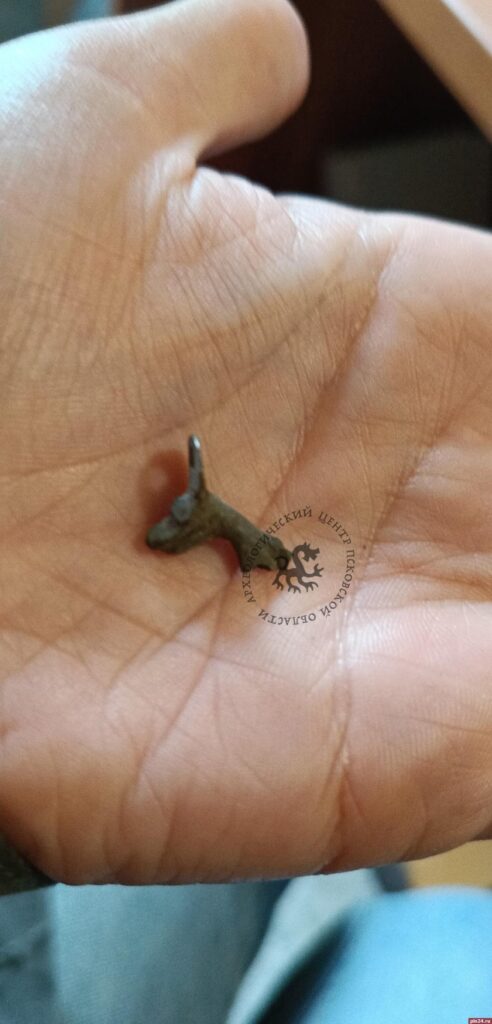
Archaeologists excavating the historic Zavelychye district of Pskov in northwestern Russia have uncovered the broken head of a medieval pendant depicting a mysterious animal. Although most of the object is missing, specialists identified it as part of a well-known class of women’s amulets generally dated to the 11th and early 12th centuries.
The fragment was discovered at the Olginsky-10 excavation on Paromenskaya Street during the 2026 field season. According to the Pskov Region Archaeological Center, its original appearance can be reconstructed from complete examples found in Pskov, the Smolensk region, other parts of medieval Rus’ and the eastern Baltic.
A Medieval Ornament Worn for Protection
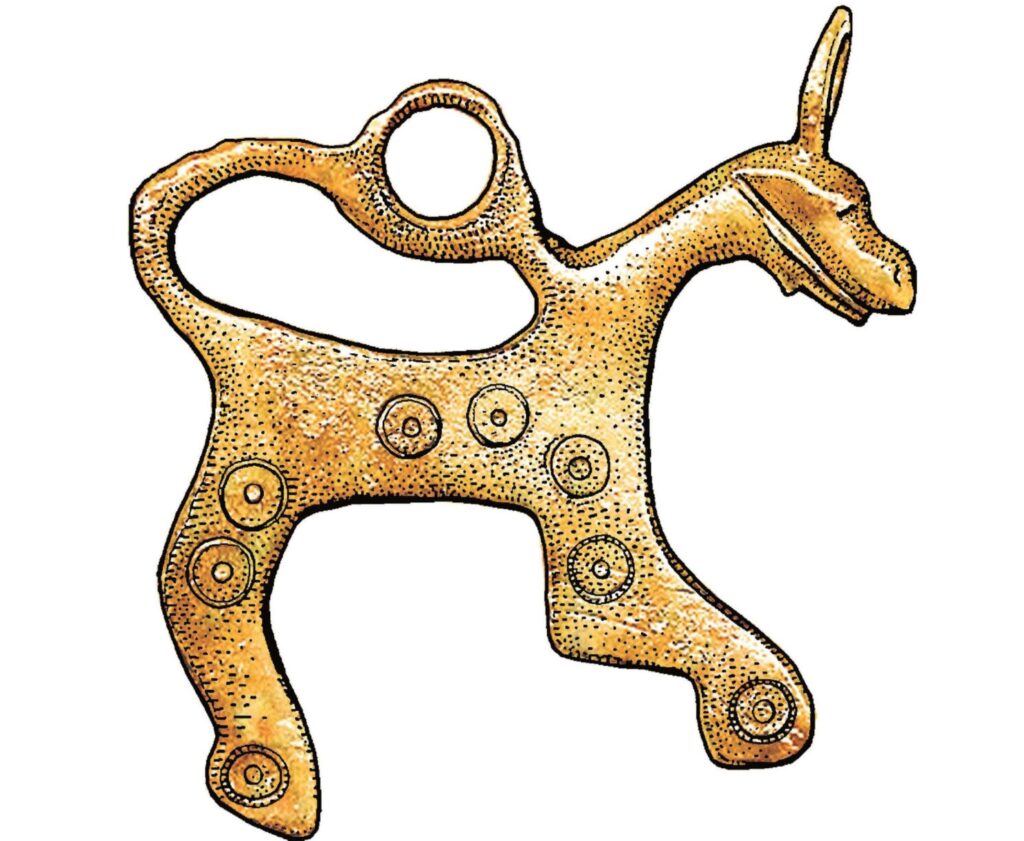
Complete pendants of this type show a compact four-legged creature with an elongated head and a tail curved upward to form a suspension loop. Surviving examples were often cast from non-ferrous metal and sometimes decorated with simple geometric patterns.
Archaeologists commonly call them “Smolensk-type horse pendants” because large numbers have been recovered in the Smolensk region. Another major concentration is known from the lower Daugava River, particularly in territories associated with the medieval Livs. Research from Latvia has documented dozens of examples, including pendants that appear to have been produced locally.
The ornaments were usually worn by women on the chest or suspended from a belt, often alongside other pendants. Their archaeological context and design suggest that they functioned as both jewellery and protective amulets.
Most date from the 11th to the first half of the 12th century, although related pieces have also been recorded in archaeological deposits from the 13th and 14th centuries.
Horse, Predator or Mythical Leucrota?
The identity of the animal has long been debated. Scholars have interpreted it as a horse, dog, leopard or lynx. The conventional horse label remains widely used, but the creature’s oversized head, unusual mouth and mixed anatomical features differ from more recognizable medieval horse images.
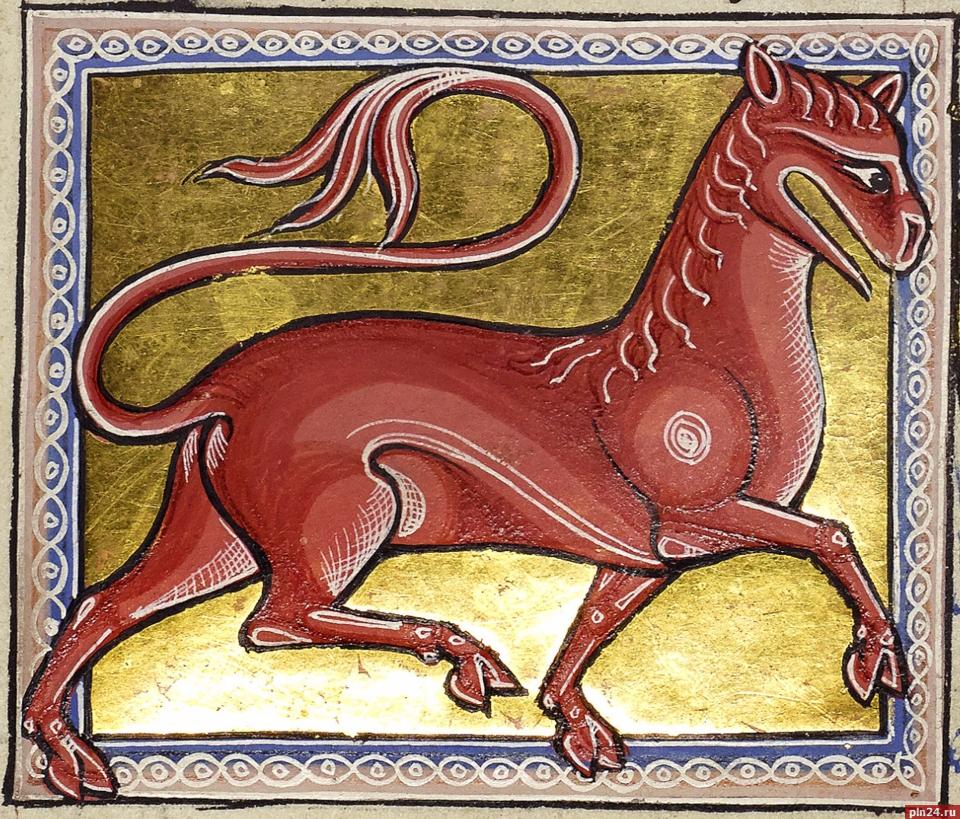
Latvian archaeologist Roberts Spirģis proposed that the pendants may instead represent the leucrota, a fabulous animal described in ancient literature and later medieval bestiaries.
Pliny the Elder portrayed the leucrota as a creature from India combining characteristics of a lion, stag and donkey. It supposedly possessed an exceptionally wide mouth and a continuous bone ridge instead of separate teeth. Ancient accounts also claimed that it could run at extraordinary speed and imitate the human voice.
Spirģis argued that the medieval bestiary tradition offers a closer visual parallel for the pendants than an ordinary horse. He also connected the image with the spread of Christianity, challenging earlier interpretations that treated the ornament solely as a survival of pagan horse symbolism.
The identification remains a hypothesis. However, it may explain how the same unusual creature appeared among communities connected through trade and cultural exchange across the eastern Baltic.
A complete version of the pendant has served as the emblem of the Institute of Archaeology of the Russian Academy of Sciences since 2004.
New Evidence from Pskov’s Zavelychye District
The discovery also contributes to a changing understanding of Zavelychye. Located on the western bank of the Velikaya River, opposite Pskov’s historic centre, the district was once considered a peripheral medieval suburb.
Excavations conducted since the early 21st century have instead revealed wealthy urban estates dating to the 11th and 12th centuries. Earlier investigations uncovered domestic compounds, a stone-paved road and objects associated with armed conflict.
Archaeologists believe parts of northern Zavelychye were destroyed during attacks in the first half of the 13th century. Excavations on Paromenskaya Street in 2026 have also produced handmade pottery fragments dating to the third quarter of the first millennium CE, indicating activity in the area centuries before the medieval neighbourhood reached its height.
Only the head of the newly discovered amulet survives. Yet its recognizable form connects one medieval Pskov resident with a wider world of personal adornment, protective belief and shared imagery stretching from Smolensk to the lower Daugava.
Archaeological Center of the Pskov Region / VKontakte
Cover Image Credit: Archaeological Center of the Pskov Region / VKontakte
