23 January 2026 The Future is the Product of the Past

Archaeologists Discover Fragment of Medieval Inscription of Church in Melnik

124 artifacts made of stone, ceramics, and metal were discovered during archaeological excavations in the Church of the Holy Mother in the town of Melnik in the Blagoevgrad province of southwestern Bulgaria.

Recent archaeological excavations have unearthed treasures that connect fragments of history, providing a glimpse into the medieval and early modern lives of this Bulgarian town.

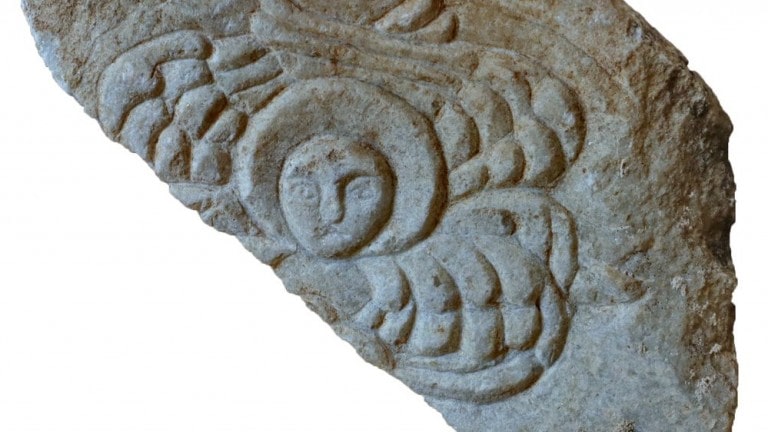
Two in particular stand out among the findings. A second fragment of a medieval inscription from the 13th-14th centuries hints at the church’s initial construction period, while a fragment of a marble relief plate from the 18th or early 19th century, depicting seraphim, showcases the artistic and religious expressions of the time.

The church under study has two main stages of construction. The first is from the ΧΙΙΙ – ΧIV century, and the second – from the middle of the 19th century. In 2023, efforts were concentrated in two sectors.
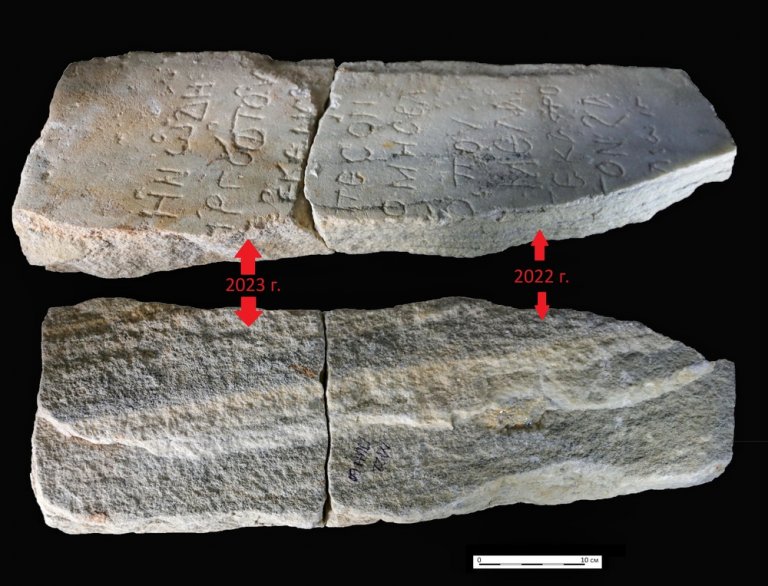
Building inscription from the 13th - 14th centuries, the fragment on the right was discovered in 2022, and the one on the left in 2023. Photo: M. Zlatkov and Reneta Karamanova
Building inscription from the 13th – 14th centuries, the fragment on the right was discovered in 2022, and the one on the left in 2023. Photo: M. Zlatkov and Reneta Karamanova

First, a part of the floor of the church’s reenactment stage was revealed. The apse of the church from the 13th – 14th centuries was examined underneath, and it was determined that the total length of the previous church in this period was 17.35 m and had a single apse.


📣 Our WhatsApp channel is now LIVE! Stay up-to-date with the latest news and updates, just click here to follow us on WhatsApp and never miss a thing!!


The excavations were held for the second consecutive season in 2023 with the financial support of the Municipality of Sandanski.

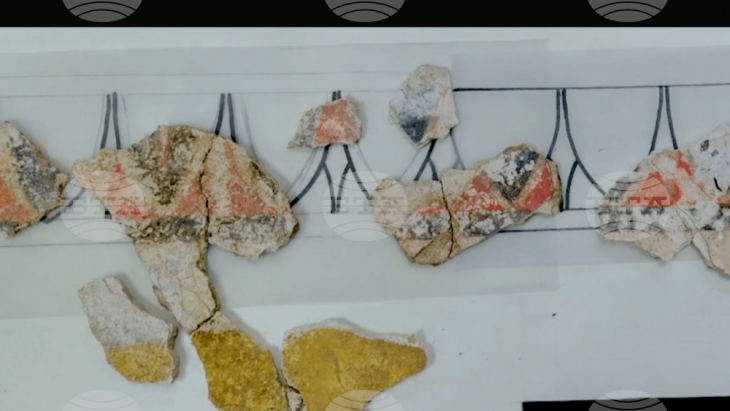
Work in the coming seasons will determine precisely when the temple was first built. In the second sector, restorers worked to remove a layer of frescoes from the 13th and 14th centuries. According to BTA, It stated that as a result of the work in the National Archeological Museum of the Bulgarian Academy of Sciences (NAIM-BAS), some of the frescos were saved despite severe fragmentation.
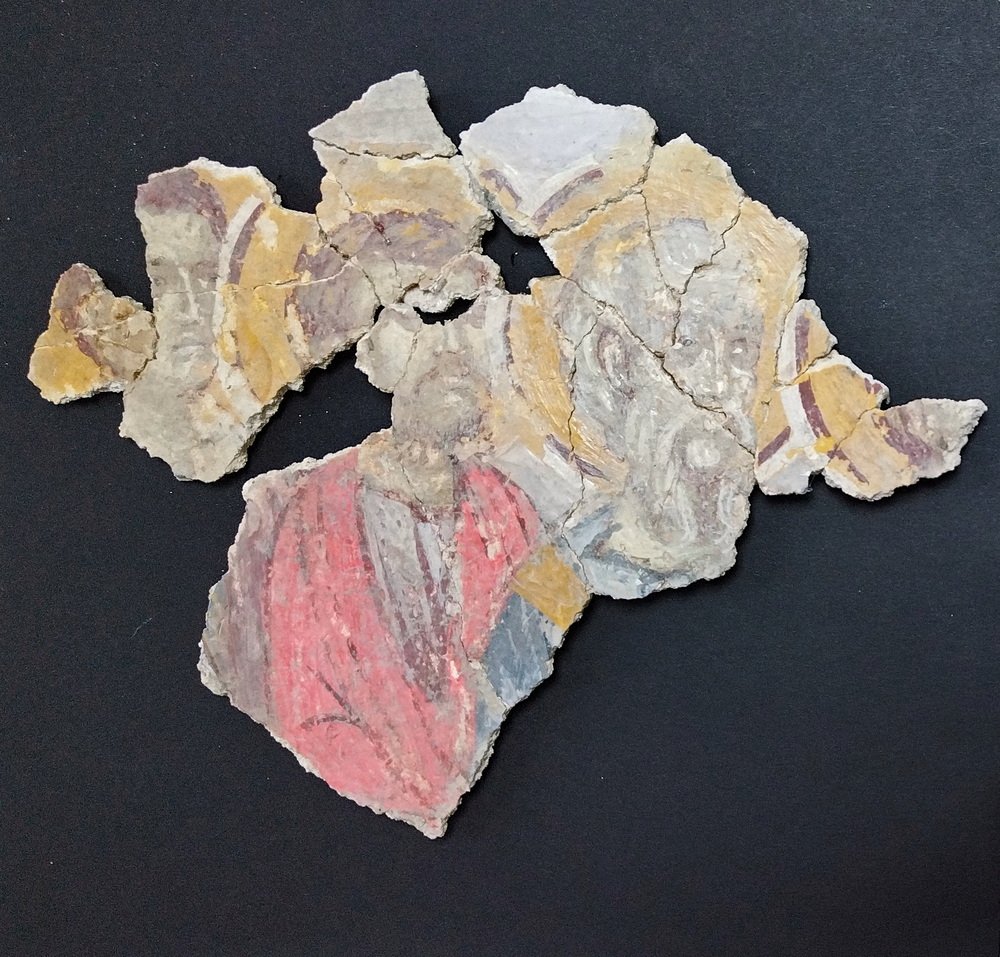
Fragments of wall paintings from the 13th – 14th centuries,  discovered in 2023. Photo: M. Zlatkov and Reneta Karamanova
Fragments of wall paintings from the 13th – 14th centuries, discovered in 2023. Photo: M. Zlatkov and Reneta Karamanova

In the Middle Ages, Melnik was a border town between the Bulgarian and the Byzantine empires.  It was a big city on the main road to Thessaloniki. However, today it has 325 official inhabitants and no one would suggest that only a century ago more than 10 000 people lived here.

Historians and archaeologists as well as the locals are excited about the discoveries made at the Church of the Holy Mother.  The potential to include this site in a tourist route as a vital historical monument could breathe new life into Melnik.

The archaeological site is presented with a poster in the Bulgarian Archaeology 2023 exhibition, at the National Archaeological Institute, and will be shown there until May 15, the museum team said.
Related Articles

The easternmost Roman aqueduct in Armenia was discovered

19 November 2021

19 November 2021

Archaeologists from the University of Münster and the National Academy of Sciences of the Republic of Armenia have discovered remains...

Otto the Great’s Tomb Marble Did Not Come from Italy or Greece, New Research Reveals

19 December 2025

19 December 2025

A major archaeological discovery in Germany is reshaping long-held assumptions about one of Europe’s most iconic imperial monuments. The tomb...

Traces of fossilized crabs in the Zagros Mountains, Iran which may hint at a hotbed of biodiversity dating from 15 million years

18 April 2022

18 April 2022

A group of paleontologists from the  University of Tehran has discovered traces of fossilized crabs in the Iranian which may...

Archaeologists Uncover Monumental Roman Building Near Waal River in Nijmegen, Netherlands

4 June 2025

4 June 2025

During a routine excavation ahead of a major urban development in the Waalfront district of Nijmegen, municipal archaeologists have uncovered...

Analysis of Butchered Bones, Somerset Pit Reveals Bronze Age Cannibalism

17 December 2024

17 December 2024

Archaeologists have uncovered the bloodiest massacre in early Bronze Age Britain and evidence of Bronze Age cannibalism. It is the...

The greatest Anglo-Saxon treasure trove ever unearthed has been discovered by a metal detectorist

10 November 2021

10 November 2021

A metal detector in West Norfolk, England, unearthed 131 coins and 4 golden artifacts going back 1,400 years. This is...

9 Synagogues in Izmir to Reopen as Museum

26 March 2022

26 March 2022

As part of a Jewish heritage project in Izmir, Turkey, nine historic synagogues will be reopened as museums. Built by...

Roman Wooden Cellar Found in Frankfurt, Germany

28 February 2024

28 February 2024

Archaeologists from the Frankfurt Archaeological Museum have recently uncovered a remarkably preserved wooden cellar in the Roman city of Nida...

2,000-year-old bamboo slips discovered in Yunnan

31 March 2023

31 March 2023

Thousands of bamboo slips (rectangles tied together to form books) have been discovered at the Hebosuo archaeological site in southwestern...

8000-year-old unique “fish-figure” small home tool found in Turkey

20 October 2021

20 October 2021

During this year’s excavations in the Yeşilova and Yassıtepe mounds in İzmir, a unique “fish-figure” small home tool was found....

Scientists Find Aztec ‘Death Whistles’ do Weird Things to the Listeners’ Brains

18 November 2024

18 November 2024

New research reveals that one of the Aztecs’ most chilling artefacts, clay death whistles, which resemble a human skull and...

1700-year-old weaving workshop discovered in southeast Turkey

4 December 2021

4 December 2021

Excavations carried out in the ancient city of Perre in the southeastern province of Adıyaman have unearthed a 1,700-year-old weaving...

1,800-Year-Old Roman Watchtower Discovered in Croatia

3 August 2025

3 August 2025

Archaeologists in Croatia have uncovered the remains of a 1,800-year-old Roman watchtower that once stood guard along the empire’s northern...

4,000-year-old settlement found during Balasore town India

9 July 2021

9 July 2021

A 4,000-year-old settlement and ancient artifacts have been discovered in the Balasore district, India. The Odisha Institute for Maritime and...

Roman mosaic found under the pavement in the narrow streets of Hvar

13 February 2022

13 February 2022

In the Old Town on the Adriatic island of Hvar, Croatia, a Roman mosaic was unearthed beneath a narrow street....