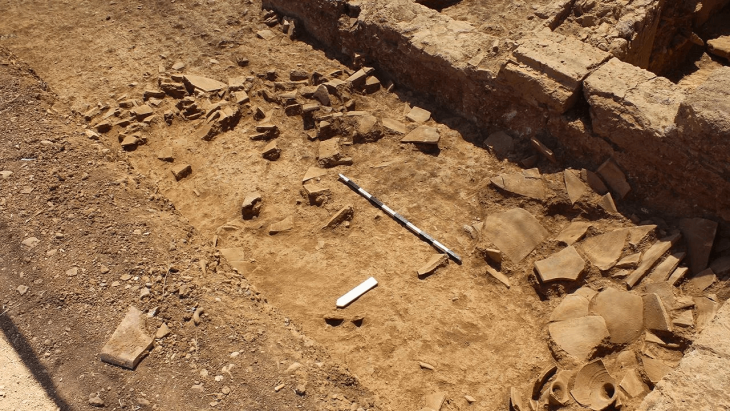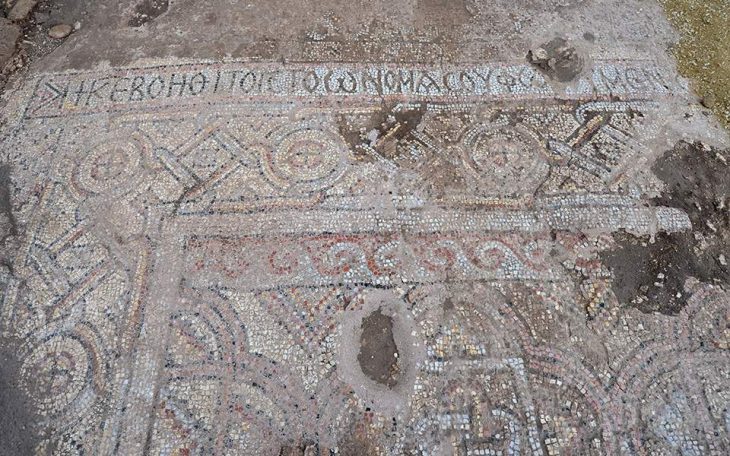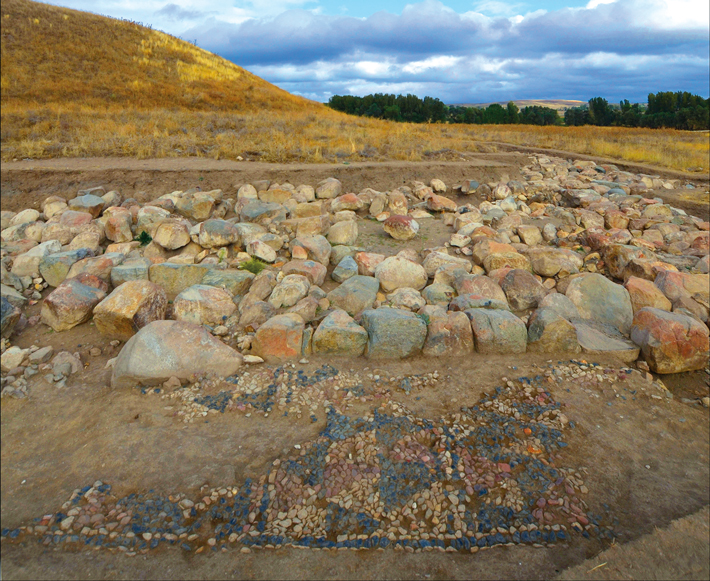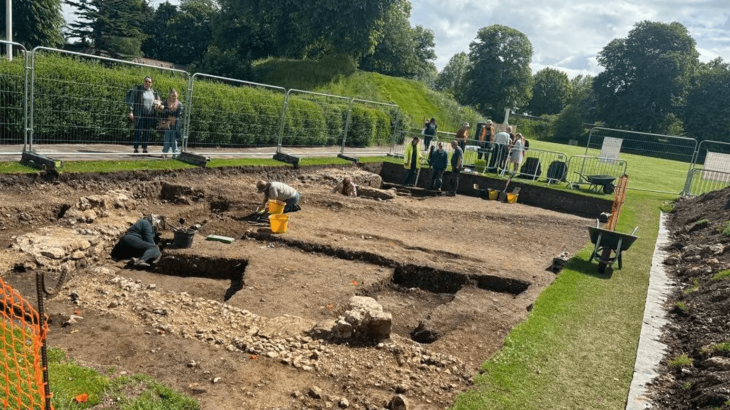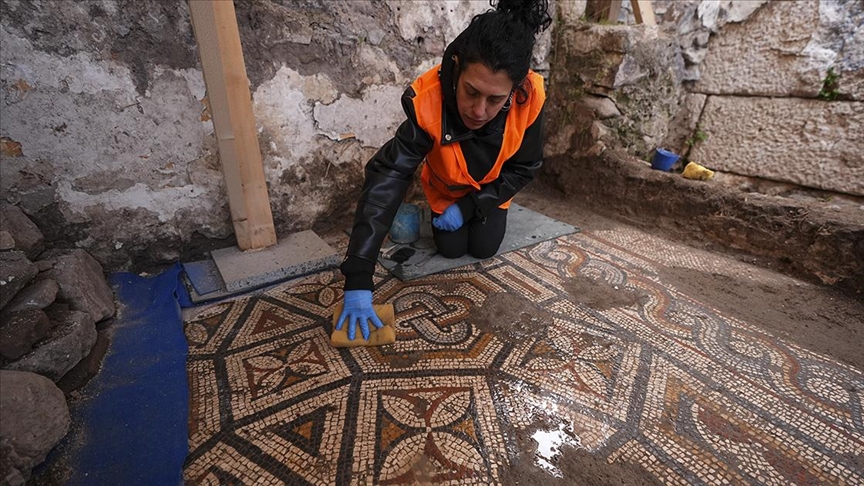
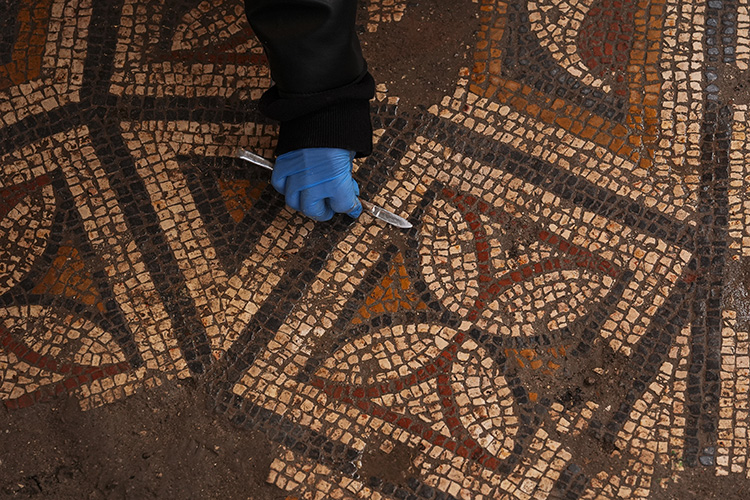
Archaeologists working in the heart of İzmir have uncovered a remarkable mosaic-floored room in the ancient city of Smyrna, revealing a striking Solomon’s Knot motif believed to have served as a protective symbol against envy and the “evil eye” during Late Antiquity. The discovery was made along the North Street of the Smyrna Agora as part of the Turkish Ministry of Culture and Tourism’s year-round Heritage for the Future Project.
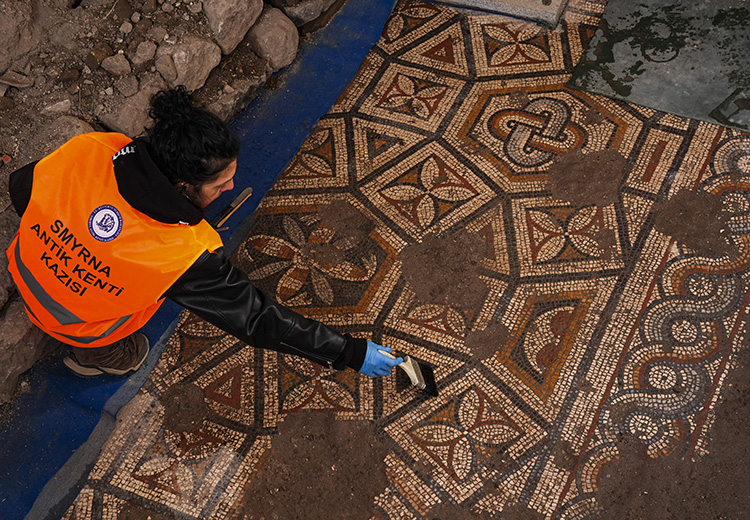
Measuring roughly 3 by 4 meters, the mosaic floor features interlaced geometric panels and vegetal designs, with the symbolic knot positioned prominently at its center. According to excavation director Prof. Dr. Akın Ersoy of İzmir Katip Çelebi University, this is the first mosaic pavement found at the site in nearly 70 years, making the discovery both rare and scientifically significant.
A Planned City of the Hellenistic World
Founded on a new urban plan following the era of Alexander the Great, Smyrna was one of the most important port cities of the eastern Mediterranean. Known today as İzmir, the city flourished under Hellenistic, Roman, and Byzantine rule, serving as a major hub of trade, culture, and civic life. The Agora of Smyrna, where excavations are concentrated today, functioned as the city’s political, commercial, and administrative center.
Excavations in recent years have focused on the Agora and the ancient theater, revealing layers of architecture that document Smyrna’s continuous urban life across centuries. The newly uncovered mosaic room lies along one of the city’s key streets, which appears to have remained active well into the Late Roman period (4th–6th centuries CE).
Protective Symbols Against Envy and Misfortune
Prof. Ersoy explains that the architectural function of the building—whether a private residence or a public space—has not yet been fully clarified. However, the symbolism of the mosaic provides important cultural clues. Late Antiquity mosaics frequently incorporated protective motifs, believed to shield inhabitants or visitors from jealousy, misfortune, or hostile intentions.
📣 Our WhatsApp channel is now LIVE! Stay up-to-date with the latest news and updates, just click here to follow us on WhatsApp and never miss a thing!!
At the center of this floor is the Solomon’s Knot, a centuries-old geometric emblem created from two interlaced closed loops. Found in Roman villas, synagogues, early Christian churches, and later Islamic and Byzantine art, the motif is widely interpreted as a symbol of eternity, harmony, wisdom, and spiritual protection. In Mediterranean cultures, it has often been associated with the idea of binding or neutralizing negative forces—similar in meaning to protective amulets used against the “evil eye.”
In the Smyrna mosaic, the knot is framed by smaller cross-like elements and ornamental patterns. Ersoy notes that many of these symbols originally developed as decorative elements but were later imbued with religious and cultural meanings as new belief systems spread across the region. Regardless of interpretation, he emphasizes, “they were understood as protective signs intended to safeguard either the building itself or the people who used it.”
A Space Reused 1,500 Years Later
One of the most intriguing findings relates to the building’s later history. Evidence shows that the mosaic floor was reopened and reused in the 19th century, likely by nearby households or a non-Muslim hospital operating in the area at the time. Mortar from later walls was discovered resting directly on the mosaic surface, indicating that the ancient flooring was intentionally preserved and incorporated into new constructions some 1,500 years after its creation.
This pattern of reuse highlights Smyrna’s long tradition of urban continuity, where later communities adapted, repaired, and reoccupied earlier structures rather than discarding them. According to Ersoy, expanding excavations planned for 2026 may reveal additional rooms or adjoining architectural units connected to the mosaic space.
Cultural Legacy Beneath Modern İzmir
The discovery underscores Smyrna’s role as a layered archaeological landscape where ancient urban life survives beneath the modern city. From its Hellenistic grid plan to its Roman streets, Byzantine churches, Ottoman neighborhoods, and 19th-century civic buildings, Smyrna represents one of the rare Mediterranean cities where thousands of years of architecture overlap in a single place.
Today, excavations continue with the support of the İzmir Metropolitan Municipality, Yaşar Education and Culture Foundation, İzmir Chamber of Commerce, and Güzel Enerji. Each new discovery—like the mosaic room with its enduring Solomon’s Knot—adds another piece to the story of a city where art, belief, and everyday life have remained intertwined across time.
Cover Image Credit: AA