
12 June 2026 The Future is the Product of the Past

Ancient golden neck ring found in Denmark

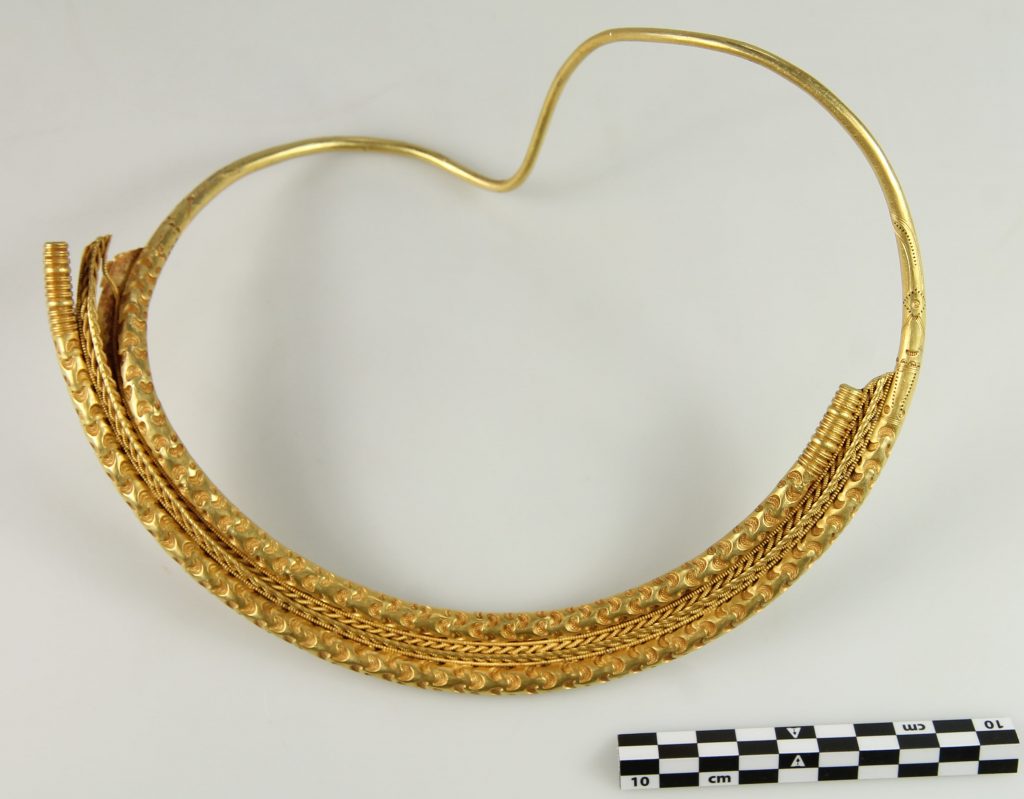
A one-of-a-kind golden neck ring from the Germanic Iron Age (400-550 A.D.) has been discovered in a field not far from Esbjerg on the Jutland Peninsula in mainland Denmark.

The ring weighs in at almost half a kilo (446 grams) and is designed with crescent-like depressions. The decoration is so meticulously detailed that the crescent shapes on the two rings are ever so slightly different: the crescents on the outer ring have eight decorative divots inside them, and the crescents on the inner ones have six. The broadest point of the ring measures 21 centimeters in diameter.

The embellishments on the ring are so rare, which makes it a “masterpiece of almost divine quality,” as termed by the South West Jutland Museum. That kind of decoration is only known from fewer than a dozen similar rings found in Denmark. And this is by far the most elaborate, most finely worked of them. It is the only one with a soldered plate with intricate gold thread decoration.

The experts noted that the ring was deliberately buried and hidden away and that the inhabitant to whom it belonged did not sacrifice the ring to the gods, which was common practice in that era.
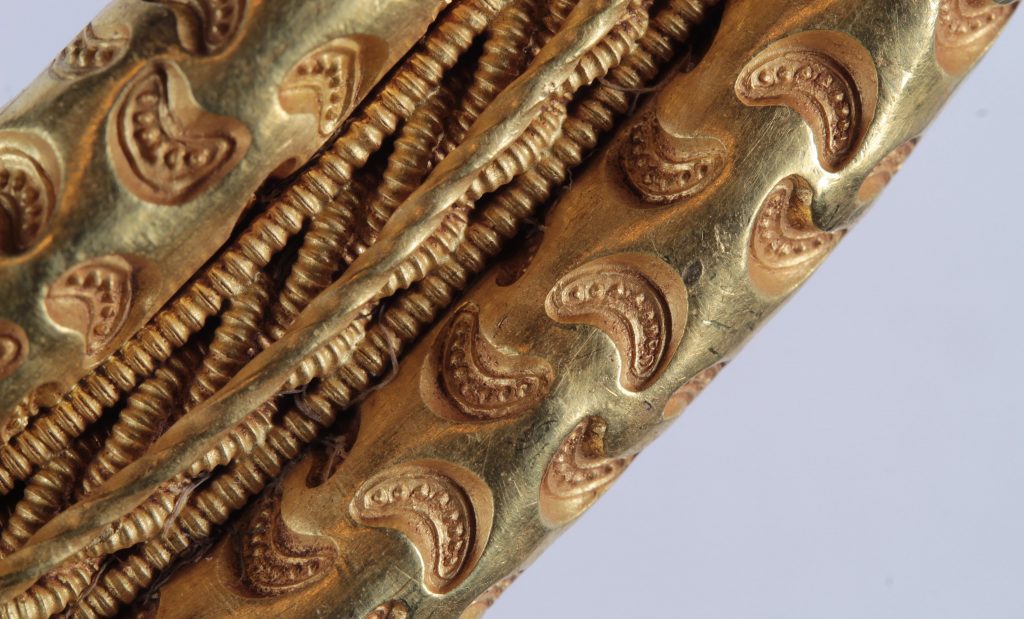
That kind of decoration is only known from fewer than a dozen similar rings found in Denmark. And this is by far the most elaborate, most finely worked of them. Photo: Sydvestjyske Museer

“When sacrificing items at that time, it usually took place in wetlands and bogs and the like. We know a large wetland existed near the discovery site, so if it was sacrificed to the gods, it would have been located out there instead”, Claus Feveile, curator at the Ribe Viking Museum, said in a statement.


📣 Our WhatsApp channel is now LIVE! Stay up-to-date with the latest news and updates, just click here to follow us on WhatsApp and never miss a thing!!


The golden neck ring was discovered by metal detectorist Dan Christensen in October 2021.  Christensen when he found the neck ring, immediately alerted museum staff. In the week following the discovery, the entire field was scanned with metal detectors in case the ring had been part of a larger grouping of precious objects scattered by agricultural activity. (Previous examples of neck rings from this period have been found in pairs.) Nothing turned up.
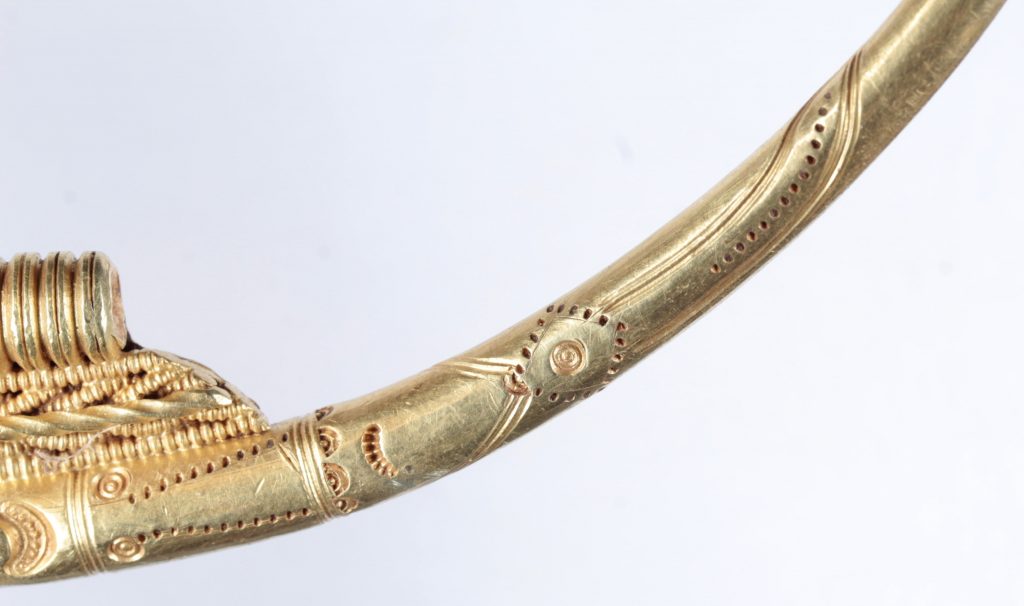
Photo: Sydvestjyske Museer

Subsequent full excavation of the find site revealed evidence of a settlement under a thin layer of plow soil, including roof-bearing post holes from multiple three-nave longhouses dating to between 300 and 600 A.D. The neck ring was found inside one of the longhouses. It was recovered from below the plow layer, so archaeologists believe it was buried where it was found.

Archaeologists don’t think it has been moved since, as the golden neck ring is in mint condition and has maintained its shape.

Initially, the neck ring will be exhibited at Museet Ribes Vikinger up until December 23.

Sydvestjyske Museer

Related Articles

Unlucky medieval woman underwent at least two skull surgeries in Longobard Italy

14 February 2023

14 February 2023

A detailed examination of the skull of a woman who lived at the medieval settlement of Castel Trosino in central...

Scientists Identify New Extinct Gibbon Species Hidden for 2,000 Years in Royal Tomb

15 November 2025

15 November 2025

A groundbreaking international study led by Chinese scientists has confirmed that a gibbon unearthed from a 2,000-year-old royal tomb in...

Beyond ‘Man the Hunter’: Stone Age Burials in Latvia Reveal Gender Equality

12 September 2025

12 September 2025

Zvejnieki cemetery in Latvia, one of Europe’s largest Stone Age burial grounds, has revealed remarkable insights into equality, ritual, and...

A carved Hand Imprint unearthed in a 1,000-year-old Jerusalem defensive moat

26 January 2023

26 January 2023

The Israel Antiquities Authority announced on Wednesday that archaeologists discovered the remains of a moat and a mysterious hand imprint...

Philippines Cagayan Cave Art 3500 Years Old

29 June 2021

29 June 2021

A depiction depicting a human-like figure on a cave wall in Penablanca town, Cagayan province, is Southeast Asia’s first directly...

1.77-Million-Year-Old Homo erectus Crania in China Challenge Long-Held Timelines of Human Dispersal

20 February 2026

20 February 2026

A pair of ancient skulls found along the Han River in central China have long puzzled paleoanthropologists. Were they classic...

Mystery of a 10,500-Year-Old Ritual: Aurochs Skull on Wooden Post Found Near Germany’s Oldest Cremation Grave

13 March 2026

13 March 2026

A remarkable archaeological discovery in northern Germany is shedding new light on the spiritual world of early hunter-gatherer societies. Researchers...

Dacian Treasure Discovered in Romania, Possibly Indicating a Hidden Settlement in Breaza

12 April 2025

12 April 2025

In the spring of 2025, an extraordinary archaeological discovery was made in the Breaza commune of Mureș County, Romania, when...

The place of Puduhepa’s hometown Lawazantiya will be illuminated with Tatarlı Höyük

9 November 2021

9 November 2021

Excavations at Tatarlı Höyük (mound) are trying to reach findings that will enable the determination of the location of Lawazantiya,...

Glacier archaeologists find a 1300-year-old arrow in melting ice

20 August 2022

20 August 2022

The Glacier archaeologists found a 1300-year-old arrow from the Norwegian Iron Age during a research project on the Langfonne ice...

In southern Turkey, the remains of a Roman villa whose floor was decorated with geometrically patterned mosaics were unearthed during construction

13 July 2022

13 July 2022

Workers working to lay the foundation of a new building in the Defne district of Hatay, southern Turkey, by accident...

Digital Pathways to the Hittite World – AI Meets Ancient Anatolia

29 October 2025

29 October 2025

A groundbreaking project is opening new digital routes to the ancient world of the Hittites. Under the title “Digital Pathways...

Empty Tombs in Roman Anatolia Reveal How Absence Became Architecture

11 June 2026

11 June 2026

Cenotaphs in Roman Anatolia were not ordinary graves. They were empty tombs built for the absent dead, and a new...

Temple of Zeus Lepsynos in Turkey regains its glory

9 May 2022

9 May 2022

The temple of Zeus in the ancient city of Euromos in southwestern Turkey regains its original splendor with the revitalization...

‘4,200-year-old Zombie grave’ discovered in Germany

22 April 2024

22 April 2024

Archaeologists excavating in East Germany have found a 4,200-year-old grave near Oppin in Saxony-Anhalt containing the skeleton of a man...