
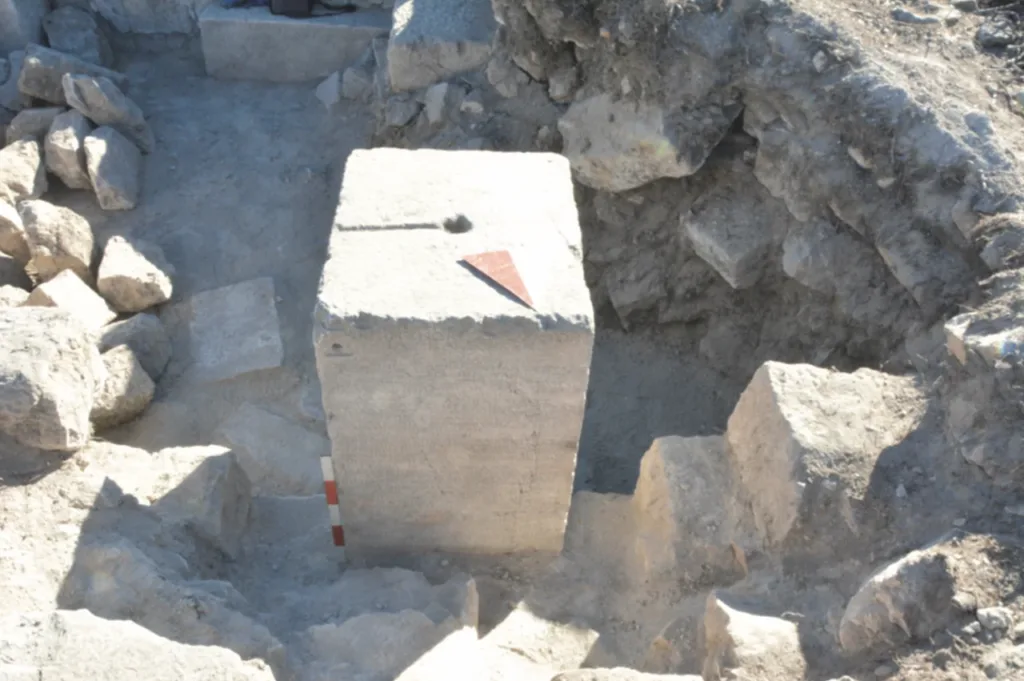
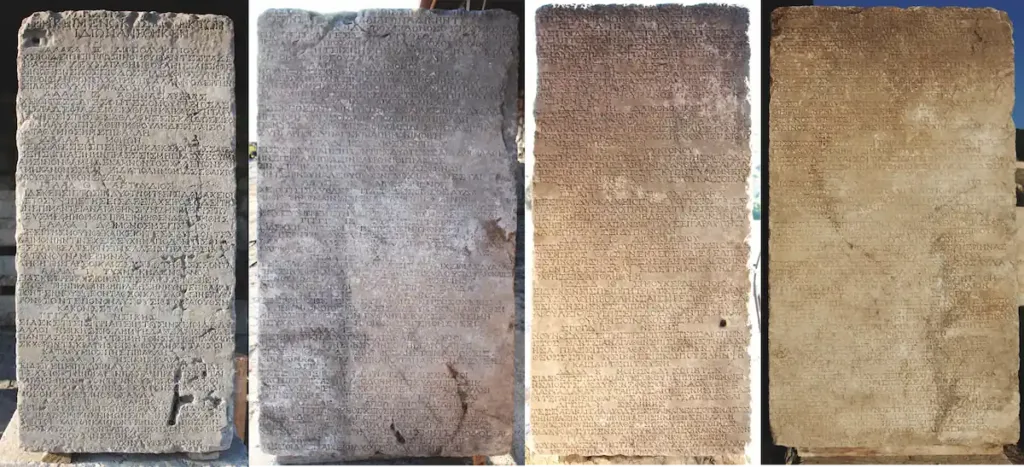
A 1,800-year-old stone monument inscribed with 56 oracles has been discovered at the ancient city of Kibyra in southwestern Türkiye. Covered with Greek inscriptions on all four sides, the monument once allowed people to seek answers about illness, travel, money, and their future by casting five animal knucklebones.
Archaeologists uncovered this limestone monument in 2024 during excavations conducted on the third terrace of the ancient city’s agora. A new study published in the academic journal Gephyra examines the inscriptions and identifies the monument as an example of astragalomancy, a form of divination in which people cast animal knucklebones to obtain messages attributed to the gods.
The research, conducted by Şenkal Kileci, Nihal Tüner Önen, and Şükrü Özüdoğru, dates the inscription to the second or third century AD. Measuring 1.24 meters in height, the surviving stone preserves an extensive collection of predictions that once formed part of a public divination system.
How Five Animal Bones Could Reveal the Future
Unlike modern fortune-telling cards, the ancient system relied on small bones taken from the ankle joints of animals such as sheep, goats, and calves. Known as astragaloi, these bones had four usable faces, each assigned a numerical value of 1, 3, 4, or 6.
A person seeking guidance would throw five knucklebones together and compare the resulting combination with the inscriptions carved on the monument. The system produced 56 possible combinations, each corresponding to a particular oracle associated with a deity. Unlike several similar inscriptions found elsewhere in Anatolia, the surviving text at Kibyra also preserves the numerical instructions needed to identify each prediction.
For example, when all five knucklebones landed on the number one, the result corresponded to an oracle associated with Olympian Zeus. The prediction promised good judgment and happiness, while also encouraging the person seeking guidance to honor Aphrodite and Hermes.
Other combinations delivered less encouraging predictions. Some warned against starting a journey or undertaking a business venture, while others promised success, recovery from illness, or the safe return of someone far from home.
Divine guidance was not always sought for political matters or affairs of state. Ordinary people also turned to the gods with deeply personal concerns, hoping to learn whether a sick loved one would recover, a journey would end safely, or a business venture would succeed. Like people today, they faced an uncertain future and sought reassurance before making important decisions.
Although the predictions appeared to depend on chance, the answers themselves followed an established literary structure. Many were composed in Greek hexameter verse, giving the messages a formal style that echoed older religious and poetic traditions.
A Monument Dedicated to Hermes
An inscription at the top of the monument suggests that a wealthy benefactor paid for the installation of the oracle and a statue of Hermes, along with its pedestal and surrounding decorations. Although the donor’s name has not survived, the dedication indicates that the entire arrangement was financed as a private contribution to the city.
Hermes was closely associated with travel, trade, communication, and divination by lots. His connection to the monument was therefore particularly appropriate for a system that offered guidance to travelers, merchants, and other visitors seeking answers.
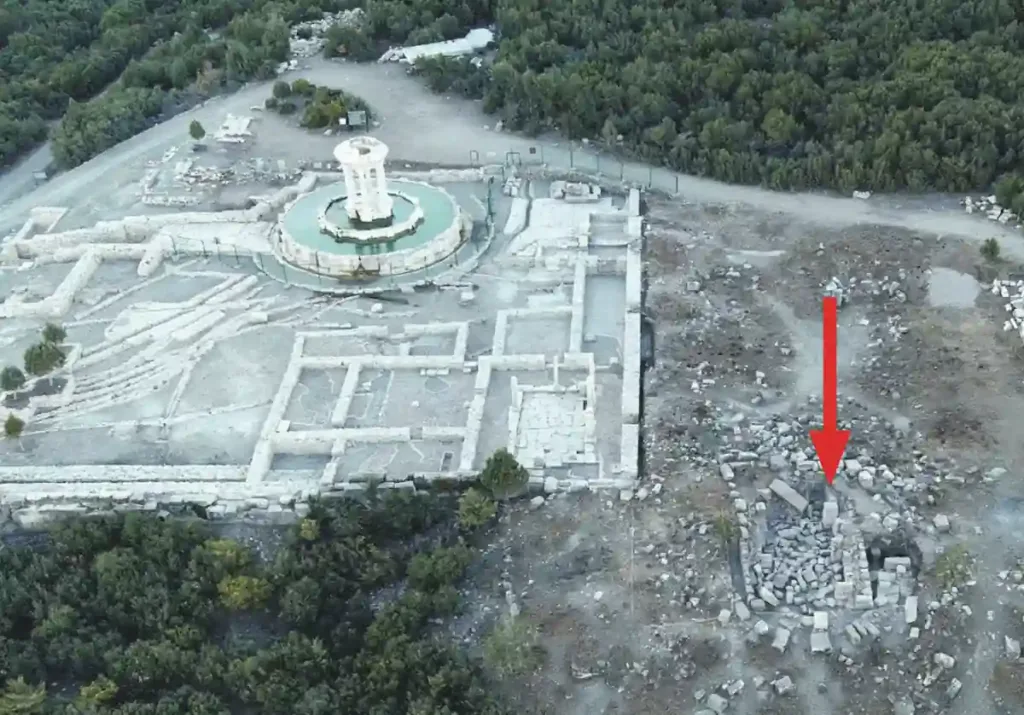
The researchers suggest that the monument originally stood in or around Kibyra’s agora, where residents and visitors could consult its predictions. Similar oracle inscriptions occupied public spaces in other Anatolian cities, sometimes through donations from wealthy citizens or civic officials.
Centuries later, builders reused the oracle monument in the northern wall of a chapel on the third terrace of Kibyra’s agora. Archaeologists discovered the inscribed stone there in 2024, providing another example of how ancient monuments found new uses as the city changed over time.
Kibyra Was Part of a Wider Anatolian Oracle Tradition
Between approximately AD 120 and 210, people in several cities across southwestern and southern Anatolia used similar knucklebone oracles to seek guidance from the gods. The new inscription shows that Kibyra participated in a religious tradition shared by communities across the region.
Researchers have documented comparable inscriptions at Termessos, Kremna, Sagalassos, Perge, and other settlements across southern Anatolia. These monuments demonstrate how a broadly shared system of divine consultation circulated between cities while developing local variations.
The Kibyra inscription closely resembles the example from Kremna, although the researchers identified grammatical differences, altered verses, and irregularities in poetic meter. Some variations may reflect mistakes made by stonecutters, while others suggest that local editors deliberately adapted the inherited texts.
Significantly, the Kibyra monument preserves the numerical casting instructions throughout its surviving sequence, unlike several comparable inscriptions in which these instructions are incomplete or omitted.
For the research team, the four-sided monument provides more than another example of ancient divination. It documents how religious beliefs, public monuments, and everyday decision-making intersected in a Roman-era Anatolian city, where the throw of five small bones could determine which divine message a person received.
Kileci, Ş., Tüner Önen, N., & Özüdoğru, Ş. (2026). A New Astragalos Oracle Text from Kibyra: A Comparative Study with Southern Asia Minor Parallels. Gephyra, 31, 257-294. https://doi.org/10.37095/gephyra.2002699
