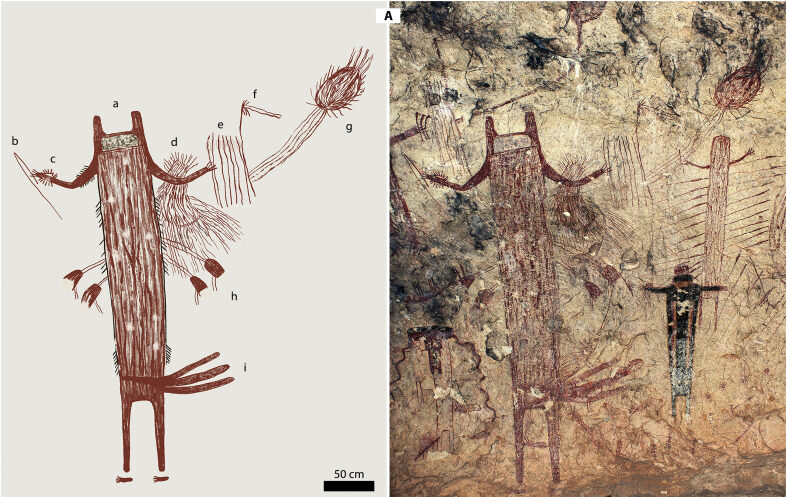
Archaeologists working in the canyonlands of southwest Texas have discovered that some of North America’s most iconic cave paintings are far older than previously believed. According to new scientific dating, Pecos River–style murals found along the U.S.–Mexico border may have been first created nearly 6,000 years ago, revealing a remarkably long and continuous artistic tradition among ancient hunter-gatherer societies.
The findings come from a large interdisciplinary study led by Dr. Carolyn E. Boyd of Texas State University, published in Science Advances. The research redefines what is known about early ritual art in North America and challenges outdated assumptions about the complexity of forager cultures.
A Sacred Landscape Along the Rio Grande
The Lower Pecos Canyonlands, located near the Rio Grande, contain hundreds of rock shelters formed by limestone overhangs. These natural alcoves provided smooth, protected wall surfaces—ideal conditions for painting. Many murals remain in the same locations where rituals and ceremonies likely took place thousands of years ago.
The paintings themselves are visually striking. Artists used red ochre, black pigments, and yellow mineral tones to create dense scenes filled with human-like figures, animals, and abstract symbols. Some murals stretch across large rock faces and contain dozens of carefully arranged elements, suggesting deliberate composition rather than spontaneous decoration.
Why Dating Cave Paintings Is So Difficult
Dating ancient rock art has long been one of archaeology’s greatest challenges. Mineral pigments alone cannot be radiocarbon dated because they contain no organic material. However, prehistoric artists often mixed pigments with organic binders, such as plant resins or animal fats, to help paint adhere to stone.
📣 Our WhatsApp channel is now LIVE! Stay up-to-date with the latest news and updates, just click here to follow us on WhatsApp and never miss a thing!!
These binders left behind microscopic traces of carbon. By isolating and dating this carbon, researchers can estimate when the paint was originally applied.
To avoid contamination from soot, groundwater, or later human activity, the research team carefully sampled organic residue embedded within specific paint layers, rather than scraping the rock surface itself.
Reading Time Through Layers of Paint
In addition to radiocarbon dating, the team used stratigraphy, a method that interprets age based on the order of layered materials. By examining which paint layers overlapped others, researchers could determine the sequence in which colors and figures were applied.
This analysis revealed a consistent painting order across many sites. Such repetition suggests shared rules and planning, reinforcing the idea that these murals followed a formal symbolic system passed down through generations.

What Is Bayesian Modeling—and Why It Matters
To refine their timeline, researchers applied Bayesian modeling, a statistical method that combines radiocarbon dates with probability theory.
In simple terms, Bayesian modeling allows scientists to:
Combine multiple dates from different samples
Account for uncertainty in each measurement
Use known relationships (such as which paint layer came first)
By doing this, the model produces a more accurate time range than any single date alone.
Using 57 direct radiocarbon dates and 25 mineral crust dates from 12 sites, the study determined that Pecos River–style painting likely began between 5,760 and 5,385 years ago and continued until about 1,370–1,035 years ago. That represents an extraordinary 4,000–4,800 years of continuous artistic tradition.
A Stable Symbolic System Across Millennia
One of the study’s most striking conclusions is the long-term stability of the imagery. Despite changes in climate, land use, and material culture, the core symbols and themes remained consistent.
Researchers identified at least eight murals that strictly followed a shared iconographic system—repeating motifs with clearly understood meanings. Across more than 200 known murals, similar figures appear again and again, suggesting a deeply rooted cosmovision, or shared understanding of how the universe works.
In societies without writing, repetition and ritual play a key role in preserving knowledge. These murals likely helped transmit myths, moral rules, ceremonial timing, and spiritual beliefs across generations.
Preservation, Respect, and Living Heritage
The dry canyon climate, combined with stable temperatures and limited sunlight under rock overhangs, helped preserve the pigments for millennia. Still, the murals remain vulnerable to flash floods, smoke damage, and human contact.
Because sampling paint risks permanent loss, researchers used pinhead-sized samples, supported by high-resolution photography and digital microscopy to minimize impact.
Importantly, many Indigenous communities still view these images as sacred, representing ancestral beings or creation stories rather than mere archaeological artifacts. As a result, the research team collaborated with Indigenous consultants to guide interpretation, sampling decisions, and public sharing of results.
Rethinking “Simple” Forager Societies
The study challenges the idea that hunter-gatherers lacked complex belief systems. Instead, it shows they maintained a sophisticated, rule-based visual language for thousands of years—one that may have influenced later Mesoamerican cultures.
By anchoring these murals in deep time, scientists can now test long-debated connections between ancient communities across the borderlands.
As research continues, the future of these painted shelters depends on careful protection, respectful collaboration, and ongoing scientific study—ensuring that this ancient visual language endures for generations to come.
Steelman KL, Boyd CE, Dering JP. Mapping the chronology of an ancient cosmovision: 4000 years of continuity in Pecos River style mural painting and symbolism. Sci Adv. 2025 Nov 28;11(48):eadx7205. doi: 10.1126/sciadv.adx7205. Epub 2025 Nov 26. PMID: 41296859; PMCID: PMC12652245.
Cover Image Credit: Boyd et al., 2025, Science Advances