
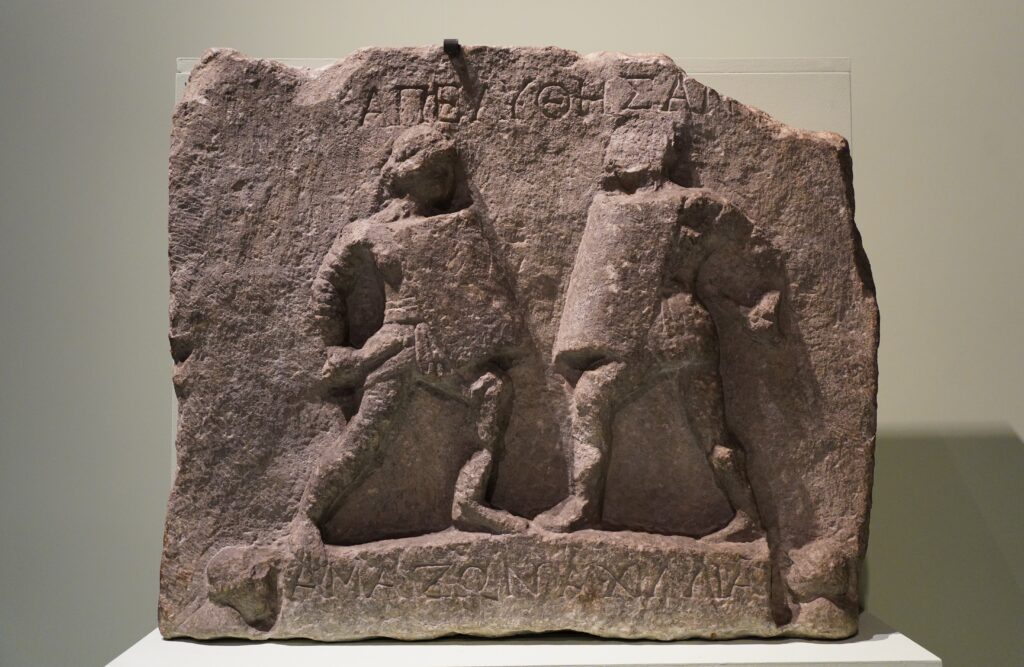
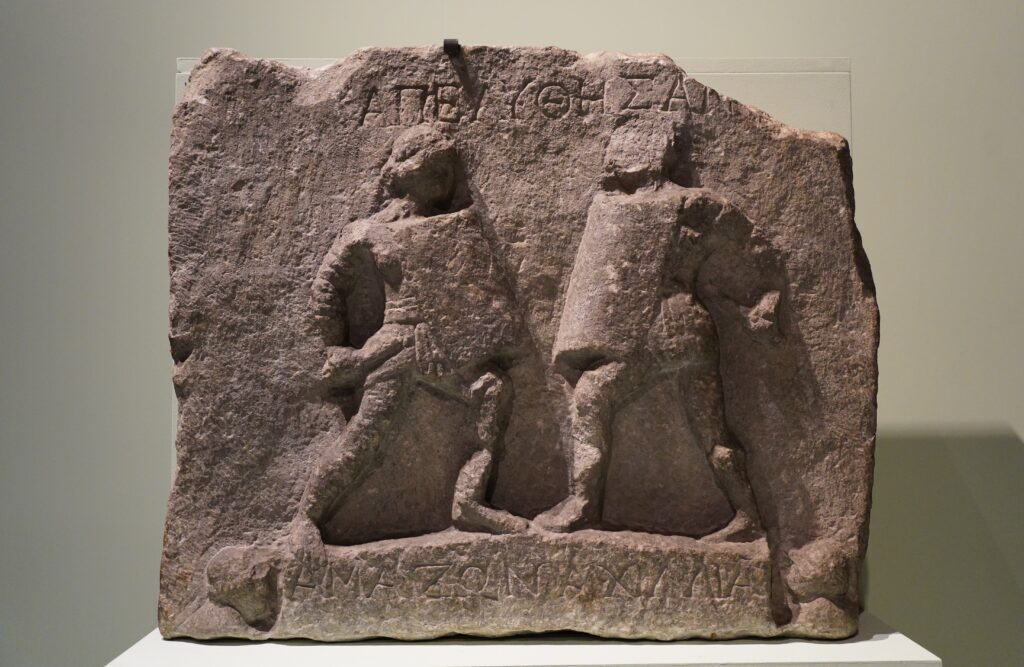
Nearly 2,000 years ago, two female gladiators known as Amazon and Achillia faced each other in the arena at ancient Halicarnassus, the city that is now Bodrum on Türkiye’s Aegean coast. Almost everything about the event has disappeared, but a Roman marble relief preserves the names, equipment, and unusual outcome of their fight.
The relief, now in the British Museum, dates to the 1st or 2nd century AD and was found at Halicarnassus. Measuring about 66 centimeters high and 78 centimeters wide, it depicts the two women advancing toward one another with swords and shields.
Their equipment closely resembles that used by male gladiators. Both women carry large shields and wear protective gear on their legs and sword arms, although neither is shown wearing a helmet. The British Museum identifies the figures through the inscriptions above them: Amazon and Achillia.
Two arena names with a mythological connection
Amazon and Achillia were probably stage names rather than the women’s birth names. Gladiators often adopted names designed to create recognizable characters in the arena, and in this case the choice appears to have carried a deliberate mythological reference.
Classical scholar Kathleen Coleman has argued that the pair’s names evoke Achilles and Penthesileia, the Amazon queen whom Achilles kills in Greek mythology. “Achillia” effectively gives Achilles a female identity, while “Amazon” recalls Penthesileia and the wider tradition of female warriors.
That connection raises the possibility that their appearance was designed as more than a straightforward gladiatorial contest. Coleman suggested that Amazon and Achillia may have fought as a recurring pair, presenting Roman audiences with an arena version of a famous mythological confrontation.
The association would have been particularly resonant at Halicarnassus. Centuries earlier, the Mausoleum of Halicarnassus had been decorated with an extensive Amazonomachy frieze depicting battles between Greeks and Amazons, showing how deeply such imagery had already become embedded in the visual culture of the city.
Relief from the Amazonomachy frieze of the Mausoleum at Halicarnassus, depicting combat between Greeks and Amazons. Credit: British Museum / Wikimedia Commons.
An unusual ending to the fight
The inscription on the relief provides one of its most significant details. Rather than recording the death of either fighter, it indicates that both women left the contest alive.
The British Museum describes the monument as commemorating either their release from gladiatorial service or their discharge following a drawn contest. Coleman proposed a more specific interpretation: the inscription refers to missio, permission for gladiators to leave the arena without being killed and return to their barracks.
Under that interpretation, Amazon and Achillia did not necessarily win their freedom. Instead, their fight may have ended in an exceptional draw in which both women performed well enough to receive permission to survive and continue their gladiatorial careers.
That distinction is important because evidence for female gladiators remains limited. Ancient writers record women appearing in Roman arenas, and the British Museum notes that Suetonius described Emperor Domitian staging contests involving women during nighttime spectacles. Physical representations such as the Halicarnassus relief, however, are much rarer.
A rare glimpse of Roman Halicarnassus
Modern Bodrum is most closely associated with the Mausoleum of Halicarnassus, one of the Seven Wonders of the Ancient World, but the Amazon and Achillia relief preserves a very different side of the city’s history. It points to the spectacles, performers and audiences that formed part of urban life under Roman rule.
The marble relief entered the British Museum collection in the 19th century and is currently listed as not on display. Its two fighters nevertheless remain unusually identifiable: after almost two millennia, their arena names and the result of their encounter can still be read from a single surviving monument.
