
A rare distilling vessel found at Gnandstein Castle in Saxony may point to alchemical activity inside one of Germany’s best-preserved medieval fortresses, according to a press release by the Landesamt für Archäologie Sachsen.
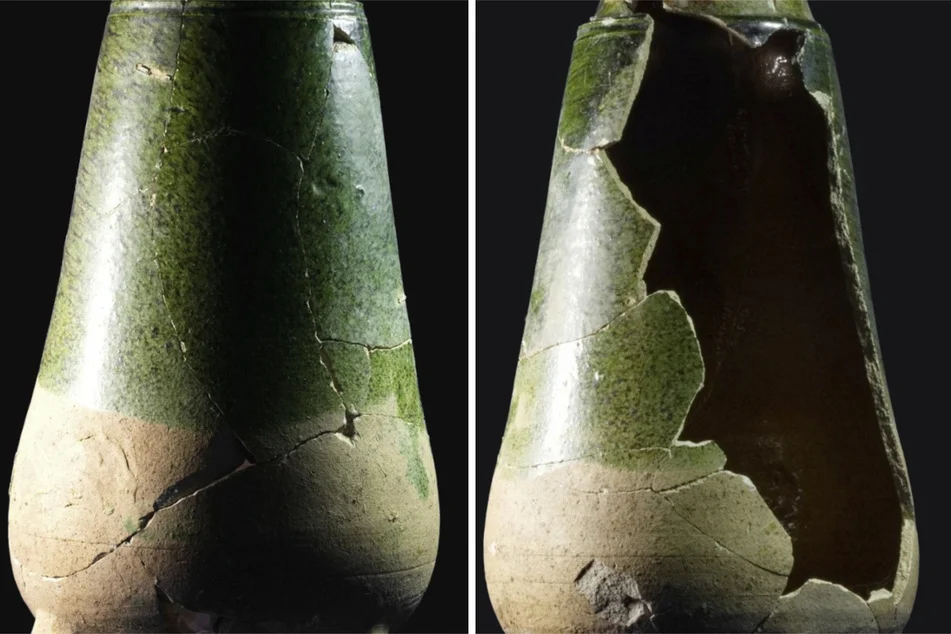
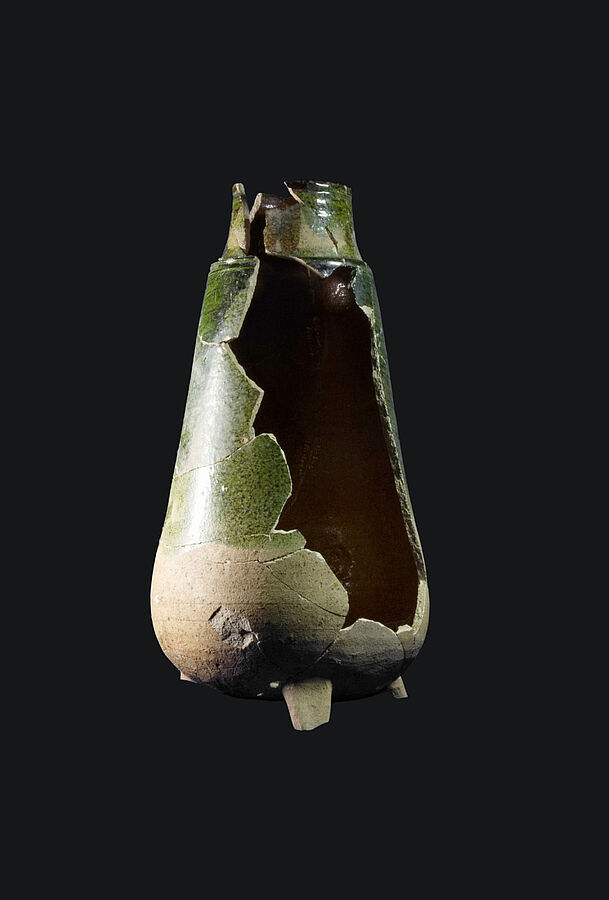
The object, a tall flask-shaped ceramic vessel with three small feet and a straight, steep neck, was uncovered during archaeological monitoring connected to construction work at the castle. Dated to the 15th or 16th century, the vessel is not an ordinary kitchen container. Archaeologists identify it as a distilling flask, part of an apparatus used to heat liquids, collect vapors, and condense them into a new substance.
That small technical detail matters. In the late medieval and early modern period, distillation stood at the meeting point of medicine, metallurgy, natural philosophy, and alchemy. It was used not only by those chasing gold or mythical elixirs, but also by people experimenting with minerals, plants, alcohol, acids and healing tinctures.
A discovery beneath later construction work
Gnandstein Castle lies in the village of Gnandstein, now part of Frohburg in the Leipzig district of Saxony. Its origins go back to the 13th century, when a fortified complex was established above the Wyhra Valley. The castle later developed from a defensive stronghold into a residence, while preserving major medieval elements.
Although the castle underwent extensive restoration between 1994 and 2004, construction and maintenance work still require archaeological supervision. The latest investigation took place in the area of the demolished westwork, where major building work was being carried out, including the installation of a technical room.
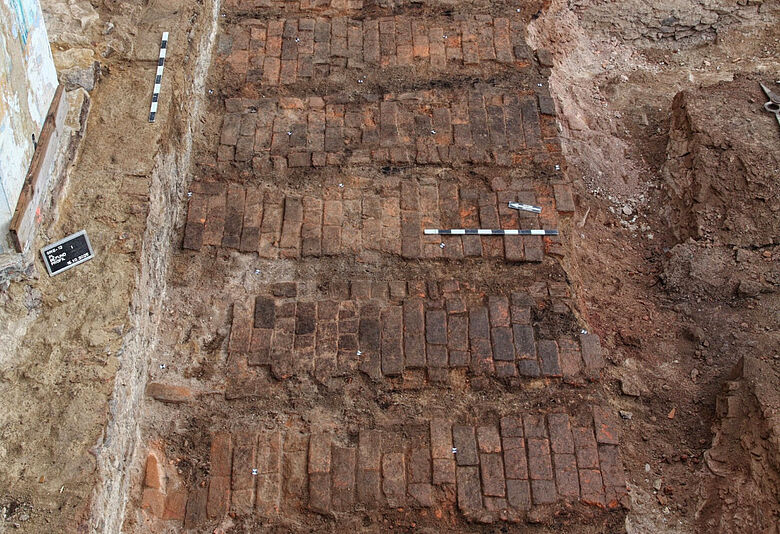
The excavation area covered about 225 square meters. Much of it had already been disturbed by earlier interventions. Even so, archaeologists uncovered around 30 square meters of brick paving from an early modern floor. They also found partly green-glazed floor tiles dating to the early 16th century.
Among the ceramic finds, one vessel stood out immediately. It was tall, bulbous, and technically unusual, with a narrow neck designed to receive a dome-shaped head. When heated, vapor from the liquid inside would rise into this upper section, condense, and then be directed away. In practical terms, this was a distillation setup.
A flask made for transformation
The Gnandstein vessel is partly green-glazed on the outside and yellow-glazed inside. Its form and construction suggest a controlled technical process rather than simple storage or cooking.
In a full distillation apparatus, the lower vessel held the material to be heated. A rounded cap, often called a head or helm, was placed over the neck. As the contents warmed, vapors moved upward, condensed on the cooler surface, and were collected as a distilled liquid. Depending on the material, the result could be alcohol, plant extract, mineral preparation or medicinal liquid.
This kind of vessel fits well with alchemical and proto-chemical practice of the 15th and 16th centuries. Yet the evidence must be treated with caution. No residues were found inside the Gnandstein flask, meaning archaeologists cannot say what was distilled in it. The find suggests possible alchemical use, but it does not identify the exact substance.
That absence is important. It prevents a sensational claim, but it also makes the object more intriguing. The vessel proves that a specialized distillation tool was present at the castle. What happened inside it remains open.
Alchemy was not only about making gold
Alchemy is often reduced to two images: the search for the philosopher’s stone and attempts to turn base metals into gold. Those ideas were real parts of alchemical culture, but they were not the whole story.
In medieval and early modern Europe, alchemy also involved observation, heating, purification, crystallization, sublimation, and distillation. It belonged to a wider world of practical experimentation. Alchemists, physicians, apothecaries, metalworkers, and miners often worked with similar tools and materials.
That makes the Gnandstein find especially relevant in Saxony. The region was closely tied to mining and metallurgy in the late medieval and early modern periods. In such a setting, alchemical knowledge was not only mystical. It could be technical, economic, and medical.
Distillation was used to produce mineral acids such as sulfuric acid and nitric acid. These substances were important in metalworking, assaying, and laboratory procedures. The same method could also be used to extract essences from herbs, leaves, seeds, fruits, and resins. For early modern practitioners, almost anything that could be heated, separated, or concentrated was a candidate for distillation.
Aqua vitae and the medical side of distillation
One of the most important products of medieval distillation was aqua vitae, the “water of life.” This was produced by distilling wine into a stronger alcoholic spirit. To modern readers, that sounds close to brandy or medicinal alcohol. To medieval and early modern users, however, it appeared far more powerful.
A clear liquid drawn from wine by fire seemed to occupy a strange category. It looked like water, burned like fire, and dissolved substances that ordinary water could not. It could carry plant extracts, preserve medicinal ingredients, and intensify the effect of herbal preparations.
Because of this, aqua vitae was often treated as a medical substance before it became a common recreational drink. Practitioners added herbs, spices, seeds, roots, and other “drugs” after distillation to create tinctures believed to heal, strengthen or protect the body.
The Gnandstein vessel could have been used for such a process. It may have distilled wine into spirit. It may have extracted plant essences. It may have produced a mineral preparation. Without chemical residue, all of these remain possibilities, not conclusions.
Why Alchemists Avoided Metal Vessels
The Landesamt für Archäologie Sachsen notes that glass and ceramic vessels were often preferred for certain distillation processes because metal containers were believed to release harmful substances. This belief was not entirely irrational. Some distilled materials, especially acidic preparations, could react with metal surfaces. Ceramic and glass offered more neutral containers for sensitive substances.
That technical choice also shows how sophisticated early distillation could be. The people using such apparatus were not simply performing symbolic rituals. They understood that materials behaved differently under heat, that vapors could be collected, and that the vessel itself could affect the result.
In that sense, alchemy helped shape the habits of laboratory work. Measuring, heating, separating, and repeating procedures became part of a practical culture that later fed into chemistry, pharmacy, and industrial production.
A castle find with a laboratory story
Gnandstein Castle is usually read through its towers, walls, living quarters, and noble history. This small vessel adds a different layer. It suggests that the castle may also have contained spaces where substances were heated, transformed, and tested.
The discovery does not prove that a secret alchemist worked behind locked doors at Gnandstein. It does something better. It places the castle inside a broader early modern world in which noble households, physicians, apothecaries, and technical specialists were interested in distillation. Such work could be medical, experimental, practical or speculative, often all at once.
The vessel also reminds us that alchemy was not only a story of failure. Its grander promises, gold-making and immortality among them, remain legendary. But its tools helped people learn how matter changes under heat. Its experiments contributed to medicine, metallurgy, perfumery, alcohol production, and the early laboratory sciences.
At Gnandstein, that larger history survives in a ceramic flask: green on the outside, yellow within, empty of residue, but full of questions.
Landesamt für Archäologie Sachsen
Cover Image Credit: Approx. 30-square-meter brick-paved floor from the early modern period. © Sven Kretzschmar, Landesamt für Archäologie Sachsen.
