
23 January 2026 The Future is the Product of the Past

Saxony’s Oldest Gold Coin Unearthed in Leipzig: A 2,200-Year-Old Celtic Masterpiece

A small yet extraordinary discovery has rewritten Saxony’s numismatic history. A certified hobby detectorist, Daniel Fest, uncovered what is now recognized as Saxony’s oldest known coin — a 2,200-year-old Celtic gold quarter stater — in a field near Leipzig-Gundorf. The find, weighing barely two grams, was officially presented this week by the State Office for Archaeology (Landesamt für Archäologie Sachsen) in Dresden.

A Discovery That Bridges Ancient Trade Networks

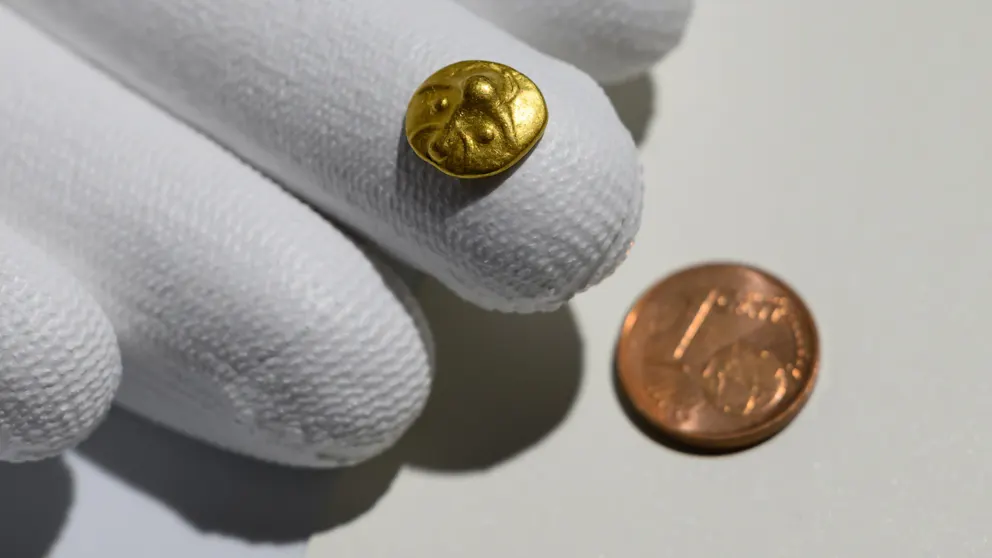
The tiny coin, smaller than a one-cent piece, was minted almost entirely from pure gold and dates back to the third century BCE. Archaeologists identify it as a quarter stater, a denomination used among Celtic tribes inhabiting Central Europe.

Its obverse bears a stylized animal head, probably a stag, with distinct eyes, horns, and a rounded forehead. The reverse features an open torc with thickened ends, a rounded-edge star, and a central sphere — motifs common among Celtic communities in northern Bohemia.

According to Dr. Regina Smolnik, Saxony’s State Archaeologist, Celtic coins are exceptionally rare east of the traditional Celtic world:

“Although Saxony lay beyond Celtic settlement areas, this find proves there were consistent exchanges and connections. It was not a circulating coin in the economic sense but likely a status object or symbolic store of value owned by a local elite engaged in trade with the Celts.”


📣 Our WhatsApp channel is now LIVE! Stay up-to-date with the latest news and updates, just click here to follow us on WhatsApp and never miss a thing!!


From Detector to Display: Responsible Discovery

Fest, who searches with his metal detector up to fifteen times a year, described the moment as unforgettable:

“It’s not my oldest find, but definitely my most beautiful.”

The discovery was promptly reported and handed over to authorities — a procedure praised by the State Office as a model of citizen collaboration in archaeology.

Barbara Klepsch, Saxony’s Minister for Culture and Tourism, emphasized the broader meaning of such cooperation during the press presentation in Dresden:

“This gold coin is a tangible fragment of our history, illuminating ancient trade and the people who once lived here. It shows how civic engagement contributes to uncovering and preserving our cultural identity.”

The Landesamt stressed that transparent reporting is vital for a legal and trustworthy relationship between volunteer detectorists and state archaeologists — a cornerstone of heritage protection policy in Saxony.
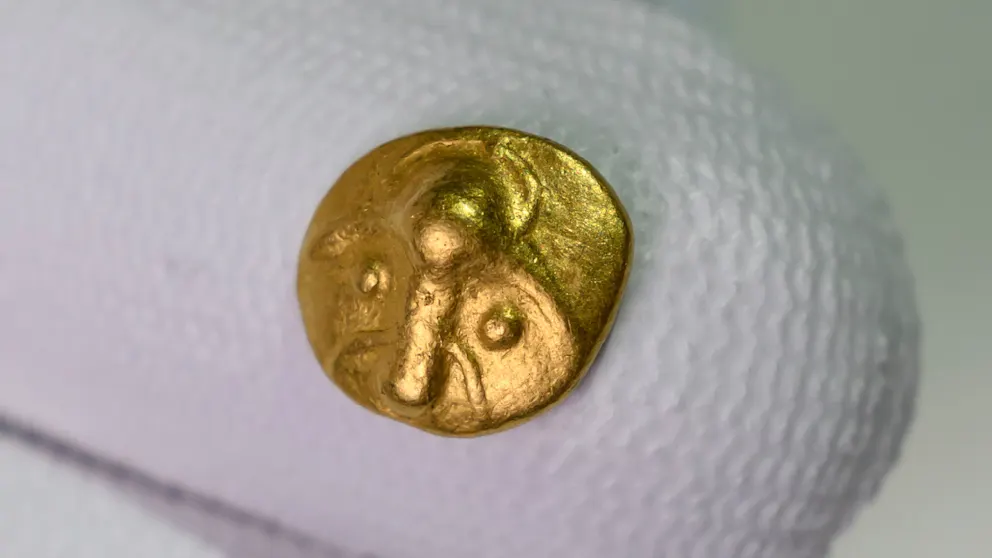
The obverse of the coin shows a stylized animal head with visible eyes, horns, and a rounded forehead. Credit: picture alliance / dpa.

The “Rainbow Bowl” Legend

Due to its convex shape, the coin belongs to a class of Celtic gold pieces nicknamed “Regenbogenschüsselchen” — “rainbow bowls.” The term originates from old folk belief: where a rainbow touches the earth, a treasure lies buried. Farmers often found such bowl-shaped coins on their fields after heavy rain, reinforcing the myth that they had fallen from the sky.

Before this discovery, the oldest known Saxon coin was a silver Büschelquinar, found in 2007 near Zauschwitz and dated to the early first century BCE. The Gundorf gold coin now pushes Saxony’s monetary record back by nearly a century, providing solid evidence that the region maintained trade links with Celtic territories much earlier than assumed.

A Two-Gram Window into the Iron Age

At just two grams, the quarter stater may be the smallest artefact ever formally presented by the State Office. Yet its cultural weight is enormous. The coin represents elite contact zones at the northeastern edge of the Celtic world, where local communities interacted with long-distance traders across Central Europe.

For archaeologists, the find also demonstrates the scientific value of controlled metal-detecting programs. Since the Landesamt began certifying responsible detectorists, several new Celtic coins have surfaced — including one other gold piece without decoration — bringing Saxony’s total to eleven Celtic coins known to date.

The newly discovered Gundorf stater, now safely conserved and documented, will go on display in Dresden. It not only enriches Saxony’s archaeological record but also reinforces the role of collaboration between citizens and scientists in protecting cultural heritage.

Landesamt für Archäologie Sachsen (LfA)

Cover Image Credit: The 2,200-year-old Celtic gold coin — smaller than a one-cent piece — was presented in Dresden. Robert Michael / dpa.

Related Articles

Fragments of ‘unique’ 17th-century iconostasis discovered in Polish church

28 October 2023

28 October 2023

Researchers from the Institute of Art at the Polish Academy of Sciences (IS PAN) have discovered substantial fragments of a...

Archaeologists unearthed fresh evidence that bedbugs came to Britain with the Romans

3 February 2024

3 February 2024

Archaeologists working the Roman garrison site of Vindolanda in Northumberland, south of Hadrian’s Wall, have discovered new proof that the...

Ancient Yemeni Farmers’ Irrigation Mastery Unearthed

31 October 2025

31 October 2025

The General Authority for Antiquities and Museums’ Dhamar branch has unveiled a remarkable archaeological find in Wadi Hijrat Munathidah, north...

New Study reveals how England’s ‘White Queen’ worshipped a disembowelled saint at the Chapel of St Erasmus

5 December 2022

5 December 2022

A new study reveals the story of how England’s “White Queen”, Elizabeth Woodville, wife of Edward IV, once worshipped at...

2000-years-old Hercules Rock Relief is being Vandalized

17 February 2024

17 February 2024

The 2000-year-old Hercules Rock Relief, located in Deliktaş, approximately 2.5 kilometers northeast of the Iznik district center of Bursa, is...

A unique find in the Middle Don: Scythian gods on a silver plate

19 November 2021

19 November 2021

Archaeologists of the Archaeological Institute of the Russian Academy of Sciences, during their excavations at the Devitsa V cemetery in...

Human Relief Found at Million Stone Excavation Site in İstanbul

18 July 2021

18 July 2021

The Milion Stone (also known as the Million Stone) from the Eastern Roman period is one of important the historical...

2,500-Year-Old Phoenician Shipwreck Being Rescued By Spanish Archaeologists

6 July 2023

6 July 2023

A 2,500-year-old Phoenician shipwreck has been found underwater in the southeastern Spanish region of Murcia. An extraordinary Phoenician shipwreck dating...

Rare 3,500-Year-Old Chariot Wheel Discovered at Inverness Golf Course

24 April 2025

24 April 2025

Archaeologists have discovered a rare prehistoric chariot wheel at the site of a future golf course near Inverness. The discovery...

Rare bronze hand discovered in Roman Vindolanda, England

11 July 2023

11 July 2023

One of Europe’s most important Roman archeological sites is the Fort of Vindolanda, one of the earliest Roman garrisons built...

Karahantepe will shed light on the mysteries of the Prehistoric period

7 October 2021

7 October 2021

Karahantepe’s ancient site, which is home to Neolithic-era T-shaped obelisks similar to the ones in the world-famous Göbeklitepe, will reveal...

A stone statue (Balbal) with height up to 3 meters found in the Issyk-Kul region of Kyrgyzstan

18 October 2022

18 October 2022

A balbal (stone statue) with a height of up to 3 meters was found during agricultural work in the Ak-Bulun...

Extremely well-preserved 2000-year-old child’s leather Shoe Discovered During Archaeological Mine Excavations

1 September 2023

1 September 2023

An “extremely well-preserved” Iron Age child’s shoe was discovered in Austria during excavations at Dürrnberg, near the historic town of...

5,500-Year-Old ‘Polish Pyramids’ Discovered by Archaeologists in Western Poland

11 July 2025

11 July 2025

Archaeologists in western Poland have uncovered two massive prehistoric structures dubbed the “Poland pyramids,” offering a remarkable glimpse into one...

A Giant Stone Panel Discovered in Mexico Reveals the Name of a Previously Unknown Maya King’s

14 August 2024

14 August 2024

Archaeologists from Mexico’s National Institute of Anthropology and History (INAH) have discovered a fascinating panel containing an extensive Maya hieroglyphic...