

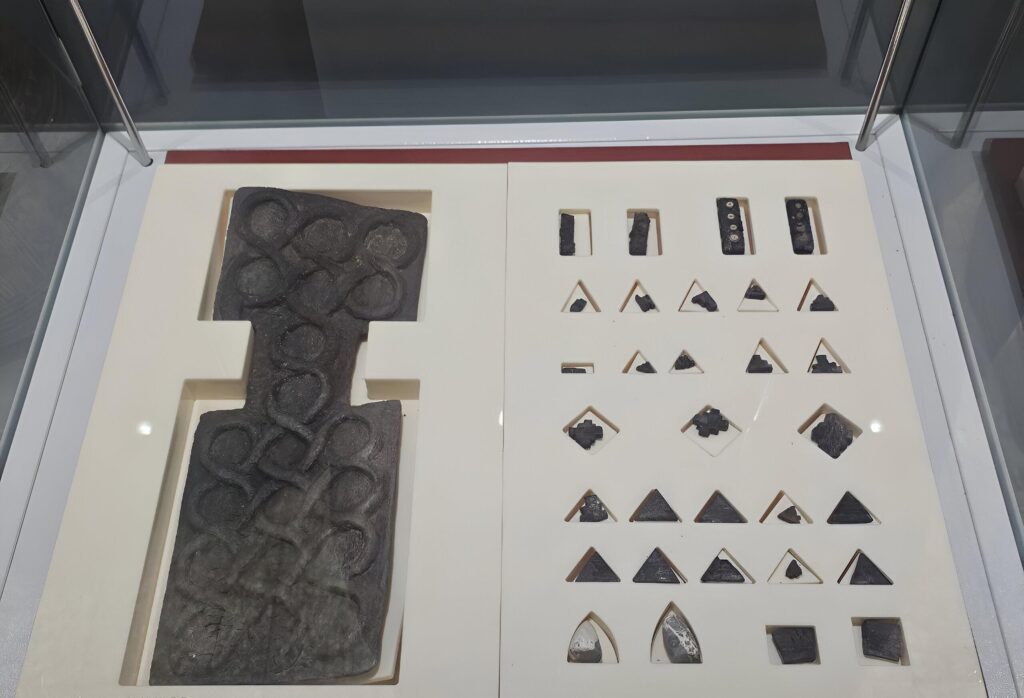
Archaeologists working at Shahr-i Sokhta, the Bronze Age settlement better known as Iran’s Burnt City, have discovered a new type of 4,600-year-old board game, adding an unexpected chapter to a site already famous for preserving one of the ancient world’s most remarkable gaming sets.
The discovery was made during the 21st season of excavations at the UNESCO World Heritage site in southeastern Iran. Alongside the game, archaeologists uncovered an engraved bone comb, traces of textiles, leather and egg, new forms of burial, and other unusually well-preserved evidence of life in the third millennium BC.
Rouhollah Shirazi, head of the excavation team, said the newly discovered game represents a different type of intellectual or board game from material previously identified at the site. Although its rules and exact form have not yet been published in detail, the object is being dated to around 4,600 years ago.
That distinction is particularly important at Shahr-i Sokhta. Nearly half a century ago, archaeologists recovered another elaborate gaming set from the same ancient city — a find that has since become central to research into the history of board games in Western and Central Asia.
Burnt City already had one extraordinary ancient game
In 1977, an Italian archaeological mission excavating Grave 731 at Shahr-i Sokhta found a wooden gaming board together with 27 pieces and dice. The assemblage, generally dated to around 2600–2400 BC, has been described as one of the most complete early board-game sets known from the ancient world.
Its carved design and gaming pieces have often been compared with the Royal Game of Ur from Mesopotamia. Because no written instructions survived at Shahr-i Sokhta, researchers have spent decades trying to understand how the game worked. A recent analysis by Sam Jelveh and Hossein Moradi proposed a playable reconstruction based on the archaeological evidence and comparisons with the Game of Twenty tradition, while stressing that the original rules remain unknown.
The newly announced discovery therefore raises a more interesting question than the presence of a single ancient game. If the new object does indeed represent a different type of game, Shahr-i Sokhta may preserve evidence for more than one gaming tradition within the same Bronze Age urban society.
For now, however, the excavation team has not released enough technical information to establish how the new game was played, whether all of its components survive, or how closely it relates to the set found in Grave 731. Those questions will require detailed publication of the new material.
A cemetery preserving more than the dead
The game was among finds recovered during excavations focused partly on the vast cemetery of Shahr-i Sokhta. Shirazi said the cemetery produced previously undocumented burial forms as well as plain, decorated and polychrome pottery and several categories of organic material rarely preserved at archaeological sites.
Among them were traces of egg, textile and leather. Such material normally decomposes rapidly, but Shahr-i Sokhta’s arid environment has created exceptional preservation conditions, allowing archaeologists to recover evidence that stone, pottery and architecture alone cannot provide.
The organic finds could help reconstruct clothing, food consumption, craft techniques and funerary practices. Radiocarbon sampling, ancient-DNA research, physical anthropology and other interdisciplinary studies are also being incorporated into the current excavation program.
The cemetery context is especially significant for the board game. Objects deliberately placed with the dead can carry meanings that extend beyond their practical use in life, and archaeologists will need to determine whether the newly discovered game was a personal possession, a marker of social identity, part of a funerary practice or something else entirely.
An engraved bone comb with links beyond the city
Another unusual object from the season is a decorated bone comb carved with an engraved design. Shirazi said no close parallel has yet been identified at Shahr-i Sokhta itself, while comparable objects are known from some archaeological sites in Central Asia.
The comb could therefore provide evidence not only for grooming and personal appearance but also for manufacturing traditions and cultural connections. Researchers have not yet determined whether it was locally produced or represents influence from farther north, making its material, manufacturing technique and decorative pattern particularly important for future analysis.
That possibility fits the broader archaeological character of Shahr-i Sokhta. UNESCO describes the city as standing at the junction of Bronze Age trade routes across the Iranian plateau, with archaeological evidence connecting its inhabitants to Central Asia, the Indus region, the Persian Gulf and Oman Sea, southwestern Iran and wider exchange networks extending toward Mesopotamia.
The Helmand Civilization was a Bronze Age cultural complex centered on the Helmand River basin, encompassing parts of southeastern Iran and southwestern Afghanistan during the third millennium BC. Shahr-i Sokhta was one of its largest and most important urban centers, alongside sites such as Mundigak in present-day Afghanistan.
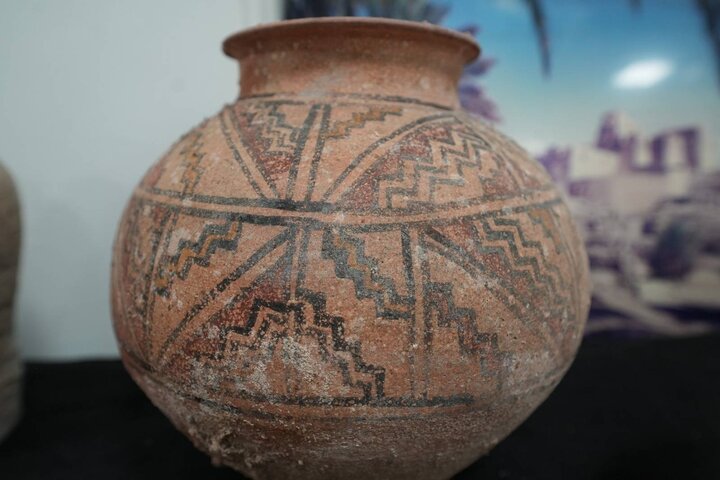
A pottery vessel from Shahr-i Sokhta, where the dry desert environment has helped preserve artifacts that reveal the city’s complex Bronze Age culture. Credit: Tehran Times
The urban heart of the Helmand Civilization
Shahr-i Sokhta was not an isolated Bronze Age settlement. It developed as one of the principal urban centers of the Helmand Civilization, a cultural complex that flourished across the Sistan basin of southeastern Iran and neighboring parts of Afghanistan during the third millennium BC.
At its height, the city appears to have occupied a central position within a landscape containing more than 100 contemporary settlements. Its workshops produced pottery, stone vessels, metal objects and ornaments, while archaeological evidence points to contacts extending toward Central Asia, the Indus Valley, the Persian Gulf, Oman and southwestern Iran. UNESCO describes Shahr-i Sokhta as an important example of the transition from village life to an organized urban community, with distinct residential, manufacturing, monumental and burial areas.
Seen against this background, the newly discovered board game and decorated comb are not simply isolated curiosities. They belong to a large urban society whose inhabitants participated in wide-ranging networks of production, exchange and cultural interaction.
Daily life beside craft production
The 21st excavation season, which began on July 20, 2026, has also changed the interpretation of part of the settlement itself. Archaeologists opened three excavation areas — one in the residential quarter and two around the cemetery.
In the northeastern residential zone, they identified two architectural phases along with animal remains, tools, stone-working waste, animal figurines and hearths. Shirazi said the evidence suggests this part of the city should not simply be classified as an industrial quarter. Craft production appears to have taken place within spaces also used for ordinary domestic activities.
This distinction matters at a settlement of Shahr-i Sokhta’s scale. Covering roughly 273 hectares, the city developed from around 3200 BC and remained occupied through four principal periods until approximately 1800 BC. UNESCO identifies separate residential, manufacturing, monumental, and burial areas as evidence for the emergence of complex urban organization in eastern Iran.
The latest discoveries bring that urban landscape down to a more personal scale. A board game, a decorated comb, fragments of fabric and leather, food remains, and hearths reveal activities that are often difficult to recover archaeologically: playing, dressing, eating, making objects and burying the dead.
For Shahr-i Sokhta, the newly discovered 4,600-year-old game is therefore more than another rare artifact. Once its form and archaeological context are fully published, it may help determine whether gaming was an isolated possession of particular individuals or part of a broader social practice within one of the largest urban communities of Bronze Age eastern Iran.
