

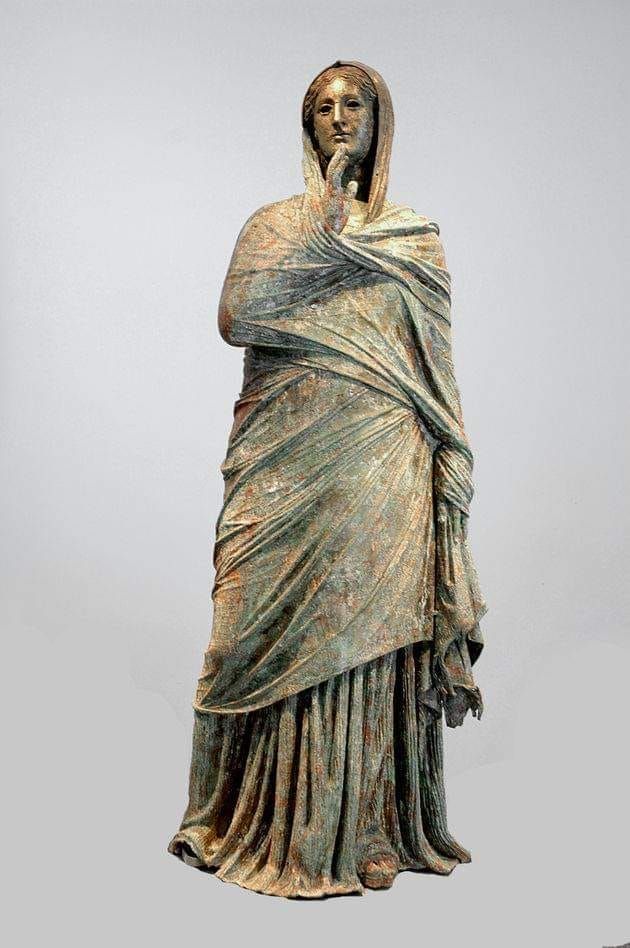
A fishing net dropped into the deep waters of the Aegean came back carrying something no crew could have expected: a nearly two-meter-tall bronze woman that had been lying on the seabed for more than two thousand years.
The discovery was made in 1994, in waters near the Greek island of Kalymnos, where fishermen hauled the statue up from a depth of roughly 120 meters. Now known as the Lady of Kalymnos, the figure quickly became one of the most remarkable underwater finds from the region—and the beginning of a much larger archaeological story.
Dated broadly to the third century BCE, the statue depicts a woman wrapped in a chiton and heavy himation, with deeply modeled folds characteristic of Hellenistic sculpture. Yet despite decades of study, one basic question remains unanswered: who was she?
Her form belongs to a sculptural tradition associated with elite women, queens, and divine figures, and has been compared with the so-called Large Herculaneum Woman type. Archaeologist Olga Palagia has proposed an especially intriguing identification, suggesting that the statue may represent Arsinoe III, queen of Egypt’s Ptolemaic dynasty.
The proposal is not universally accepted, but it raises an even more compelling question. If the figure represented a queen, goddess or another high-status woman, how did such a costly bronze end up 120 meters beneath the Aegean?
The most plausible explanation is that the statue was being transported by ship when it was lost. Bronze sculptures were valuable objects that travelled widely across the Hellenistic and Roman Mediterranean, and Kalymnos lay along maritime routes linking the Aegean with the eastern Mediterranean.
But the Lady of Kalymnos did not remain an isolated discovery.
Research published by the J. Paul Getty Museum notes that the reward paid after the statue was handed over to Greek archaeological authorities encouraged fishermen to report other bronze finds from the same region. Over the following two decades, additional pieces began to surface, including the larger-than-life head of a bearded ruler wearing a Macedonian kausia, parts of mounted statues and fragments belonging to armored horsemen.
Some of these objects were newly recovered from the sea. Others appear to have been kept for years in private houses or storage spaces before eventually reaching archaeologists.
What began as an accidental catch therefore revealed something much larger: the waters around Kalymnos had preserved a scattered collection of ancient bronze sculpture, perhaps lost in more than one maritime disaster.
After extensive conservation, the Lady of Kalymnos returned to the island and is now the centerpiece of the Archaeological Museum of Kalymnos. More than three decades after she was pulled from the sea, however, her story remains incomplete.
We know where she was found and roughly when she was made. We still do not know who she was, where her final voyage began, or why it ended on the floor of the Aegean.
Greek Ministry of Culture – Archaeological Museum of Kalymnos.
Image Credit: Official Kalymnos Archaeological Museum Guide
