
23 January 2026 The Future is the Product of the Past

A 7,800-Year-Old Massive Stone Wall Discovered Beneath the Sea off the Coast of France

Several meters beneath the restless waters off western France, archaeologists have uncovered the remains of a monumental stone construction that forces a fundamental rethink of Europe’s prehistoric coastlines. Near the Île de Sein, at the outer edge of Brittany, a massive submerged wall—built around 5800 BCE—now stands as one of the earliest known large-scale stone structures created by coastal hunter-gatherers in Atlantic Europe.

Stretching roughly 120 meters across a drowned valley, the wall lies at depths between seven and nine meters below today’s sea level. What first appeared as faint linear anomalies in seabed mapping has proven, after years of underwater investigation, to be a carefully engineered construction composed of stacked granite blocks reinforced with upright monoliths and vertical stone slabs. In places, these stones still rise nearly two meters high, locked in position despite more than seven millennia of marine erosion.

The discovery was initiated in 2017 through high-resolution LIDAR bathymetry, which revealed unnatural geometric forms on the seabed west of Sein Island. Subsequent dives carried out between 2022 and 2024 confirmed the human origin of at least eleven separate stone structures across the submerged plateau. Among them, the main wall—known as TAF1 by researchers—stands apart for its scale, complexity, and durability, unlike anything previously documented from this early period in France.

When the wall was built, the landscape looked radically different. Sea levels were several meters lower, and the now-submerged plateau formed a productive coastal environment shaped by tidal channels, rocky ridges, and shallow valleys. Archaeologists place the construction firmly within the transition from the Late Mesolithic to the Early Neolithic, a time when communities across Europe were beginning to experiment with new ways of organizing labor, resources, and territory.

What makes the Sein Island structures exceptional is not only their age but their engineering. The main wall is reinforced by more than sixty upright monoliths, arranged in parallel rows and anchored deeply into the bedrock. Between them, builders inserted vertical slabs and filled the structure with angular granite blocks, creating a broad, asymmetrical barrier designed to withstand powerful tidal currents and Atlantic swells. Some nearby structures follow similar principles, while others consist of narrower stone alignments made from smaller blocks.


📣 Our WhatsApp channel is now LIVE! Stay up-to-date with the latest news and updates, just click here to follow us on WhatsApp and never miss a thing!!


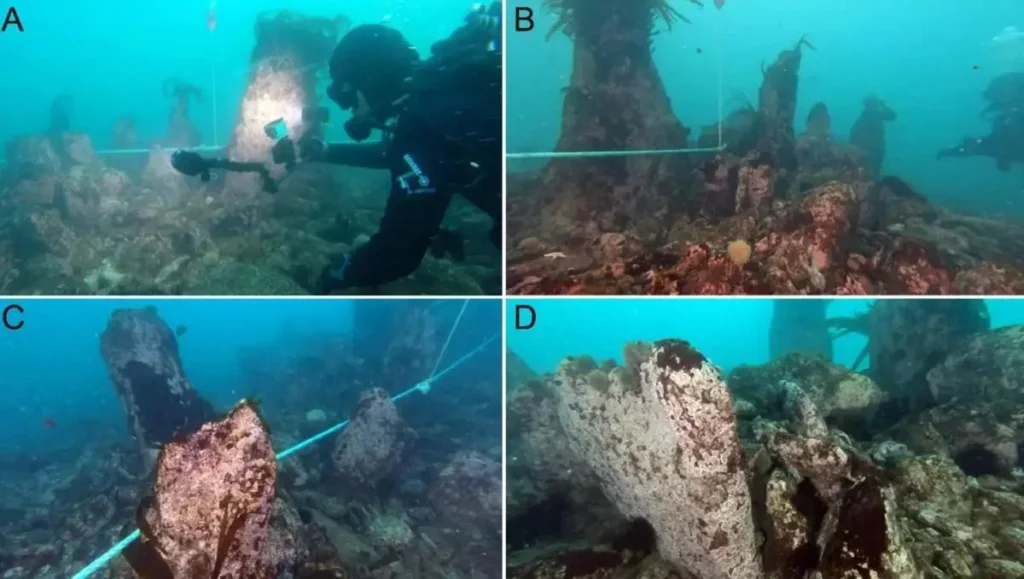
Winter 2023 views of the TAF1 structure, where the absence of algae reveals the stone architecture with exceptional clarity. A green rope laid along the east–west axis highlights the crest of the wall and the alignment of monoliths and slabs. Images A and B show a general view of the monolith rows at the top of the structure, while images C and D document a distinctive double row of upright monoliths running parallel to the wall’s axis, spaced approximately 1.5 meters apart. In image C, the rope marks the space between the two rows. Photo credit: SAMM, 2023. Study by Yves Fouquet et al.,International Journal of Nautical Archaeology (2025).
Winter 2023 views of the TAF1 structure, where the absence of algae reveals the stone architecture with exceptional clarity. A green rope laid along the east–west axis highlights the crest of the wall and the alignment of monoliths and slabs. Images A and B show a general view of the monolith rows at the top of the structure, while images C and D document a distinctive double row of upright monoliths running parallel to the wall’s axis, spaced approximately 1.5 meters apart. In image C, the rope marks the space between the two rows. Photo credit: SAMM, 2023. Study by Yves Fouquet et al., International Journal of Nautical Archaeology (2025).

Researchers believe that at least part of this submerged complex functioned as fish weirs—stone traps designed to funnel and capture fish with the rhythm of the tides. Such installations are known elsewhere in prehistoric Europe, but the Seine Island examples are larger, deeper, and architecturally more sophisticated than most previously recorded. Their construction would have required coordinated labor, detailed knowledge of tides and marine behavior, and long-term planning—traits once assumed to belong only to later farming societies.

Yet the sheer mass of the largest walls raises additional questions. Some scholars suggest that these structures may have served multiple roles, combining fishing with coastal protection or acting as territorial markers in a dynamic shoreline landscape. The walls’ unusual width and reinforced seaward sides hint at deliberate strategies to resist storm waves, suggesting that their builders were not merely exploiting the coast but actively shaping it.

The find also casts new light on the gradual rise of megalithic traditions in Brittany. The iconic standing stones and monumental tombs that would later define the region appear centuries after these submerged constructions were built. In this sense, the walls off Sein Island may represent an architectural precursor—a forgotten chapter in the long development of stone building along Europe’s Atlantic façade.

Local folklore adds an evocative layer to the discovery. Breton legends speak of a drowned land or lost settlement beyond the Bay of Douarnenez, swallowed by the sea in ancient times. While archaeologists caution against literal interpretations, they acknowledge that collective memories of vanished coastlines may echo real events experienced by prehistoric communities as rising seas slowly reclaimed inhabited landscapes.
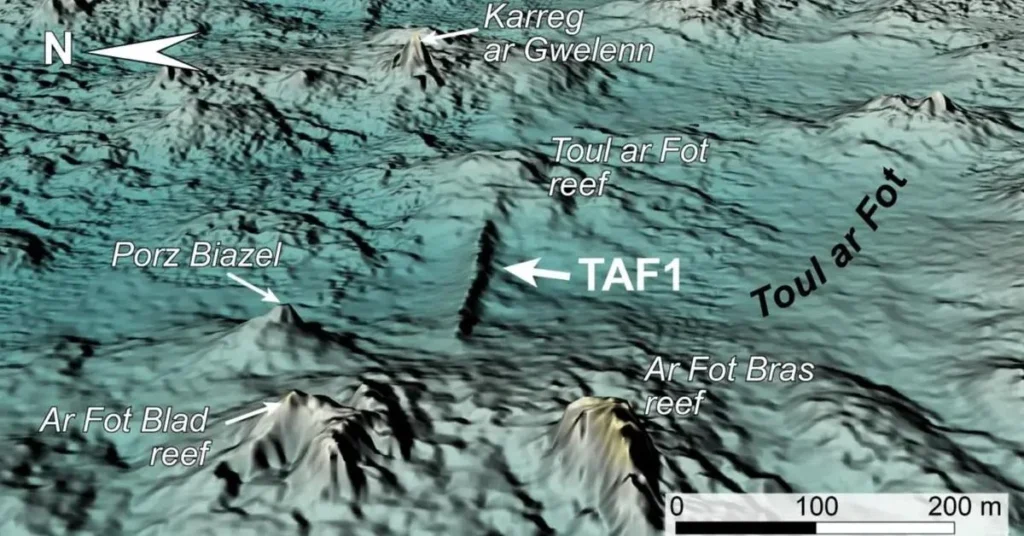
Three-dimensional view of the TAF1 structures looking east, highlighting the pronounced linearity of the construction and the asymmetrical profiles of its north (left) and south (right) flanks. Vertical exaggeration is set to 3, while brown tones indicate reefs that remain permanently above the present sea level. Credit: Yves Fouquet et al., International Journal of Nautical Archaeology (2025).

Beyond France, the discovery contributes to a growing body of underwater archaeology reshaping views of Europe’s deep past. Similar submerged stone alignments have recently been documented in the Baltic Sea, where prehistoric groups engineered landscapes to manage animal migrations and marine resources. Together, these finds challenge long-held assumptions about the technological limits of hunter-gatherer societies.

As research continues, scientists plan to refine the dating of the Sein Island structures and search for further traces of settlement along the submerged coastline. Each new dive adds detail to a picture that is only beginning to emerge: a world where prehistoric people did not simply adapt to environmental change, but met it with ambition, planning, and stone.

Yves Fouquet, Jean-Michel Keroulle, Pierre Stéphan, Yvan Pailler, Philippe Bodénès, et al. Submerged Stone Structures in the Far West of Europe During the Mesolithic/Neolithic Transition (Sein Island, Brittany, France). International Journal of Nautical Archaeology, In Press. https://hal.science/hal-05406477

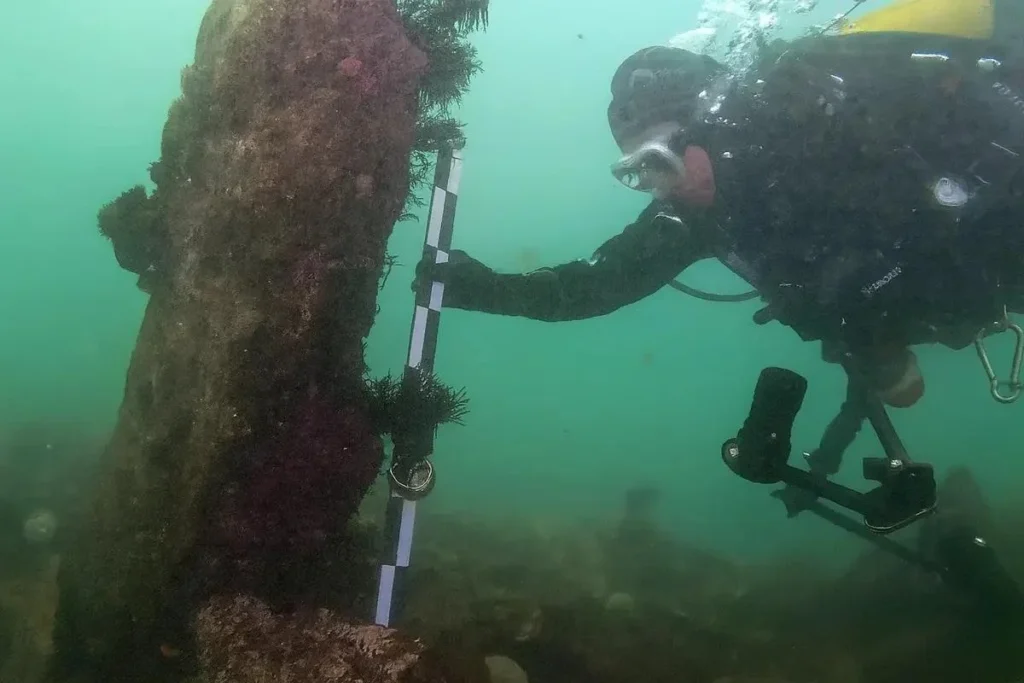
Cover Image Credit: A diver measures the height of an upright granite monolith on the submerged structure; the measuring rod visible in the image is 1 meter long. Photo credit: SAMM, 2023. Study by Yves Fouquet et al., International Journal of Nautical Archaeology (2025).

Related Articles

Traces of fossilized crabs in the Zagros Mountains, Iran which may hint at a hotbed of biodiversity dating from 15 million years

18 April 2022

18 April 2022

A group of paleontologists from the  University of Tehran has discovered traces of fossilized crabs in the Iranian which may...

46 Ice Age Animals Found in a Northern Norway Cave: “Extremely Rare” Discovery Reveals a Frozen Past

22 October 2025

22 October 2025

A remarkable discovery in northern Norway has uncovered the remains of 46 species from the last Ice Age — from...

During roadwork in Oregon, a woolly mammoth tusk was discovered

21 June 2021

21 June 2021

A 12,000-year-old woolly mammoth tusk was discovered beneath the street by crews rerouting a gas line in Corvallis, Oregon. “Whenever...

50 Lost War Helmets Found Near Wrocław University

16 June 2025

16 June 2025

In a remarkable archaeological discovery, over 50 military helmets from both World Wars have been unearthed just steps away from...

On the beach of Herculaneum, a victim of the Vesuvius explosion was discovered with his bag

4 December 2021

4 December 2021

Archaeologists released haunting images Wednesday of the skeletal remains of a man buried by the eruption of Mount Vesuvius in...

Tombs of Queens of Commagene Detected

23 September 2021

23 September 2021

The graves built by Commagene King Mithritades II (36-21 BC) for his mother Isias, his sister Antiokhis, and Antiochis’s daughter...

1,400-Year-Old Ice Storage Unearthed at Baekje Fortress Reveals Ancient Korean Engineering

16 October 2025

16 October 2025

Archaeologists in South Korea have unearthed the first-ever Baekje-era ice storage facility at Busosanseong Fortress, a UNESCO World Heritage site...

Two monumental sculpted Roman heads unearthed in Carlisle, northern England

25 May 2023

25 May 2023

Two monumental statue heads believed to be dated to the early 3rd century have been unearthed during excavations at a...

Unusual Iron Age Female Grave Found in Pryssgården, Sweden

3 November 2024

3 November 2024

In an Iron Age cemetery in Sweden, archaeologists found a woman’s grave buried with a small needle and an iron...

Gladiators’ ancient hygiene tools on exhibit in Izmir

22 July 2021

22 July 2021

Turkey’s Izmir Archaeological Museum is hosting a different exhibition this month. A bronze strigil is the museum’s guest this month...

Anaweka Waka: New Zealand’s Most Significant Archaeological Find Gets a Permanent Home

29 July 2025

29 July 2025

Discovered in 2012, New Zealand’s most significant archaeological find may soon become the centerpiece of a purpose-built wharewaka in Golden...

Rare Ancient Mosaics Seized in Türkiye: Crowned Sea Goddess and Mythical Creatures Uncovered in Smuggling Plot

2 September 2025

2 September 2025

In a decisive cultural heritage protection operation, gendarmerie officers in the Nurdağı district of Gaziantep province in southeastern Türkiye seized...

Ancient DNA Reveals Living Descendants of China’s Mysterious Hanging Coffin Builders

27 November 2025

27 November 2025

A groundbreaking genomic study uncovers the true origins of China’s mysterious hanging coffins and reveals that the modern Bo people...

Archaeologists found a noble woman buried beside her ‘husband’ 1,000 years ago with the top of her face hollowed out

4 November 2023

4 November 2023

Archaeologists unearthed the 1,000-year-old remains of a woman with her face and head hollowed out buried next to her husband...

3,000-Year-Old Eyeliner Innovative Formula Discovered in Iran: A Unique Iron Age Kohl Without Lead

17 July 2025

17 July 2025

Ancient black eyeliner found in Iron Age graves reveals a previously unknown cosmetic recipe using graphite and manganese oxide, predating...