
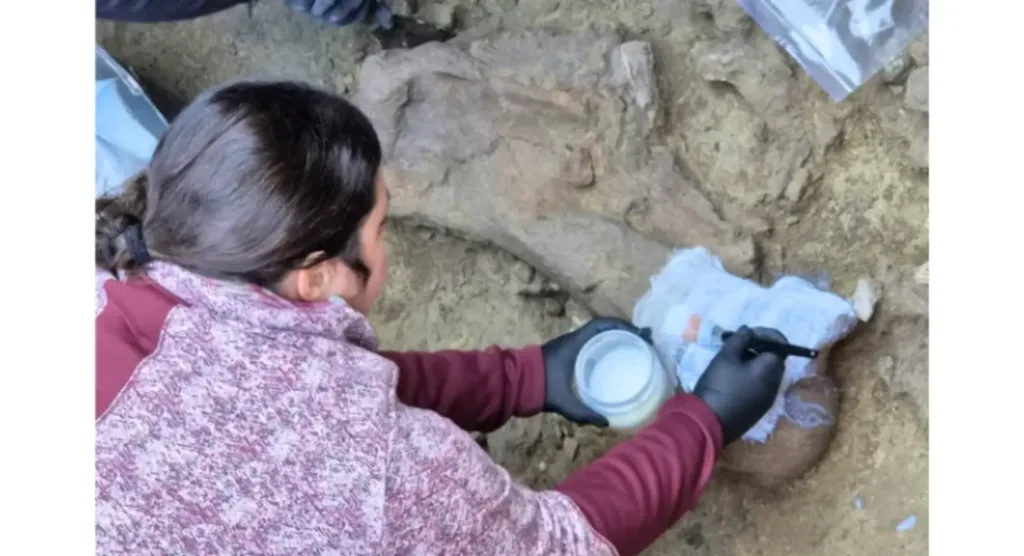
A fractured skull from an extinct elephant relative is offering a striking glimpse into how some of the earliest people in central Chile interacted with the giant animals around them. Archaeologists working at the former Tagua Tagua lake have uncovered much of the skeleton of an adult gomphothere dating to roughly 12,500 years ago, including a skull that appears to have been deliberately broken open.
The researchers believe the damage may reflect human activity, possibly an attempt to reach and consume the animal’s brain. They have not yet confirmed that interpretation, and radiocarbon dates from the latest excavation are still pending, but the find adds to growing evidence that people repeatedly used the lake shore and exploited its rich animal resources near the end of the Pleistocene.
The excavation, led by archaeologist Rafael Labarca of the Pontificia Universidad Católica de Chile, took place between August 31 and September 14 in Chile’s O’Higgins Region. The bones were exceptionally well preserved and belonged to an adult gomphothere, a massive herbivore distantly related to modern elephants.
A fractured skull raises questions about human activity
The most intriguing part of the discovery is the skull. According to the university, researchers found it fractured in a way that may indicate people opened it to reach the brain, a nutrient-rich part of the animal that could have been consumed.
For now, that remains a working interpretation rather than a confirmed act of butchery. The excavation team has not yet obtained consolidated radiocarbon dates from the new remains, although the archaeological context suggests an age of about 12,500 years. The researchers currently place human activity in this part of the lake shore between roughly 12,600 and 12,400 years ago.
The location itself strengthens the significance of the find. Archaeologists uncovered the gomphothere opposite an area first excavated in 1967 by Julio Montané, suggesting that the archaeological site extends considerably farther than previously thought.
More than one animal was being used
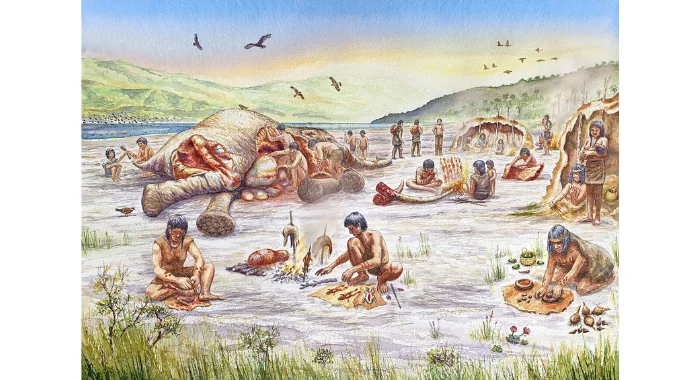
The gomphothere did not appear in isolation. Excavations also revealed horse remains, large quantities of burned bird bones and stone tools, creating a broader picture of how people used the former lake environment.
Labarca said the association indicates that human groups exploited several kinds of animals living around Tagua Tagua. Rather than relying on a single spectacular megafaunal species, they appear to have drawn from a varied lakeside ecosystem that offered birds, mammals and other resources.
That distinction matters because the site can reveal more than whether early people hunted or butchered gomphotheres. It provides evidence for how communities moved through the landscape, selected resources and repeatedly returned to a productive place over generations.
People kept returning to the lake shore
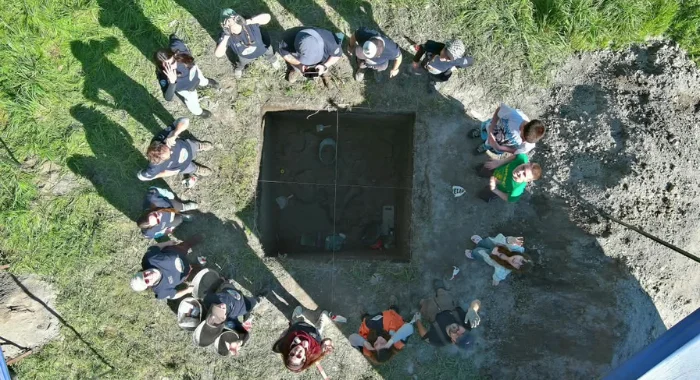
Research in the area began with a network of one-by-one-meter test pits in 2023. Two of those pits produced extinct fauna together with stone artifacts, prompting expanded excavations in 2025 and 2026.
The current work forms part of a group of sites known as Tagua Tagua 1, Tagua Tagua 3 and Tagua Tagua 1 Oriente. Together, they suggest that people did not establish one permanent settlement on the shore. Instead, groups appear to have visited intermittently during the final millennia of the Pleistocene, returning to take advantage of the lake’s resources.
The broader goal is to reconstruct the ancient shoreline itself and understand how human activity changed across hundreds or perhaps thousands of years. That makes the newly uncovered gomphothere one piece of a much longer story rather than an isolated kill or carcass-processing event.
A giant from Chile’s lost megafauna
Gomphotheres once ranged across Chile during the Pleistocene. These distant relatives of elephants could reach several meters in height and weigh several tons, feeding on grasses, leaves, and bark while helping shape the landscapes they inhabited. Evidence from Chile has already linked humans with these animals before their extinction around the end of the Pleistocene.
Tagua Tagua has become particularly important because it preserves both megafaunal remains and traces left by people who lived alongside them. The newly excavated skeleton now offers an unusually direct point of contact between those two worlds.
If further analysis confirms that humans deliberately opened the skull, the fractured bone may preserve something more intimate than evidence of coexistence. It could record the moment when people processed one of the largest animals in their environment for food, more than 12,000 years ago.
