15 December 2025 The Future is the Product of the Past

Remains of a 5-year-old girl found under Real Alcázar in Spain

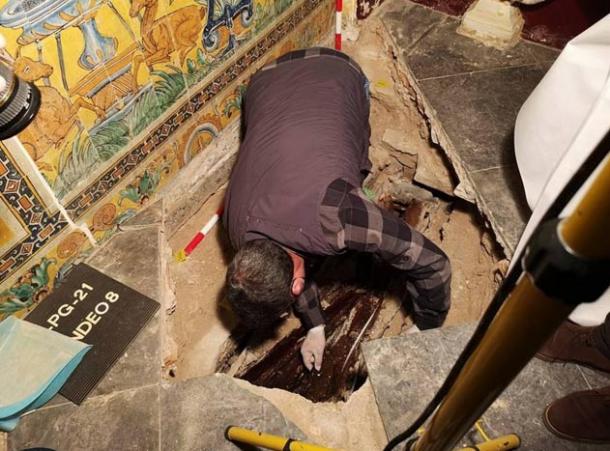
The body of a five-year-old fair-haired girl who lived in the late Middle Ages and was most likely of noble ancestry was discovered 20 centimeters underneath the floor of the main altar of the chapel of the Real Alcázar of Seville.

In the analysis of this Alcázar burial, archaeologists believe that her coffin was moved to a more sacred spot next to the main altar in the 1930s.

On April 20, a team of archaeologists discovered the lid of the small lead sarcophagus while experimenting on the palace’s 16th-century ceramic tiles before the restoration project designed by artist Cristobal de Augusta. A shattered wooden coffin and a complete skeleton first discovered at Real Alcázar, included linen, shoe leather, and two mother-of-pearl buttons among the items found in the sarcophagus.

The Spanish daily El Pais her statement according to lead anthropologist Professor Juan Manuel Guijo, the coffin measured about 4 feet long (1.21 m) and 1 foot deep (0.3 m), which is in keeping with styles in the 13th or 14th century. The archaeologist said when he discovered the Alcázar burial, the little girl’s arms were “semi-flexed and crossed over her thorax.”
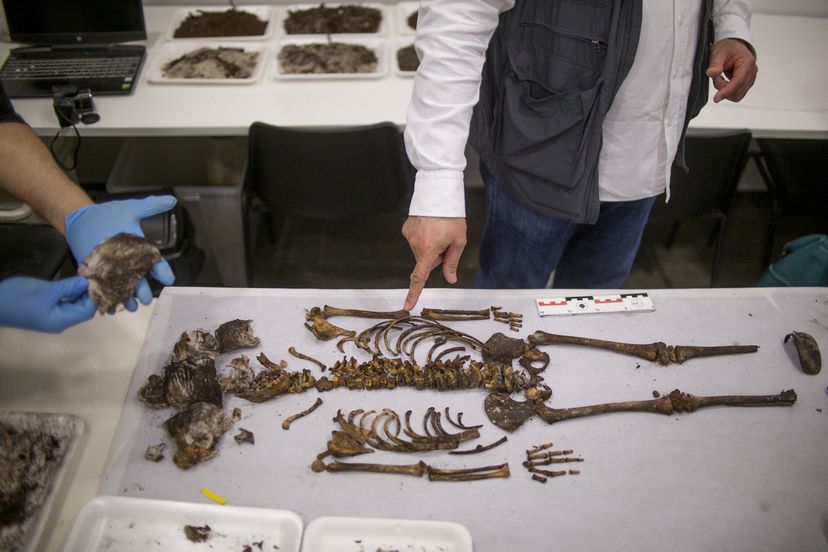
Two investigators with the remains of a five-year-old girl from the Middle Ages found in the chapel of the Real Alcázar of Seville.PACO PUENTES / EL PAÍS

The research team’s leader, archaeologist Miguel Angel Tabales, is certain that the altar of the chapel was not the little girl’s original burial site. He also thinks she must have come from a wealthy family to be buried in the royal palace. Around 1930 and 1940, the chapel was repaved, and she was placed to the side of the altar, according to his theory. Tabales thinks the coffin was found and moved here while the chapel was being rebuilt.


📣 Our WhatsApp channel is now LIVE! Stay up-to-date with the latest news and updates, just click here to follow us on WhatsApp and never miss a thing!!


Researchers will receive Carbon 14 test results within 3 months and it will be possible to find out the age of the girl.

Although the finding of the little girl is extraordinary in and of itself, there are still unsolved mysteries at this place. The first concerns the contents of six small boxes discovered alongside the human remains.

However, Miguel Ángel Tabales said that the discovery of the little girl is perhaps “the tip of the iceberg,” and that “there could be more in the basement of the chapel.”

Whether the researchers are right will become evident over time. But it is already possible to say that this discovery will lead to other discoveries.
Related Articles

One of the Largest Early Medieval Silver Hoards Ever Found in Sweden Unearthed Near Stockholm

13 October 2025

13 October 2025

In an astonishing find that could reshape our understanding of early medieval Scandinavian wealth, a private individual digging for earthworms...

Synchrotron Technique Reveals Mysterious Portrait Underneath Renaissance Painting

16 April 2023

16 April 2023

Conservators and curators from the Art Gallery of New South Wales used the Australian Synchrotron’s advanced imaging technique to learn...

Fragments of ‘unique’ 17th-century iconostasis discovered in Polish church

28 October 2023

28 October 2023

Researchers from the Institute of Art at the Polish Academy of Sciences (IS PAN) have discovered substantial fragments of a...

2,600-year-old Terracotta Pipeline found in India

11 August 2024

11 August 2024

During the 10th phase of archaeological excavations at the Keeladi archaeological site in Tamil Nadu, India, archaeologists uncovered a terracotta...

Earliest Known Stone Mold for Coin Production in Roman Hispania Unearthed

27 March 2025

27 March 2025

Researchers from the University of Jaén have made a groundbreaking discovery at the archaeological site of Obulco, modern-day Porcuna, revealing...

The 20-million-year-old fossil of a sea creature in the ancient city of Tyana may have been used as a means of payment

22 October 2021

22 October 2021

During the ongoing excavations in the ancient city of Tyana in the Kemerhisar district of Niğde, a 20-million-year-old fossil thought...

Ancient Balkan genomes trace the rise and fall of the Roman Empire’s frontier, reveal Slavic migrations to southeastern Europe

7 January 2024

7 January 2024

The genomic history of the Balkan Peninsula during the first millennium of the common era—a period marked by significant changes...

A pendant with a figure of St. Nicholas found in the Ancient Church Hidden in Turkish Lake

7 October 2022

7 October 2022

Underwater archaeological excavations and research, which were started 8 years ago in the basilica located 20 meters off the lake...

Romanian Police Find the Stolen Viking Helmet

21 February 2021

21 February 2021

Romanian police specializing in heritage crimes recovered a medieval helmet of “Viking origin” on February 7, which had disappeared a...

Gold from the ancient cities of Troy, Poliochni, and Ur had the same Origin

3 December 2022

3 December 2022

Using an innovative mobile laser method, scientists determined that gold found in ancient Troy, Poliochini, and Ur had the same...

A new finding in Persepolis reveals a Royal wall

23 October 2023

23 October 2023

A new find at Persepolis, whose magnificent ruins rest at the foot of Kuh-e Rahmat (Mount of Mercy) in southwestern...

A 6,000-Year-Old Trypillia Clay Bull Figurine Unearthed in Galicia

11 December 2025

11 December 2025

A 6,000-year-old Trypillia clay bull figurine found in Galicia reveals new insights into the spiritual life, symbolism, and artistic traditions...

Archaeologists may have Found a Viking Age Marketplace in Norway

21 February 2024

21 February 2024

Archaeologists from the University of Stavanger have identified the possible remains of a marketplace from the Viking Age on a...

Radiocarbon dating shows that the Roman settlement of Karanis survived in Egypt until the Arab Conquest in the 7th century AD

13 May 2024

13 May 2024

New research results are rewriting the history of Karanis, an ancient Greco-Roman agricultural settlement in the Fayum oasis in Egypt....

From Tengri to Teshub: Sacred Yada Stone and Elemental Power in Ancient Anatolia

19 May 2025

19 May 2025

From the windswept steppes of Central Asia to the sacred temples of Anatolia, ancient civilizations shared a powerful belief: that...