
A row of small holes carved into a bathhouse step in Morocco has opened an unexpected window onto leisure, waiting, and social life in the early medieval Islamic world.
Archaeologists studying the medieval hammam of Walīla, the Islamic-period settlement at Roman Volubilis, have identified a stone game board that may represent the earliest known evidence for the game tab/sig in North Africa. The find, published in the journal Libyan Studies by Tim Penn, Corisande Fenwick, and Hassan Limane, gives researchers a rare securely dated example of a game board from an early Islamic context.
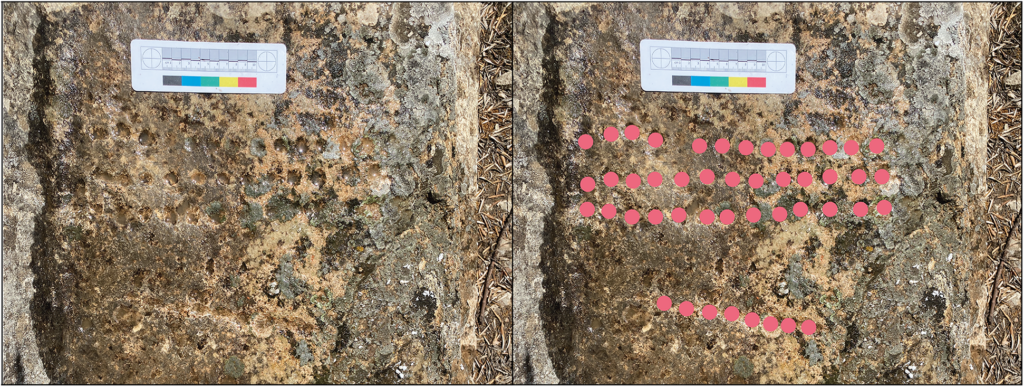
The board was carved into the upper step leading down to the cold plunge pool of the hammam. It measures about 34 centimeters by 9.5 centimeters and consists of three rows of at least 13 shallow holes. A fourth, more irregular row may have been used for scoring, or may belong to another unfinished or damaged board.
A small board in a highly visible place
The location of the board is one of the most revealing parts of the discovery. It was not hidden in a private corner. It sat at the entrance to the cold pool, in a place every bather would have seen.
According to the researchers, there was enough room for two people to sit and play while another person still entered the pool. That detail matters. The board was not simply a random scratch on stone. Its position suggests that play was part of the rhythm of the bathhouse, perhaps while people waited, rested or talked between stages of bathing.
The hammam itself was built in the late eighth or early ninth century CE and was abandoned by the tenth or eleventh century. This gives the board a much firmer date than many ancient and medieval game boards, which are often difficult to separate from earlier Roman or late antique phases.
Walīla after Rome
Volubilis was once an important Roman city in northern Morocco and served as a major center in Mauretania Tingitana. After Roman authority withdrew, the settlement continued in altered form. By the early medieval period it was known as Walīla.
The site later became closely tied to the early Idrisid period. In 788–789 CE, Idrīs I arrived there after fleeing the eastern Islamic world and was accepted by the Awraba, a Berber group that had converted to Islam. Walīla became one of the earliest centers of Islamic political power in North Africa before the rise of Fez.
The hammam where the board was found formed part of a larger extramural complex with courtyard buildings. Scholars have suggested that this complex may have been linked to the residence of Idrīs I and his son. Its architecture, heating system, and material culture point to a community with connections beyond local traditions, including links to the wider Islamic Mediterranean.
Was the game tab, sig or something else?
The game board does not match a simple, well-known typology. The researchers considered two main possibilities: mancala and tab/sig.
Mancala-style games are usually played with seeds, stones or similar small objects moved between holes. But the Walīla board does not fit that interpretation well. Its holes are small and shallow, and the three-row layout with an odd number of holes is not ideal for known mancala arrangements.
The better fit, the authors argue, is tab/sig. Known as tāb wa-d-dukk in the Levant and as sīg in parts of the Maghreb and Saharan Africa, the game belongs to a wider family of running-fight board games. Players move pieces across rows and try to capture or eliminate an opponent’s pieces. Modern versions often use thrown sticks or other simple devices rather than standard dice.
If the interpretation is correct, the Walīla board pushes the history of tab/sig in North Africa back by several centuries. Until now, most comparable early boards came from the Middle East, Arabia, Portugal or western Türkiye. The Moroccan example suggests that the game, or a closely related version of it, had already reached the western Islamic world in the early medieval period.
Bathhouses as places of play
The discovery also changes how archaeologists think about hammams. Public baths were not only places for washing. They were social spaces, where people moved through heat, water, conversation and waiting.
A game board carved into a step captures that daily life in a direct way. It shows people using the built environment around them, turning a stone surface into a shared object of play. The board may have required permission from whoever controlled the hammam, since it was cut into a prominent part of the structure and not into a disposable surface.
This is what makes the find important. It is not a luxury object, nor a written record from an elite archive. It is a trace of ordinary interaction: two people sitting near a cold pool, moving small pieces across a carved pattern while others passed through the bathhouse.
For early medieval Morocco, where the archaeology of games remains limited, the Walīla board offers rare evidence that leisure and competition were woven into communal life. It also suggests that games moved across regions with people, trade, and cultural contact, adapting as they reached new settings.
The small carved board from Walīla may look modest at first glance. But in the history of North African board games, it could mark a much earlier chapter than scholars once believed.
Penn, T., Fenwick, C., & Limane, H. (2026). Gaming in the Maghreb al-Aqsa: new evidence from Idrisid Walīla (Volubilis). Libyan Studies, 1–12. doi:10.1017/lis.2025.10033
Cover Image Credit: The gameboard in the hammam at Walīla (left), with mark-up showing position of holes (right) (INSAP-UCL Volubilis Archaeological Project). Penn, T., et.al., 2026
